Question
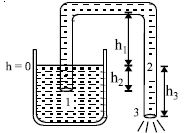
Figure shows a siphon. Choose the wrong statement:

($P_0$ = atmospheric pressure)
Answer

By Bernoulli equation

$\mathrm{P}_{0}+\rho \mathrm{gh}_{3}=\mathrm{P}_{0}+1 / 2 \rho \mathrm{v}^{2}$

$1 / 2 \rho v^{2}=\rho g h_{3}$

$\mathrm{P}_{0}=\mathrm{P}_{2}+1 / 2 \rho \mathrm{v}^{2}$

$\mathrm{P}_{2}=\mathrm{P}_{0}-\rho \mathrm{gh}_{3}$

Need a full question paper?

Generate a complete, print-ready paper with questions like this in minutes — across 16+ boards, with answer keys.
Start Generating Free

Similar questions

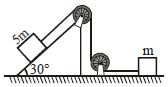
Acceleration of system is :-
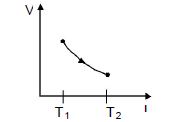
The figure shows a process $AB$ undergone by $2$ moles of an ideal diatomic gas. The process $AB$ is in such a way that $VT =$ constant. $T_1 = 300 K $and $T_2 = 500 K$ ( $R = $ gas constant)
If the kinetic energy of the particle is increased to $16$ times its previous value, the percentage change in the de Broglie wavelength of the particle is 
In diode, when there is saturation current, the plate resistance $({r_p})$ is
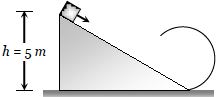
As per given figure to complete the circular loop what should be the radius if initial height is $5 \,m$ .......... $m$.
First, a set of ${n}$ equal resistors of $10\; \Omega$ each are connected in series to a battery of emf $20\; {V}$ and internal resistance $10\; \Omega .$ A current $I$ is observed to flow. Then, the $n$ resistors are connected in parallel to the same battery. It is observed that the current is increased $20$ times, then the value of $n$ is .... .
A large drop of oil (density $0.8\,g / cm ^3$ and viscosity $\eta_0$) floats up through a column of another liquid (density $1.2\,g / cm ^3$ and viscosity $\eta_L$ ). Assuming that the two liquids do not mix, the velocity with which the oil drop rises will depend on.
The stationary wave $y = 2a\sin kx\cos \omega \,t$ in a closed organ pipe is the result of the superposition of $y = a\sin (\omega \,t - kx)$ and
A mass $m$ attached to a spring oscillates with a period of $3\,s$. If the mass is increased by $1\,kg$ the period increases by $1\,s$. The initial mass $m$ is
The length of an iron wire is $L$ and area of cross-section is $A$. The increase in length is $l$ on applying the force $F$ on its two ends. Which of the statement is correct