MCQ
In diode, when there is saturation current, the plate resistance $({r_p})$ is
  • A
    Zero
  • Infinite
  • C
    Some finite quantity
  • D
    Data is insufficient

Answer

Correct option: B.
Infinite
b
(b) Plate resistance $\left(r_{p}\right)=\frac{\delta V}{\delta I}$ (where $\mathrm{d} \mathrm{V}$ is the change in voltage and $\delta \mathrm{l}$ is the change in current. At saturation, currelnt $\delta 1=0 .$ Therefore at saturation $\left(r_{p}\right)=\frac{\delta V}{0}=\infty$

Need a full question paper?

Generate a complete, print-ready paper with questions like this in minutes — across 16+ boards, with answer keys.
Start Generating Free

Similar questions

Three liquids of equal masses are taken in three identical cubical vessels $A, B$ and $C .$ Their densities are $\rho_{A}, \rho_{B}$ and $\rho_{C} \cdot$ The force exerted by the liquid on the base of the cubical vessel is
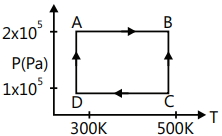
Two moles of helium gas are taken over the cycle $ABCDA$, as shown in the $P-T$ diagram. Assuming the gas to be ideal the work done on the gas in taking it from $A $ to $B$ is ...... $R$
Match List $I$ with List $II$ of Electromagnetic waves with corresponding wavelength range :

List $I$ List $II$
$(A)$ Microwave $(I)$ $400\,nm$ to $1\,nm$
$(B)$ Ultraviolet $(II)$ $1\,nm$ to $10^{-3}\,nm$
$(C)$ $X-$Ray $(III)$ $1\,mn$ to $700\,nm$
$(D)$ Infra-red $(IV)$ $0.1\,m$ to $1\,mm$

Choose the correct answer from the options given below:
Which of the following waves have the maximum wavelength
The difference between the apparent frequency of a source of sound as perceived by an observer during its approach and recession is $2\%$ of the natural frequency of the source. If the velocity of sound in air is $300 \,m/sec,$ the velocity of the source is ... $m/sec$ (It is given that velocity of source $<<$ velocity of sound)
A road is banked at an angle of $30^o$ to the horizontal for negotiating a curve of radius $10\sqrt 3 m$. At what velocity will a car experience no friction while negotiating the curve? ............... $km/hr$
A train is moving with a constant speed along a large circular track. The engine of the train emits a sound of frequency $f$ . The frequency heard by the guard at rear end of the train
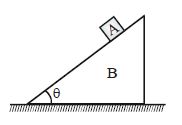
In the figure shown, $A$ & $B$ are free to move. All the surfaces are smooth. then $(0 < \theta < 90^o)$
An intrinsic semiconductor is converted into $N$-type extrinsic semiconductor by doping it with
A body crosses the topmost point of a vertical circle with critical speed. Its centripetal acceleration, when the string is horizontal will be