Figure shows a thick shell made of electrical conductivity $\sigma$ and has inner & outer radii of $10\ cm$ & $20\ cm$ respectively and is filled with ice inside it. Its inside and outside surface are kept at different potentials by a battery of internal resistance $\frac{2}{\pi} \Omega \ \&\ \epsilon = 5V$. Find value of $\sigma$ for which ice melts at maximum possible rate if $25\%$ of heat generated by shell due to joule heating is used to melt ice.
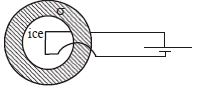
Diffcult
Download our app for free and get started
$\mathrm{dR}=\frac{\rho \mathrm{d} \mathrm{r}}{4 \pi \mathrm{r}^{2}}$
$\mathrm{R}=\int \mathrm{dR}=\frac{\rho}{4 \pi} \int_{\mathrm{r}_{1}}^{\mathrm{r}_{2}} \frac{\mathrm{dr}}{\mathrm{r}^{2}} \Rightarrow \mathrm{R}=\frac{\rho\left(\mathrm{r}_{2}-\mathrm{r}_{1}\right)}{4 \pi \mathrm{r}_{1} \mathrm{r}_{2}}$
Rate of melting is max when power dissipated in sphere is max. Using maximum power transfer theorem,
$\mathrm{R}=\mathrm{r} .$ of battery i.e. $\frac{\rho\left(\mathrm{r}_{2}-\mathrm{r}_{1}\right)}{4 \pi \mathrm{r}_{1} \mathrm{r}_{2}}=\frac{2}{\pi}$
$\rho = \frac{{8{r_1}{r_2}}}{{{r_2} - {r_1}}} = \frac{{8(200)}}{{10}} = \frac{{160}}{{100}}$ (in $SI$)
Also, $\sigma=\frac{1}{\rho}=\frac{10}{16}=\frac{5}{8}$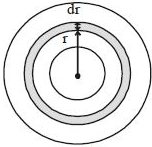

Download our appand get started for free
Experience the future of education. Simply download our apps or reach out to us for more information. Let's shape the future of learning together!No signup needed.*
Similar Questions
- 1Two resistors of $6\,\Omega $ and $9\,\Omega $ are connected in series to a $120\, volt$ source. The power consumed by the $6\,\Omega $ resistor is ........... $W$View Solution
- 2What will be the most suitable combination of three resistors $A =2\, \Omega, B =4\, \Omega, C =6\, \Omega$ so that $\left(\frac{22}{3}\right)\Omega$ is equivalent resistance of combination$?$View Solution
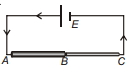
- 3In the following diagram, the lengths of wires $A B$ and $B C$ are equal, but the radius of wire $A B$ is double that of $B C$. The ratio of potential gradient on wires $A B$ and on $B C$ will be (wires are made of same material)View Solution
- 4View SolutionConductivity increases in the order of
- 5$STATEMENT-1$ In a Meter Bridge experiment, null point for an unknown resistance is measured. Now, the unknown resistance is put inside an enclosure maintained at a higher temperature. The null point can be obtained at the same point as before by decreasing the value of the standard resistance. andView Solution
$STATEMENT-2$ Resistance of a metal increases with increase in temperature.
- 6A cell of constant $e.m.f.$ first connected to a resistance ${R_1}$ and then connected to a resistance ${R_2}$. If power delivered in both cases is then the internal resistance of the cell isView Solution
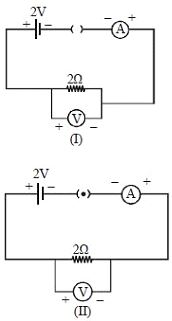
- 7For the circuits shown in figures $I$ and $II$, the voltmeter reading would beView Solution
- 8A copper wire of length $10\,m$ and radius $\left(10^{-2} / \sqrt{\pi}\right) m$ has electrical resistance of $10 \,\Omega$. The current density in the wire for an electric field strength of $10( V / m )$ is :View Solution
- 9In a meter bridge experiment, initially the jockey is at null point. Now resistance $R_1$ $\&$ $R_2$ is interchanged. Shift in the position of jockey is ................ $cm$View Solution
- 10A cell of internal resistance $r$ drives current through an external resistance $R$ . The power delivered by the cell to the external resistance will be maximum when:View Solution