Question
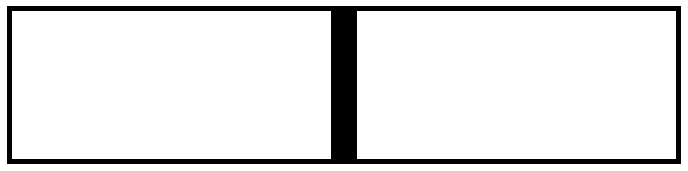
Figure. shows a vessel partitioned by a fixed diathernnc separator. Different ideal gases are filled in the two parts. The rms speed of the molecules in the left part equals the mean speed of the molecules in the right part. Calculate the ratio of the mass of a molecule in the left part to the mass of a molecule in the right part.
Answer

The left side of the container has a gas, let having molecular $wt. M_1$
Right part has $Mol.\ wt = M_2$
Temperature of both left and right chambers are equal as the separating wall is diathermic,
$\sqrt{\frac{3\text{RT}}{\text{M}_1}}=\sqrt{\frac{8\text{RT}}{\pi\text{M}_2}}\Rightarrow\frac{3\text{RT}}{\text{M}_1}=\frac{8\text{RT}}{\pi\text{M}_2}$
$\Rightarrow\frac{\text{M}_1}{\pi\text{M}_2}=\frac{3}{8}$
$\Rightarrow\frac{\text{M}_1}{\text{M}_2}$
$=\frac{3\pi}{8}=1.1778\approx1.18$

Need a full question paper?

Generate a complete, print-ready paper with questions like this in minutes — across 16+ boards, with answer keys.

Start Generating Free

Similar questions

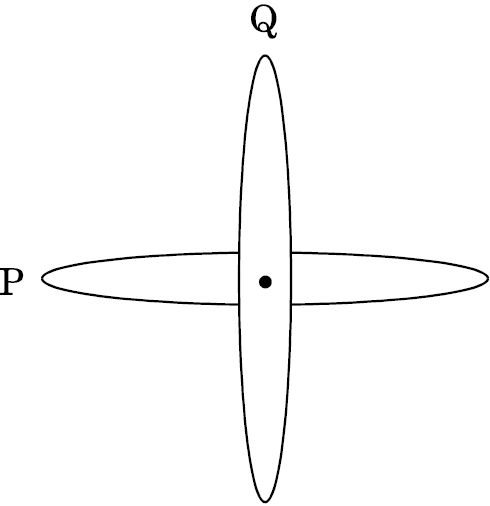
Two identical loops P and Q each of radius 5 cm are lying in perpendicular planes such that they have a common centre as shown in the figure. Find the magnitude and direction of the net magnetic field at the common centre of the two coils, if they carry currents equal to 3 A and 4 A respectively.
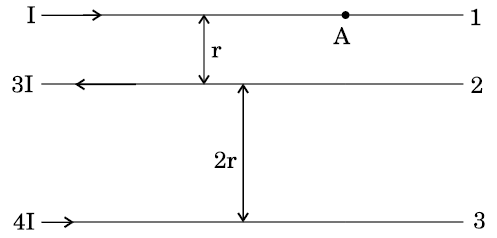
The figure shows three infinitely long straight parallel current carrying conductors. Find the
  1. magnitude and direction of the net magnetic field at point A lying on conductor 1,
  2. magnetic force on conductor 2.
What is drift velocity? Explain the dependence of drift velocity and electric field on the mobility.
Two cells of $\text {EMFs} \ 1 V, 2 V$ and internal resistance $2 \Omega$ and $1 \Omega$ respectively are connected in
$i$. series,
$ii.$ parallel. What should be the external resistance in the circuit so that the current through the resistance be the same in the two cases? In which case, more heat is generated in the cells?
Suppose, one wishes to construct a 1.0 farad capacitor using circular discs. If the separation between the discs be kept at 1.0mm, what would be the radius of the discs?
A light ray falling at an angle of $45^\circ$ with the surface of a clean slab of ice of thickness $1m$ is refracted into it at an angle of $30^\circ$ . Calculate the time taken by the light rays, to cross the slab. Speed of light in vacuum $= 3 \times 10^8\ m/s$
It is said that any charge given to a conductor comes to its surface. Should all the protons come to the surface? Should all the electrons come to the surface? Should all the free electrons come to the surface?
A semiconducting material has a band gap of 1eV. Acceptor impurities are doped into it which create acceptor levels 1meV above the valence band. Assume that the transition from one energy level to the other is almost forbidden if kT is less than $\frac{1}{50}$ of the energy gap. Also, if kT is more than twice the gap, the upper levels have maximum population. The temperature of the semiconductor is increased from 0K. The concentration of the holes increases with temperature and after a certain temperature it becomes approximately constant. As the temperature is further increased, the hole concentration again starts increasing at a certain temperature. Find the order of the temperature range in which the hole concentration remains approximately constant.
The length of a rod is exactly $1m$ when measured at rest. What will be its length when it moves at a speed of:
  1. $3 \times 10^5\ m/s.$
  2. $3 \times 10^6\ m/s.$
  3. $3 \times 10^7\ m/s.$
  1. Define current sensitivity of a galvanometer. Write its expression.
  2. A galvanometer has resistance $G$ and shows full scale deflection for current $Ig.$
  1. How can it be converted into an ammeter to measure current up to $I_0(I_0 > Ig)?$
  2. What is the effective resistance of this ammeter?