MCQ
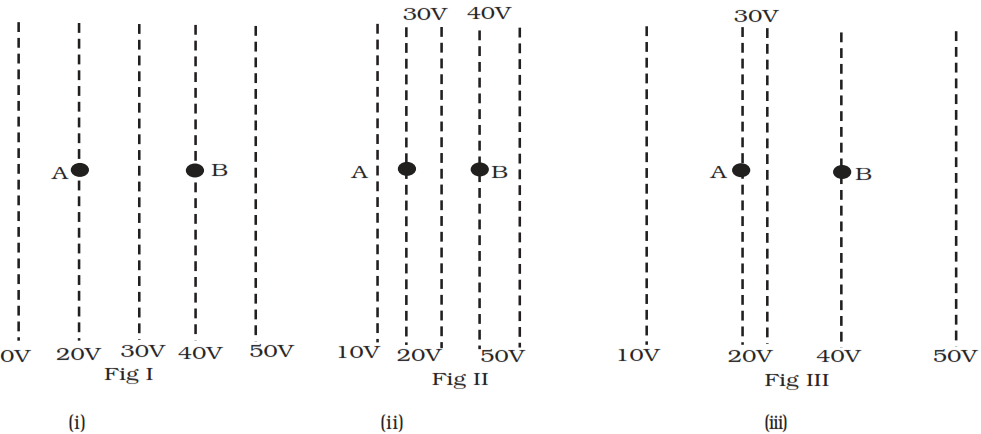
Figure shows some equipotential lines distributed in space. A charged object is moved from point A to point B.

  • A
    The work done in Fig. (i) is the greatest.
  • B
    The work done in Fig. (ii) is least.
  • C
    The work done is the same in Fig. (i) Fig. (ii) and Fig. (iii).
  • D
    The work done in Fig. (iii) is greater than Fig. (ii)but equal to that in Fig. (i).

Answer

  1. The work done is the same in Fig. (i) Fig. (ii) and Fig. (iii).

Key concept: For a given charge distribution, locus of all points or regions for which the electric potential has a constant value are called equipotential regions. Such equipotential can be surfaces, volumes or lines. Regarding equipotential surface the following points should be kept in mind:
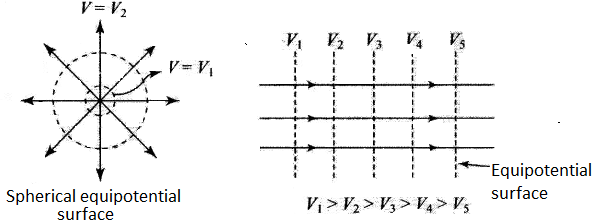
  1. The density of the equipotential lines gives an idea about the magnitude of electric field. Higher the density, larger the field strength.
  2. The direction of electric field is perpendicular to the equipotential surfaces or lines.
  3. The equipotential surfaces produced by a point charge or a spherically charge distribution are a family of concentric spheres.
  4. For a uniform electric field, the equipotential surfaces are a family of plane perpendicular to the field lines.
  5. A metallic surface ofany shape is an equipotential surface.
  6. Equipotential surfaces can never cross each other.
  7. The work done in moving a charge along an equipotential surface is always zero.

As the direction of electric field is always perpendicular to one equipotential surface maintained at high electrostatic potential than other equipotential surface maintained at low electrostatic potential. Hence direction of electric field is from B to A in all three cases.
The positively charged particle experiences electrostatic force along the direction of electric field, hence moves in the direction opposite to electric field. Thus, the work done by the electric field on the charge will be negative. We know

$\text{W}_\text{electrical}=-\Delta\text{U}=-\text{q}\Delta\text{V}=\text{q}(\text{V}_\text{Intial}-\text{V}_\text{final})$

Here initial and final potentials are same in all three cases and same charge is moved, so work done is same in all three cases.
Need a full question paper?

Generate a complete, print-ready paper with questions like this in minutes — across 16+ boards, with answer keys.

Start Generating Free

Similar questions

What happens to the capacitance when a dielectric material is inserted between the plates of a parallel plate capacitor?

Assertion :  Basic difference between an electric line and magnetic line of force is that former is discontinuous and the latter is continuous or endless.

Reason     : No electric lines of forces exist inside a charged body but magnetic lines do exist inside a magnet.

(a) If both assertion and reason are true and the reason is the correct explanation of the assertion.

(b) If both assertion and reason are true but reason is not the correct explanation of the assertion.

(c) If assertion is true but reason is false.

(d) If the assertion and reason both are false.

Hydrogen atom excites energy level from fundamental state to n = 3. Number of spectrum lines according to Bohr, is

(a) 4 

(b) 3

(c) 1  

(d) 2

The magnitude of the electric field due to a point charge object at a distance of 4.0 m is $9 N / C$. From the same charged object the electric field of magnitude, $16 \frac{N}{ C }$ will be at a distance of

n electron is moving on a circular path of radius r with speed v in a transverse magnetic field B. e/m for it will be

(a)  

(b)  

(c) Bvr

(d)  

If a coil of metal wire is kept stationary in a non-uniform magnetic field, then

(a) An e.m.f. is induced in the coil

(b) A current is induced in the coil

(c) Neither e.m.f. nor current is induced

(d) Both e.m.f. and current is induced

A charge of 5C  experiences a force of 5000 N when it is kept in a uniform electric field. What is the potential difference between two points separated by a distance of 1 cm

(a) 10 V

(b) 250 V

(c) 1000 V

(d) 2500 V

The example of non-ohmic resistance is:
A long straight wire of circular cross section of radius'a carries a steady current 1. The current is uniformly distributed across its cross section. The ratio of magnitudes of the magnetic field at a point a/2 above the surface of wire to that of a point a 2 below its surface is
What is shape of magnet in moving coil galvanometer to make the radial magnetic field?