MCQ
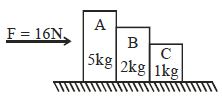
Figure shows three blocks in contact and kept on a smooth horizontal surface. What is ratio of force exerted by block $A$ on $B$ to that of $B$ on $C$
- A$2 : 1$
- ✓$3 : 1$
- C$6 : 1$
- D$1 : 2$
Acceleration of the blocks: $a=\frac{F}{M}=\frac{16}{8}=2$
Let $N_{A B}$ and $N_{B C}$ be the force exerted by block $A$ on $B$ and by block $B$ on $\mathrm{C}$ respectively.
$F-N_{B A}=m_{A} a$ where $N_{A B}=N_{B A}$
$\therefore 16-N_{B A}=5 \times 2=10$
$\Rightarrow N_{B A}=6=N_{A B}$
$N_{A B}-N_{C B}=m_{B} \times a=2 \times 2=4$
$\therefore N_{C B}=N_{B C}=6-4=2$
$\therefore \frac{N_{A B}}{N_{B C}}=\frac{6}{2}=\frac{3}{1}$
Generate a complete, print-ready paper with questions like this in minutes — across 16+ boards, with answer keys.
Reason : A point charge when released from rest in a region having only electrostatic field always moves along electric lines of force.
Statement $-1:$ In Young's double slit experiment, the number of fringes observed in the field of view is small With longer wavelength of light and is large with shorter wavelength of light.
Statement $-2:$ In the double slit experiment the fringe width depends directly on the wavelength of light.