The $K.E.$ and $P.E.$ of a particle executing $SHM$ with amplitude $A$ will be equal when its displacement is
Medium
Download our app for free and get started
$\mathrm{KE}=\mathrm{PE}$
$\frac{1}{2} \mathrm{m} \omega^{2}\left(\mathrm{A}^{2}-\mathrm{y}^{2}\right)=\frac{1}{2} \mathrm{m} \omega^{2} \mathrm{y}^{2}$
$\Rightarrow \mathrm{y}=\frac{\mathrm{A}}{\sqrt{2}}$

Download our appand get started for free
Experience the future of education. Simply download our apps or reach out to us for more information. Let's shape the future of learning together!No signup needed.*
Similar Questions
- 1A particle of mass m is under the influence of a force $F$ which varies with the displacement $x$ according to the relation $F = - kx + {F_0}$ in which $k$ and ${F_0}$ are constants. The particle when disturbed will oscillateView Solution
- 2The equation of a simple harmonic motion is $X = 0.34\cos (3000t + 0.74)$ where $X$ and $t$ are in $mm$ and $sec$. The frequency of motion isView Solution
- 3$Assertion :$ The amplitude of an oscillating pendulum decreases gradually with timeView Solution
$Reason :$ The frequency of the pendulum decreases with time. - 4A particle free to move along the $x-$axis has potential energy given by $U(x) = k[1 - \exp {( - x)^2}]$ for $ - \infty \le x \le + \infty $, where k is a positive constant of appropriate dimensions. ThenView Solution
- 5The bob of simple pendulum having length $l$, is displaced from mean position to an angular position $\theta$ with respect to vertical. If it is released, then velocity of bob at lowest positionView Solution
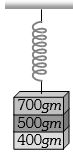
- 6Three masses $700g, 500g$, and $400g$ are suspended at the end of a spring a shown and are in equilibrium. When the $700g$ mass is removed, the system oscillates with a period of $3$ seconds, when the $500 \,gm$ mass is also removed, it will oscillate with a period of ...... $s$View Solution
- 7A spring block system in horizontal oscillation has a time-period $T$. Now the spring is cut into four equal parts and the block is re-connected with one of the parts. The new time period of vertical oscillation will beView Solution
- 8The length of a seconds pendulum is .... $cm$View Solution
- 9A massless spring $(k = 800\, N/m)$, attached with a mass $(500\, g)$ is completely immersed in $1\, kg$ of water. The spring is stretched by $2\, cm$ and released so that it starts vibrating. What would be the order of magnitude of the change in the temperature of water when the vibrations stop completely? (Assume that the water container and spring receive negligible heat and specific heat of mass $= 400\, J/kg\, K$, specific heat of water $= 4184\, J/kg\, K$)View Solution
- 10View SolutionIn case of a simple pendulum, time period versus length is depicted by