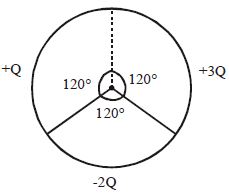
Figure shows three circular arcs, each of radius $R$ and total charge as indicated. The net electric potential at the centre of curvature is
Medium
Download our app for free and get started
$\mathrm{V}_{\mathrm{net}}$ at center
${\mathrm{V}_{\mathrm{net}}=\frac{\mathrm{K}(3 \theta+\theta-2 \theta)}{\mathrm{r}}} $
${\mathrm{V}_{\mathrm{net}}=\frac{2 \theta}{4 \pi \varepsilon_{0} \mathrm{r}}=\frac{\theta}{2 \pi \varepsilon_{0} \mathrm{r}}}$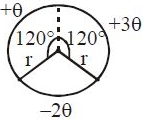

Download our appand get started for free
Experience the future of education. Simply download our apps or reach out to us for more information. Let's shape the future of learning together!No signup needed.*
Similar Questions
- 1Eight drops of mercury of equal radii possessing equal charges combine to form a big drop. Then the capacitance of bigger drop compared to each individual small drop is........$times$View Solution
- 2View SolutionA table tennis ball which has been covered with conducting paint is suspended by a silk thread so that it hang between two plates, out of which one is earthed and other is connected to a high voltage generator. This ball
- 3A parallel plate condenser with oil between the plates (dielectric constant of oil $K = 2$) has a capacitance $C$. If the oil is removed, then capacitance of the capacitor becomesView Solution
- 4A disk of radius $R$ with uniform positive charge density $\sigma$ is placed on the $x y$ plane with its center at the origin. The Coulomb potential along the $z$-axis isView Solution
$V(z)=\frac{\sigma}{2 \in_0}\left(\sqrt{R^2+z^2}-z\right)$
A particle of positive charge $q$ is placed initially at rest at a point on the $z$ axis with $z=z_0$ and $z_0>0$. In addition to the Coulomb force, the particle experiences a vertical force $\vec{F}=-c \hat{k}$ with $c>0$. Let $\beta=\frac{2 c \in_0}{q \sigma}$. Which of the following statement($s$) is(are) correct?
$(A)$ For $\beta=\frac{1}{4}$ and $z_0=\frac{25}{7} R$, the particle reaches the origin.
$(B)$ For $\beta=\frac{1}{4}$ and $z_0=\frac{3}{7} R$, the particle reaches the origin.
$(C)$ For $\beta=\frac{1}{4}$ and $z_0=\frac{R}{\sqrt{3}}$, the particle returns back to $z=z_0$.
$(D)$ For $\beta>1$ and $z_0>0$, the particle always reaches the origin.
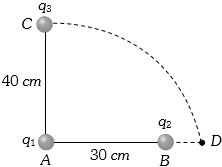
- 5Two charges ${q_1}$ and ${q_2}$ are placed $30\,\,cm$ apart, shown in the figure. A third charge ${q_3}$ is moved along the arc of a circle of radius $40\,cm$ from $C$ to $D$. The change in the potential energy of the system is $\frac{{{q_3}}}{{4\pi {\varepsilon _0}}}k$, where $k$ isView Solution
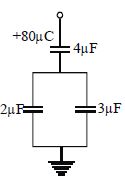
- 6In the given circuit, a charge of $+80\, \mu C$ is given to the upper plate of the $4\,\mu F$ capacitor. Then in the steady state, the charge on the upper plate of the $3\,\mu F$ capacitor is.....$\mu C$View Solution
- 7A proton and an anti-proton come close to each other in vacuum such that the distance between them is $10 \,cm$. Consider the potential energy to be zero at infinity. The velocity at this distance will be ........... $\,m / s$View Solution
- 8The two metallic plates of radius $r$ are placed at a distance $d$ apart and its capacity is $C$. If a plate of radius $r/2$ and thickness $d$ of dielectric constant $6$ is placed between the plates of the condenser, then its capacity will beView Solution
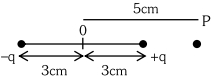
- 9An electric dipole is placed as shown in the figure.The electric potential (in $10^2\,V$ ) at point $P$ due to the dipole is $\left(\in_0=\right.$ permittivity of free space and $\left.\frac{1}{4 \pi \in_0}=K\right)$ :View Solution
- 10Point charge ${q_1} = 2\,\mu C$ and ${q_2} = - 1\,\mu C$ are kept at points $x = 0$ and $x = 6$ respectively. Electrical potential will be zero at pointsView Solution