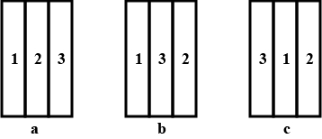
Figure shows three different arrangements of materials $1, 2$ and $3$ to form a wall. Thermal conductivities are $k_1 > k_2 > k_3$ . The left side of the wall is $20\,^oC$ higher than the right side. Temperature difference $\Delta T$ across the material $1$ has following relation in three cases
Easy


Download our appand get started for free
Experience the future of education. Simply download our apps or reach out to us for more information. Let's shape the future of learning together!No signup needed.*
Similar Questions
- 1Two spheres of different materials one with double the radius and one-fourth wall thickness of the other, are filled with ice. If the time taken for complete melting ice in the large radius one is $25$ minutes and that for smaller one is $16$ minutes, the ratio of thermal conductivities of the materials of larger sphere to the smaller sphere isView Solution
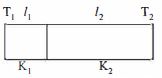
- 2One end of a thermally insulated rod is kept at a temperature $T_1$ and the other at $T_2$ . The rod is composed of two sections of length $l_1$ and $l_2$ and thermal conductivities $K_1$ and $K_2$ respectively. The temperature at the interface of the two section isView Solution
- 3A sphere, a cube and a thin circular plate, all made of the same material and having the same mass are initially heated to a temperature of $1000°C$ . Which one of these will cool firstView Solution
- 4A metallic sphere cools from $50^{\circ} C$ to $40^{\circ} C$ in $300 \,s.$ If atmospheric temperature around is $20^{\circ} C ,$ then the sphere's temperature after the next $5$ minutes will be close to$.....C$View Solution
- 5The temperature of sun is $5500 K$ and it emits maximum intensity radiation in the yellow region $(5.5 \times {10^{ - 7}}m)$. The maximum radiation from a furnace occurs at wavelength $11 \times {10^{ - 7}}m.$The temperature of furnace is ....... $K$View Solution
- 6A solid cube and a solid sphere of the same material have equal surface area. Both are at the same temperature ${120^o}C$, thenView Solution
- 7View SolutionWhich factor does not affect convection?
- 8Two rods one made of copper and other made of steel of the same length and same cross sectional area are joined together. The thermal conductivity of copper and steel are $385\,J\,s ^{-1}\,K ^{-1}\,m ^{-1}$ and $50\,J\,s ^{-1}\,K ^{-1}\,m ^{-1}$ respectively. The free ends of copper and steel are held at $100^{\circ}\,C$ and $0^{\circ}\,C$ respectively. The temperature at the junction is, nearly $.......^{\circ}\,C$View Solution
- 9In Newton's experiment of cooling, the water equivalent of two similar calorimeters is $10 $ gm each. They are filled with $350 gm$ of water and $300 gm$ of a liquid (equal volumes) separately. The time taken by water and liquid to cool from ${70^o}C$ to ${60^o}C$ is $3$ min and $95$ sec respectively. The specific heat of the liquid will be ...... $Cal/gm\,^oC$View Solution
- 10A partition wall has two layers $A$ and $B$ in contact, each made of a different material. They have the same thickness but the thermal conductivity of layer $A$ is twice that of layer $B$. If the steady state temperature difference across the wall is $60K$, then the corresponding difference across the layer $A$ is ....... $K$View Solution