Two rods one made of copper and other made of steel of the same length and same cross sectional area are joined together. The thermal conductivity of copper and steel are $385\,J\,s ^{-1}\,K ^{-1}\,m ^{-1}$ and $50\,J\,s ^{-1}\,K ^{-1}\,m ^{-1}$ respectively. The free ends of copper and steel are held at $100^{\circ}\,C$ and $0^{\circ}\,C$ respectively. The temperature at the junction is, nearly $.......^{\circ}\,C$
NEET 2022, Medium
Download our app for free and get started
$\frac{\Delta \theta}{\Delta t }=\frac{385 A (100-\theta)}{\ell}=\frac{50 A (\theta-0)}{\ell}$
$\Rightarrow 77(100-\theta)=10 \theta \Rightarrow 7700-77 \theta=10 \theta$
$\Rightarrow 87 \theta=7700$
$\Rightarrow \theta=\frac{7700}{87}=88.5^{\circ}\,C$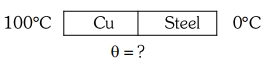

Download our appand get started for free
Experience the future of education. Simply download our apps or reach out to us for more information. Let's shape the future of learning together!No signup needed.*
Similar Questions
- 1Hot water cools from ${60^o}C$ to ${50^o}C$ in the first $10$ minutes and to ${42^o}C$ in the next $10$ minutes. The temperature of the surrounding is ......... $^oC$View Solution
- 2View SolutionWhen fluids are heated from the bottom, convection currents are produced because
- 3Heat is flowing through a conductor of length l from $x = 0$ to $x = l$ . If its thermal resistance per unit length is uniform, which of the following graphs is correctView Solution
- 4The total radiant energy per unit area, normal to the direction of incidence, received at a distance $R$ from the centre of a star of radius $r$, whose outer surface radiates as a black body at a temperature $T\ K$ is given byView Solution
- 5A body cools from $80^{\circ}\,C$ to $60^{\circ}\,C$ in $5$ minutes. The temperature of the surrounding is $20^{\circ} C$. The time it takes to cool from $60^{\circ}\,C$ to $40^{\circ}\,C$ is........... $s$View Solution
- 6A constant potential difference is applied to the ends of a graphite rod, whose resistance decreases with a rise of temperature. The rod can be $(1)$ covered with asbestos or $(2)$ left open to atmosphere. Answer for steady state.View Solution
- 7In a room where the temperature is ${30^o}C$, a body cools from ${61^o}C$ to ${59^o}C$ in $4$ minutes. The time (in min.) taken by the body to cool from ${51^0}C$ to ${49^0}C$ will be ....... $\min$View Solution
- 8A wall has two layers $A$ and $B$, each made of a different material. Both the layers have the same thickness. The thermal conductivity of the material of $A$ is twice that of $B$. Under thermal equilibrium, the temperature difference across the wall is $36\,^oC$. The temperature difference across the layer $A$ is ......... $^oC$View Solution
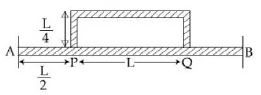
- 9Temperature difference of $120\,^oC$ is maintained between two ends of a uniform rod $AB$ of length $2L$. Another bent rod $PQ$, of same cross-section as $AB$ and length $\frac{{3L}}{2}$, is connected across $AB$ (See figure). In steady state, temperature difference between $P$ and $Q$ will be close to .......... $^oC$View Solution
- 10Two bottles $A$ and $B$ have radii $R_{A}$ and $R_{B}$ and heights $h_{A}$ and $h_{B}$ respectively, with $R_{B}=2 R_{A}$ and $h_{B}=2 h_{A}$. These are filled with hot water at $60^{\circ} C$. Consider that heat loss for the bottles takes place only from side surfaces. If the time, the water takes to cool down to $50^{\circ} C$ is $t_{A}$ and $t_{B}$ for bottles $A$ and $B$, respectively. Then, $t_{A}$ and $t_{B}$ are best related asView Solution