Question
Figure shows three equidistant slits being illuminated by a monochromatic parallel beam of light. Let $\text{BP}_0-\text{AP}=\frac{\lambda}{3}$ and $\text{D}>\lambda.$
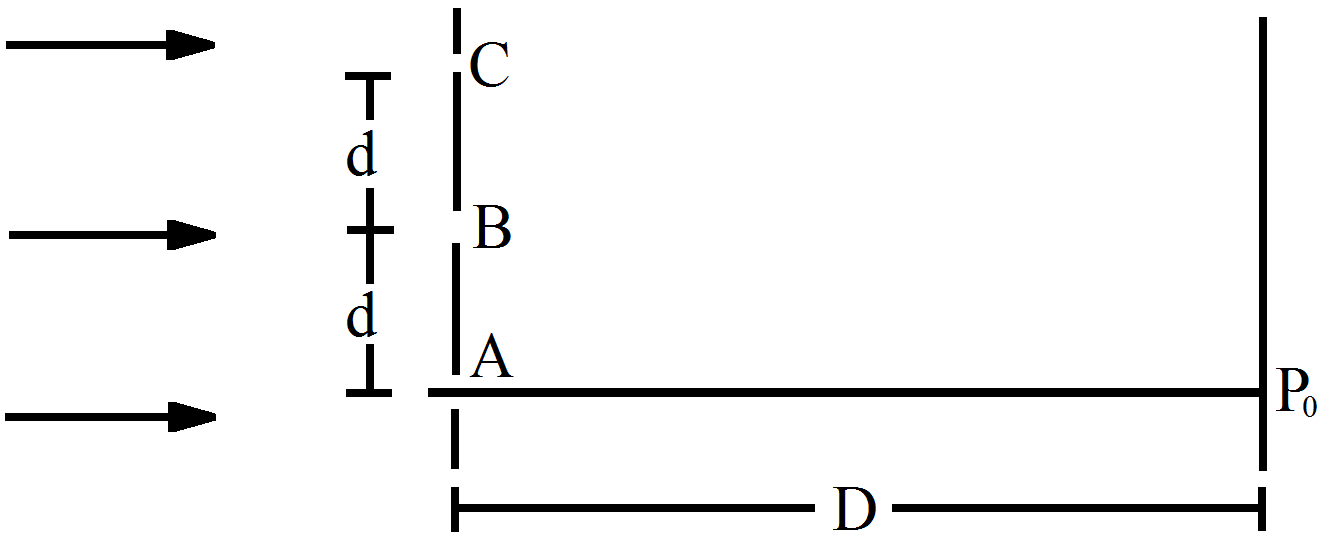
  1. Show that in this case $\text{d}=\sqrt{\frac{2\lambda\text{D}}{3}}.$
  2. Show that the intensity at $P,$ is three times the intensity due to any of the three slits individually.
Answer

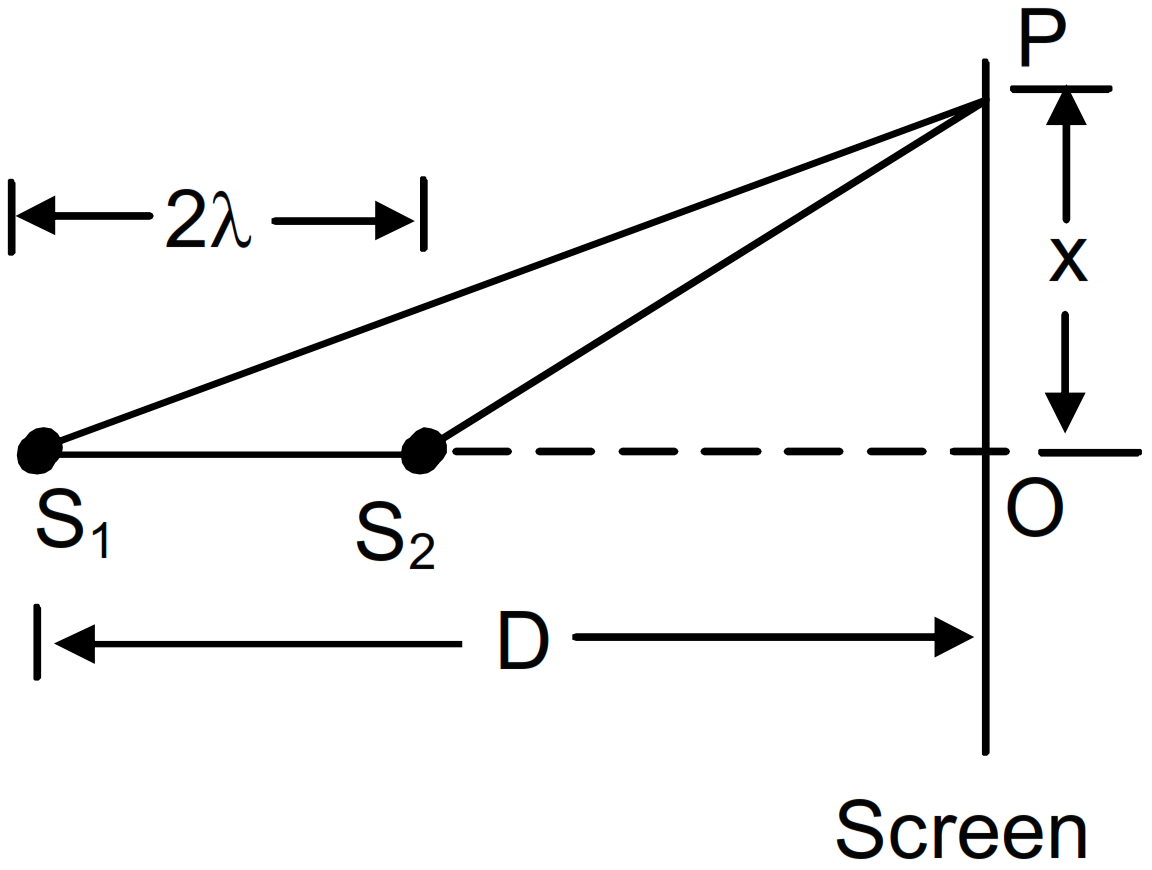
Since $S_1, S_2$ are in same phase, at $O$ there will be maximum intensity.
Given that, there will be a maximum intensity at $P$.

$\Rightarrow$ path difference $=\Delta\text{x}=\text{n}\lambda$
From the figure,
$(\text{S}_1\text{P})^2-(\text{S}_2\text{P})^2=\Big(\sqrt{\text{D}^2+\text{X}^2}\Big)^2-\Big(\sqrt{(\text{D}-2\lambda)^2+\text{X}^2}\Big)^2$
$=4\lambda\text{D}-4\lambda^2=4\lambda\text{D}\ (\lambda^2$ is so small and can be neglected$)$
$\Rightarrow\text{S}_1\text{P}-\text{S}_2\text{P}=\frac{4\lambda\text{D}}{2\sqrt{\text{x}^2+\text{D}^2}}=\text{n}\lambda$
$\Rightarrow\frac{2\text{D}}{\sqrt{\text{x}^2+\text{D}^2}}=\text{v}$
$\Rightarrow\text{n}^2(\text{X}^2+\text{D}^2)=4\text{D}^2=\Delta\text{X}=\frac{\text{D}}{\text{n}}\sqrt{4-\text{n}^2}$
when $\text{n}=1,\text{x}=\sqrt{3}\text{D}\ (1^{st}$ order$)$
$\text{n}=2,\text{x}=0\ (2^{nd}$ order$)$
$\therefore$ When $\text{X}=\sqrt{3}\text{D},$ at $P$ there will be maximum intensity.

Need a full question paper?

Generate a complete, print-ready paper with questions like this in minutes — across 16+ boards, with answer keys.

Start Generating Free

Similar questions

A gun of mass M fires a bullet of mass m with a horizontal speed V. The gun is fitted with a concave mirror of focal length f facing tpwards the receding bullet. Find the speed of separation of the bullet and the image just after the gun was fired.
State and Prove Gauss theorem in electrostatics.
A hollow sphere is released from the top of an inclined plane of inclination $\theta.$
  1. What should be the minimum coefficient of friction between the sphere and the plane to prevent sliding?
  2. Find the kinetic energy of the ball as it moves down a length 1 on the incline if the friction coefficient is half the value calculated in part (a).
Find the diameter of the image of the moon formed by a spherical concave mirror of focal length $7.6m.$ The diameter of the moon is $3450\ km$ and the distance between the earth and the moon is $3.8 \times 10^5\ km$.
$Fe^+$ ions are accelerated through a potential difference of $500V$ and are injected normally into a homogeneous magnetic field $B$ of strength $20.0mT.$ Find the radius of the circular paths followed by the isotopes with mass numbers $57$ and $58.$ Take the mass of an ion $= A (1.6 \times 10^{-27})kg,$ where $A$ is the mass number.
Consider $N = n_1n_2$ identical cells, each of emf $\epsilon$ and internal resistance $r$. Suppose $n_1$ cells are joined in series to form a line and $n_2$ such lines are connected in parallel. The combination drives a current in an external resistance $R. (a)$ Find the current in the external resistance. $(b)$ Assuming that $n_1$ and $n_2$ can be continuously varied, find the relation between $n_1, n_2, R$ and $r$ for which the current in $R$ is maximum.

A (current vs time) graph of the current passing through a solenoid is shown in Fig. For which time is the back electromotive force (u) a maximum. If the back emf at t = 3s is e, find the back emf at t = 7s, 15s and 40s. OA, AB and BC are straight line segments.
A circular loop carrying a current i is made of a wire of length L. A uniform magnetic field B exists parallel to the plane of the loop.
  1. Find the torque on the loop.
  2. If the same length of the wire is used to form a square loop, what would be the torque? Which is larger?
A plane electromagnetic wave travels in vacuum along $z -$ direction. What can you say about the directions of its electric and magnetic field vectors? If the frequency of the wave is $30 \ \text{MHz},$ what is its wavelength?
$i$. An ac source generating a voltage $V = V _0 \sin \omega t$ is connected to a capacitor of capacitance $C$ . Find the expression of the current $I$ flowing through it. Plot a graph of $V$ and $I$ versus $\omega t$ to show that the current is $\frac{\pi}{2}$ ahead of the voltage.
$ii$. A resistor of $200 \Omega$ and a capacitor of $15 \mu F$ are connected in series to a $220 V, 50 Hz$ ac source. Calculate the current in the circuit and the rms voltage across the resistor and the capacitor. Why the algebraic sum of these voltages is more than the source voltage?