Question

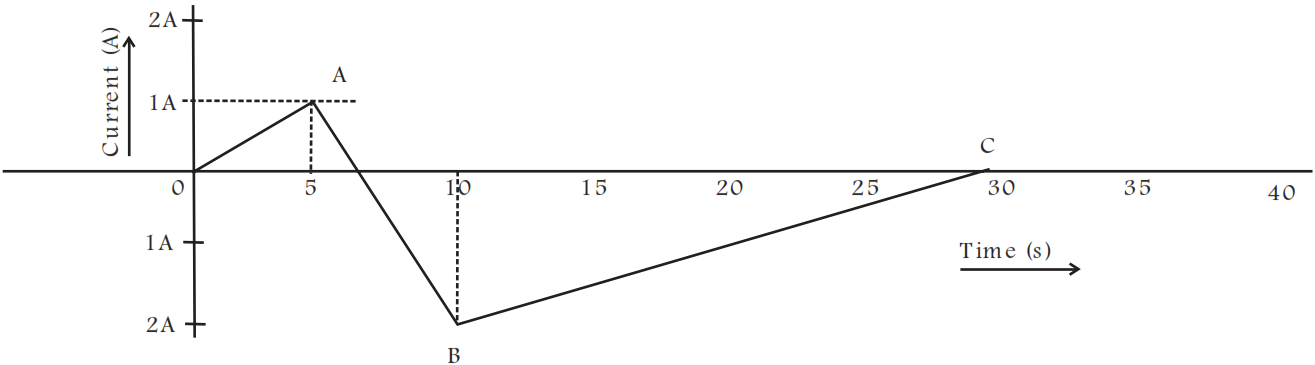
A (current vs time) graph of the current passing through a solenoid is shown in Fig. For which time is the back electromotive force (u) a maximum. If the back emf at t = 3s is e, find the back emf at t = 7s, 15s and 40s. OA, AB and BC are straight line segments.
Answer

Key concept: Whenever the electric current passing through a coil or circuit changes, the magnetic flux linked with it will also change. As a result of this, in accordance with 'Faraday's laws of electromagnetic induction, an emf is induced in the coil or the circuit which opposes the change that causes this induced emf is called back emf, the current so produced in the coil is called induced current. The induced emf is given by,
$\epsilon=-\frac{\text{d}(\text{N}\phi_\text{B})}{\text{dt}}$
$\epsilon=-\text{L}\frac{\text{dl}}{\text{dt}}$
Thus, negative sign indicates that induced emf (e) apposes any change (increase of decrease) of current in the coil.
When the rate of change of current is maximum, then back emf in solenoid is (u) a maximum. This occurs in AB part of the graph. So, maximum back emf will be obtained between 5s < t < 10s.
Since, the back emf at t = 3s is e.
Also, the rate of change of current at t = 3,
and slope (s) of OA $(\text{from t}=0\text{s to t}=5\text{s})=\frac{1}{5}\frac{\text{A}}{\text{S}}$.
So, we have
If $\text{u}=\text{L}\frac{1}{5}\Big(\text{for t}=3\text{s},\frac{\text{dI}}{\text{dt}}=\frac{1}{5}\Big).$
where, L is a constant (coefficient of self-induction).
And emf is $\epsilon=-\text{L}\frac{\text{dI}}{\text{dt}}$
Similarly, we have for other values.
For $5\text{s}<\text{t}<10\text{s},\text{u}_1=-\text{L}\frac{3}{5}=-\frac{3}{5}\text{L}=-3\text{e}$
Thus, at $\text{t}=7\text{s},\text{u}_1=-3\text{e}$
For $10\text{s}<\text{t}<30\text{s}$
$\text{u}_2=\text{L}\frac{2}{20}=\frac{\text{L}}{10}=\frac{1}{2}\text{e}$
for $\text{t}>30\text{s},\text{u}_2=0$
Thus, the back emf ar t = 7s, 15s and 40s are $-3\text{e},\frac{\text{e}}{2}$ and 0 respectively.

Need a full question paper?

Generate a complete, print-ready paper with questions like this in minutes — across 16+ boards, with answer keys.

Start Generating Free

Similar questions

A paisa coin is made up of $Al-Mg$ alloy and weighs $0.75g$. It has a square shape and its diagonal measures $17\ mm.$ It is electrically neutral and contains equal amounts of positive and negative charges.
Treating the paisa coins made up of only Al, find the magnitude of equal number of positive and negative charges. What conclusion do you draw from this magnitude?
A turn of radius 20m is banked for the vehicles going at a speed of 36 km/h. If the coefficient of static friction between the road and the tyre is 0.4, what are the possible speeds of a vehicle so that it neither slips down nor skids up?
A right-angled triangle abc, made from a metallic wire, moves at a uniform speed v in its plane as shown in figure. A uniform magnetic field B exists in the perpendicular direction. Find the emf induced:
  1. In the loop abc.
  2. In the segment bc.
  3. In the segment ac.
  4. In the segment ab.
Figure shows an outline of Lloyd's mirror experiment. $M$ is a plane mirror; $S$ is a narrow slit illuminated by some source of light $($not shown$)$ and $S$' is the image of S in $M. M, S$ and $S\ '$ are in a plane perpendicular to the paper. $O$ is the line of intersection of the mirror and the screen.
$a$. What is the origin of fringes observed on the screen?
Image

$b$. Why is the slit $S$ placed so as to have very oblique angle of incidence of light striking the mirror?
$c.$ The two path lengths $PS$ and $PS\ '$ are equal when $P$ coincides with $O$. Yet the fringe at $O$ is found in the experiment to be dark not bright. What does this observation imply?
In the previous problem, suppose $m_2 = 2.0\ kg$ and $m_3 = 3.0\ kg$. What should be the mass $m$ so that it remains at rest?
Two particles $A$ and $B,$ having opposite charges$ 2.0 \times 10^{-6}C$ and $2.0 \times 10^{-6}C,$ are placed at a separation of $1.0\ cm$.
  1. Write down the electric dipole moment of this pair.
  2. Calculate the electric field at a point on the axis of the dipole $1.0\ m$ awa.y from the centre.
  3. Calculate the electric field at a point on the perpendicular bisector of the dipole and $1.0\ m$ away from the centre.
Clear the difference between interference and diffraction.
A horizontal cesium plate ($\phi$ = l.9 eV) is moved vertically downward at a constant speed u in a room full of radiation of wavelength 250 run and above. What should be the minimum value of u so that the vertically upward component of velocity is nonpositive for each photoelectron?
The temperatures of equal masses of three different liquids $A, B$ and $C$ are $12^\circ C, 19^\circ C$ and $28^\circ C$ respectively. The temperature when $A$ and $B$ are mixed is $16^\circ C,$ and when $B$ and $C$ are mixed, it is $23^\circ C$. What will be the temperature when $A$ and $C$ are mixed?
$^{238}U$ decays to $^{206}Pb$ with a half$-$life of $4.47 \times 10^9y$. This happens in a number of steps. Can you justify a single half for this chain of processes? A sample of rock is found to contain $2.00\ mg$ of $^{238}U$ and $0.600\ mg$ of $^{206}Pb$. Assuming that all the lead has come from uranium, find the life of the rock.