Question
Figure shows three equidistant slits being illuminated by a monochromatic parallel beam of light. Let $\text{BP}_0-\text{AP}=\frac{\lambda}{3}$ and $\text{D}>\lambda.$
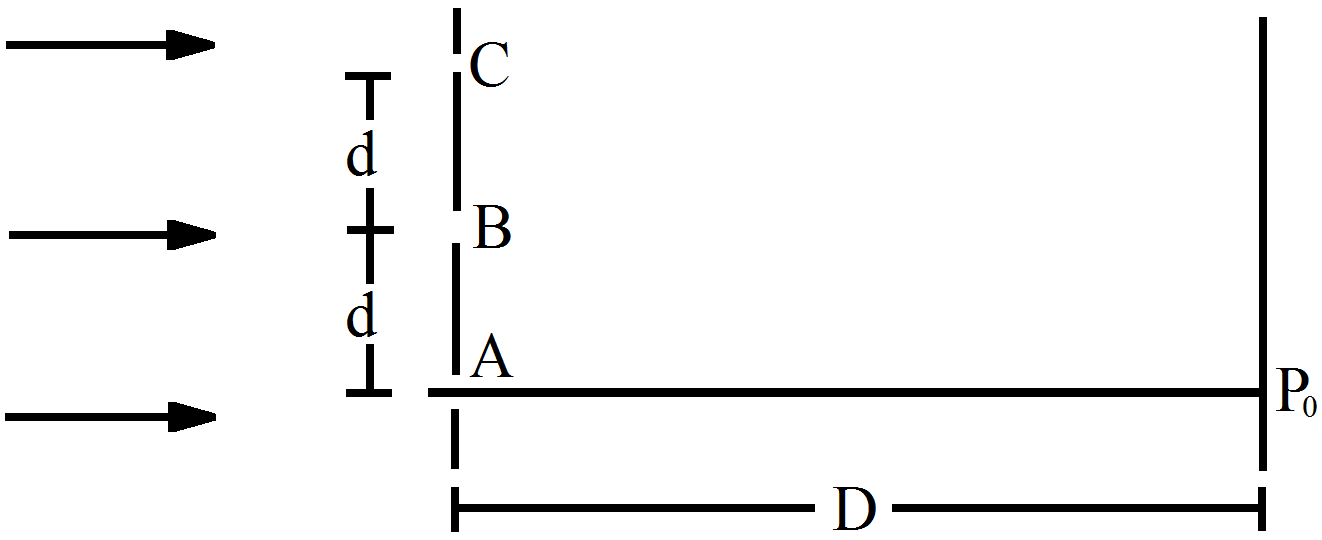
  1. Show that in this case $\text{d}=\sqrt{\frac{2\lambda\text{D}}{3}}.$
  2. Show that the intensity at P, is three times the intensity due to any of the three slits individually.
Answer

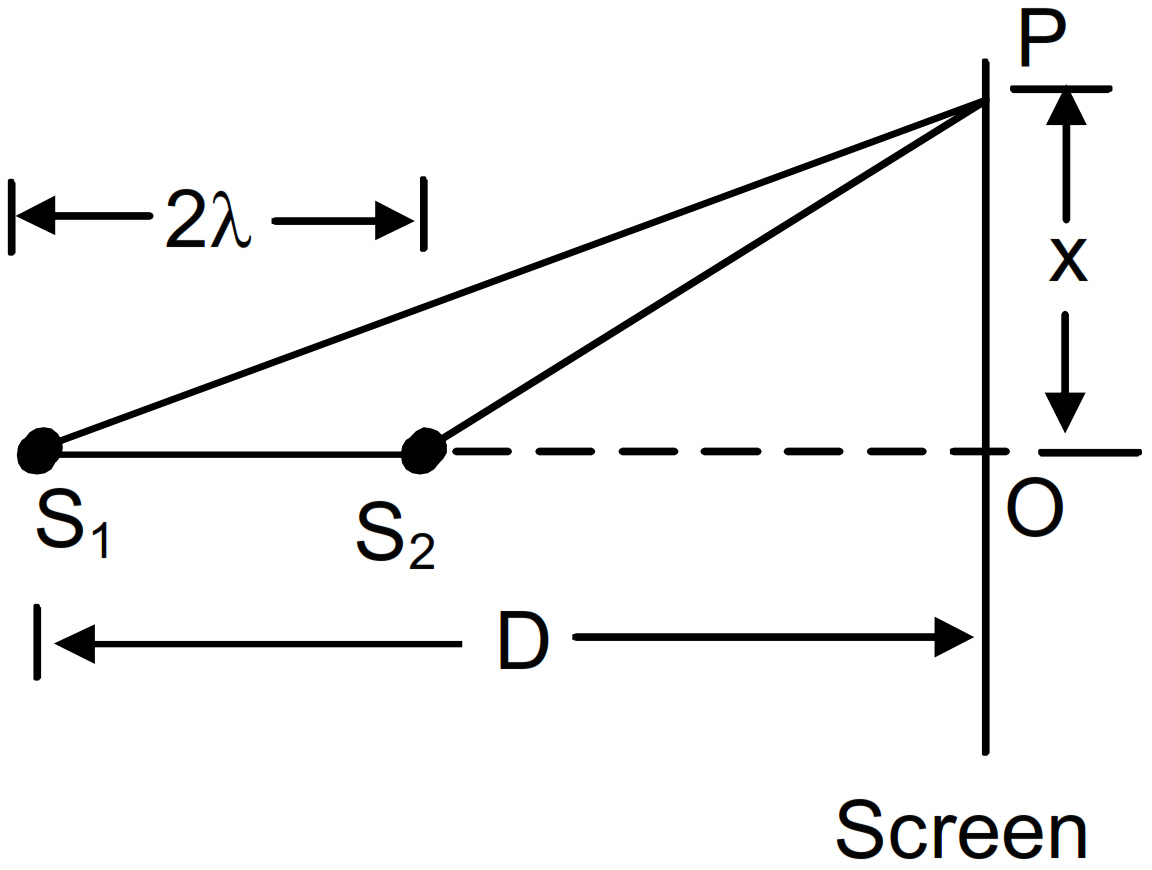
Since S1, S2 are in same phase, at O there will be maximum intensity.

Given that, there will be a maximum intensity at P.

⇒ path difference $=\Delta\text{x}=\text{n}\lambda$

From the figure,

$(\text{S}_1\text{P})^2-(\text{S}_2\text{P})^2=\Big(\sqrt{\text{D}^2+\text{X}^2}\Big)^2-\Big(\sqrt{(\text{D}-2\lambda)^2+\text{X}^2}\Big)^2$

$=4\lambda\text{D}-4\lambda^2=4\lambda\text{D}$ ($\lambda^2$ is so small and can be neglected)

$\Rightarrow\text{S}_1\text{P}-\text{S}_2\text{P}=\frac{4\lambda\text{D}}{2\sqrt{\text{x}^2+\text{D}^2}}=\text{n}\lambda$

$\Rightarrow\frac{2\text{D}}{\sqrt{\text{x}^2+\text{D}^2}}=\text{v}$

$\Rightarrow\text{n}^2(\text{X}^2+\text{D}^2)=4\text{D}^2=\Delta\text{X}=\frac{\text{D}}{\text{n}}\sqrt{4-\text{n}^2}$

when $\text{n}=1,\text{x}=\sqrt{3}\text{D}$ (1st order)

$\text{n}=2,\text{x}=0$ (2nd order)

$\therefore$ When $\text{X}=\sqrt{3}\text{D},$ at P there will be maximum intensity.

Need a full question paper?

Generate a complete, print-ready paper with questions like this in minutes — across 16+ boards, with answer keys.

Start Generating Free

Similar questions

Einstein’s mass - energy relation emerging out of his famous theory of relativity relates mass (m) to energy (E) as E = mc2, where c is speed of light in vacuum. At the nuclear level, the magnitudes of energy are very small. The energy at nuclear level is usually measured in MeV, where 1MeV = 1.6 × 10⁻¹³J; the masses are measured in unified atomic mass unit (u) where 1u = 1.67 × 10⁻²⁷kg.
  1. Show that the energy equivalent of 1u is 931.5MeV.
  2. A student writes the relation as 1u = 931.5MeV. The teacher points out that the relation is dimensionally incorrect. Write the correct relation.
A rocket is fired ‘vertically’ from the surface of mars with a speed of 2km s-1. If 20% of its initial energy is lost due to martian atmospheric resistance, how far will the rocket go from the surface of mars before returning to it? Mass of mars = 6.4 × 10²³kg; radius of mars = 3395km; G = 6.67 × 10⁻¹¹N m2 kg-2.
Two masses 8kg and 12kg are connected at the two ends of a light inextensible string that goes over a frictionless pulley. Find the acceleration of the masses and the tension in the string when the masses are released.
A bullet of mass 20g travelling horizontally with a speed of 500m/s passes through a wooden block of mass 10.0kg initially at rest on a level surface. The bullet emerges with a speed of 100m/s and the block slides 20cm on the surface before coming to rest. Find the friction coefficient between the block and the surface.

A wire of mass m and length l can slide freely on a pair of smooth, vertical rails (figure). A magnetic field B exists in the region in the direction perpendicular to the plane of the rails. The rails are connected at the top end by a capacitor of capacitance C. Find the acceleration of the wire neglecting any electric resistance.

Define conservative and non-conservative forces. Give example and properties of conservative forces.
A 5kg rifle fires a 58 bullet with a speed of 500ms-1. What kinetic energy is acquired.
  1. By the bullet and.
  2. By the rifle?
  3. Find the the ratio of the distance which the rifle moves backward while the bullet is in the barrel to the distance the bullet moves forward.
Define impulse and establish its relation with momentum change. Explain the importance of impulse. Or Define impulse of a force and prove that the impulse of a force on a body is equal to change in momentum. Or State the momentum impulse theorem. Explain its physical importance with examples.
Radiation coming from transition n = 2 to n = 1 of hydrogen atoms falls on helium ions in n = 1 and n = 2 states. What are the possible transitions of helium ions as they absorbs energy from the radiation?
A person travels by a car at a speed of 180km/h. It takes exactly 10 hours by his wristwatch to go from the station A to the station B:
  1. What is the rest distance between the two stations?
  2. How much time is taken in the road frame by the car to go from the station A to the station B?
A family uses 8kW of power.
  1. Direct solar energy is incident on the horizontal surface at an average rate of 200W per square meter. If 20% of this energy can be converted to useful electrical energy, how large an area is needed to supply 8kW?
  2. Compare this area to that of the roof of a typical house.