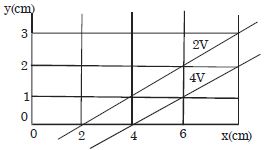
Figure shows two equipotential lines in $x, y$ plane for an electric field. The scales are marked. The $x-$ component $E_x$ and $y$ -component $E_y$ of the electric field in the space between these equipotential lines are respectively :-
Medium


Download our appand get started for free
Experience the future of education. Simply download our apps or reach out to us for more information. Let's shape the future of learning together!No signup needed.*
Similar Questions
- 1A series combination of $n_1$ capacitors, each of value $C_1$ is charged by a source of potential difference $4\, V.$ When another parallel combination of $n_2$ capacitors, each of value $C_2,$ is charged by a source of potential difference $V$, it has the same (total) energy stored in it, as the first combination has. The value of $C_2,$ in terms of $C_1$ is thenView Solution
- 2In a capacitor of capacitance $20\,\mu \,F$, the distance between the plates is $2\,mm$. If a dielectric slab of width $1\,mm$ and dielectric constant $2$ is inserted between the plates, then the new capacitance is......$\mu \,F$View Solution
- 3In Millikan's oil drop experiment an oil drop carrying a charge $Q$ is held stationary by a potential difference $2400\,V$ between the plates. To keep a drop of half the radius stationary the potential difference had to be made $600\,V$. What is the charge on the second dropView Solution
- 4Two thin wire rings each having a radius $R$ are placed at a distance $d$ apart with their axes coinciding. The charges on the two rings are $ + q$ and $ - q$. The potential difference between the centres of the two rings isView Solution
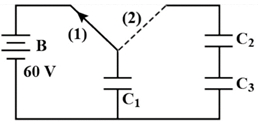
- 5A capacitor $C_1$ is charged up to a voltage $V\, = 60\,V$ by connecting it to battery $B$ through switch $( 1)$, Now $C_1$ is disconnected from battery and connected to a circuit consisting of two uncharged capacitors $C_2\, = 3.0\,\mu F$ and $C_3\,= 6.0\,\mu F$ through a switch $(2)$ as shown in the figure. The sum of final charges on $C_2$ and $C_3$ is......$\mu C$View Solution
- 6A particle of mass $m$ and carrying charge $-q_1$ is moving around a charge $+q_2$ along a circular path of radius r. Find period of revolution of the charge $-q_1$View Solution
- 7Consider three concentric metallic spheres $A, B$ and $C$ of radii $a , b, c$, respectively where $a < b < c$. $A$ and $B$ are connected, whereas $C$ is grounded. The potential of the middle sphere $B$ is raised to $V$, then the charge on the sphere $C$ isView Solution
- 8In order to obtain a time constant of $10$ seconds in an $RC$ circuit containing a resistance of $10^3\,\Omega,$ the capacity of a condenser should be.....$ \mu F$View Solution
- 9A charge $ + q$ is fixed at each of the points $x = {x_0},\,x = 3{x_0},\,x = 5{x_0}$..... $\infty$, on the $x - $axis and a charge $ - q$ is fixed at each of the points $x = 2{x_0},\,x = 4{x_0},x = 6{x_0}$,..... $\infty$. Here ${x_0}$ is a positive constant. Take the electric potential at a point due to a charge $Q$ at a distance $r$ from it to be $Q/(4\pi {\varepsilon _0}r)$. Then, the potential at the origin due to the above system of charges isView Solution
- 10The magnitude of electric field on the surface of a uniformly charged metalic spherical shell is $E$. If a hole is made in it using a insulating device, then the magnitude of electric field in the hole will beView Solution