A charge $ + q$ is fixed at each of the points $x = {x_0},\,x = 3{x_0},\,x = 5{x_0}$..... $\infty$, on the $x - $axis and a charge $ - q$ is fixed at each of the points $x = 2{x_0},\,x = 4{x_0},x = 6{x_0}$,..... $\infty$. Here ${x_0}$ is a positive constant. Take the electric potential at a point due to a charge $Q$ at a distance $r$ from it to be $Q/(4\pi {\varepsilon _0}r)$. Then, the potential at the origin due to the above system of charges is
IIT 1998, Diffcult


Download our appand get started for free
Experience the future of education. Simply download our apps or reach out to us for more information. Let's shape the future of learning together!No signup needed.*
Similar Questions
- 1View SolutionA sheet of aluminium foil of negligible thickness is introduced between the plates of a capacitor. The capacitance of the capacitor
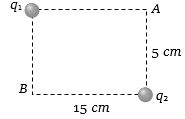
- 2$n$ the rectangle, shown below, the two corners have charges ${q_1} = - 5\,\mu C$ and ${q_2} = + 2.0\,\mu C$. The work done in moving a charge $ + 3.0\,\mu C$ from $B$ to $A$ is.........$J$ $(1/4\pi {\varepsilon _0} = {10^{10}}\,N{\rm{ - }}{m^2}/{C^2})$View Solution
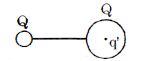
- 3Two conducting hollow sphere of radius $R$ and $3R$ are found to have $Q$ charge on outer surface when both are connected with a long wire and $q'$ charge is kept at the centre of bigger sphere. Then which one is trueView Solution
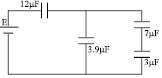
- 4Four capacitors and a battery are connected as shown. The potential drop across the $7$ $ \mu F$ capacitor is $ 6$ $ V$. Then the :View Solution
- 5Charges of $ + \frac{{10}}{3} \times {10^{ - 9}}C$ are placed at each of the four corners of a square of side $8\,cm$. The potential at the intersection of the diagonals isView Solution
- 6View SolutionThe combined capacity of the parallel combination of two capacitors is four times their combined capacity when connected in series. This means that
- 7View SolutionAssertion : Two equipotential surfaces cannot cut each other.
Reason : Two equipotential surfaces are parallel to each other.
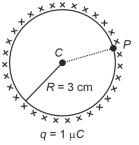
- 8A thin spherical shell is charged by some source. The potential difference between the two points $C$ and $P$ (in $V$) shown in the figure is:View Solution
(Take $\frac{1}{4 \pi \varepsilon_0}=9 \times 10^9$ $SI$ units)
- 9Two charges of magnitude $5\, nC$ and $-2\, nC$, one placed at points $(2\, cm, 0, 0)$ and $(x\, cm, 0, 0)$ in a region of space, where there is no other external field. If the electrostatic potential energy of the system is $ - 0.5\,\mu J$. The value of $x$ is.....$cm$View Solution
- 10The electric potential at a point on the axis of an electric dipole depends on the distance $r$ of the point from the dipole asView Solution