Question
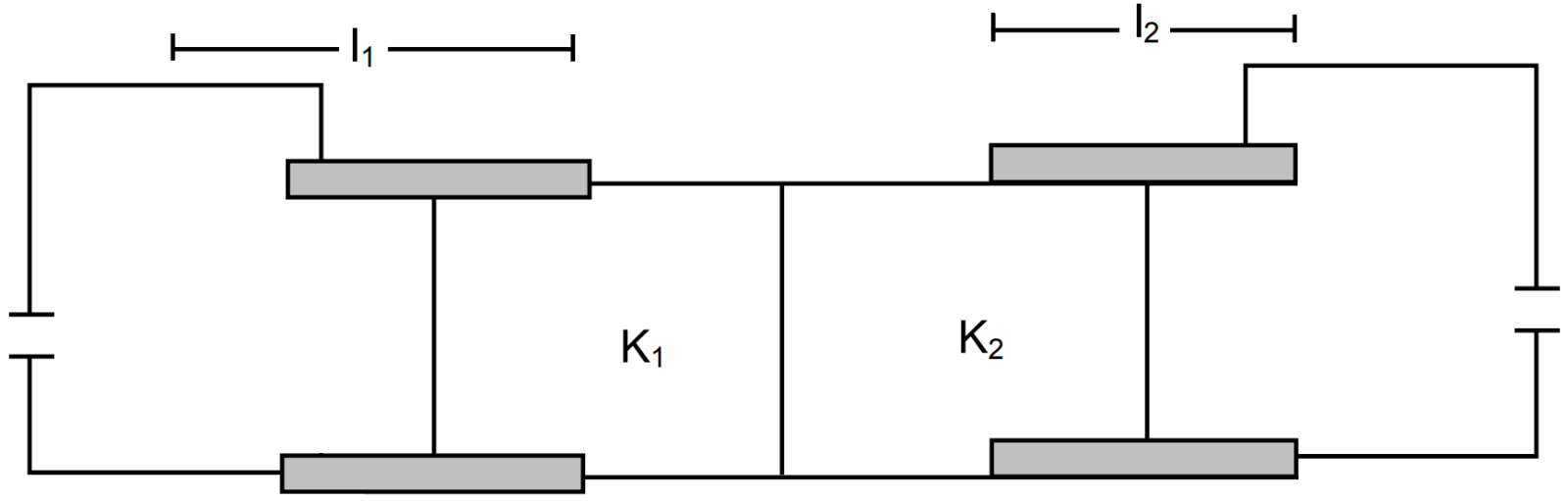
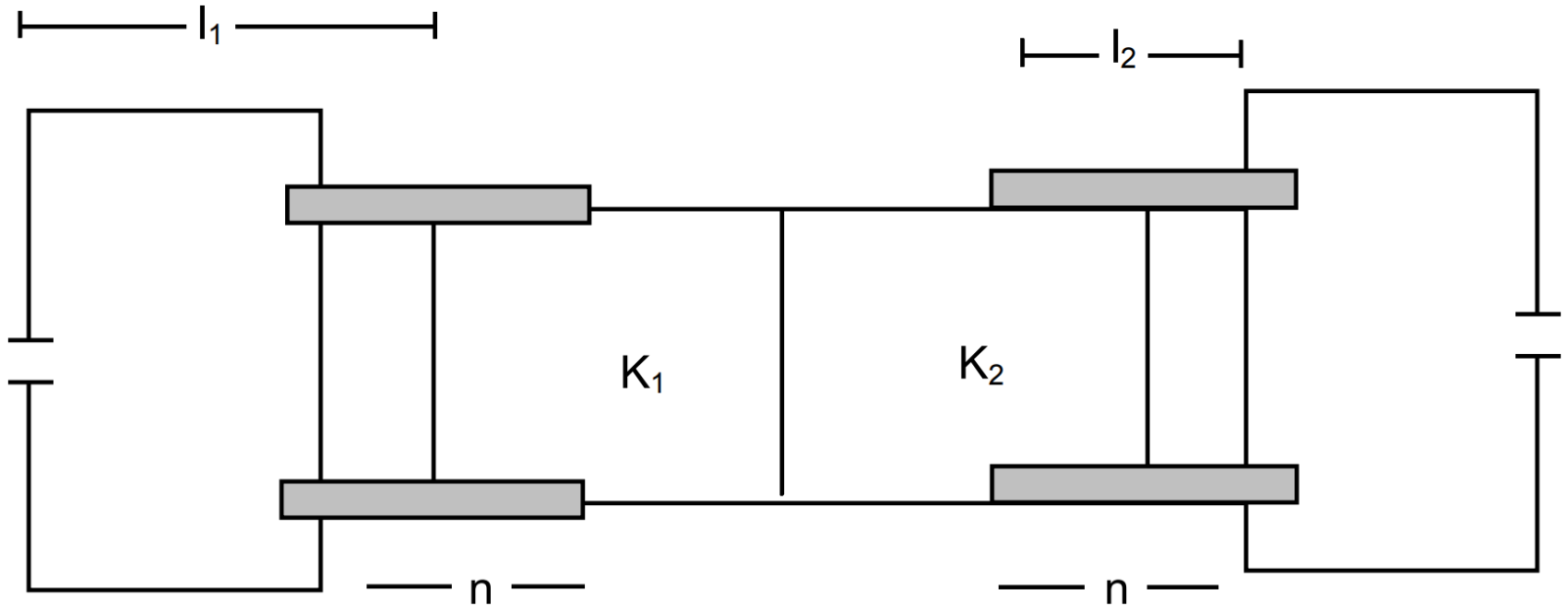
Figure shows two parallel plate capacitors with fixed plates and connected to two batteries. The separation between the plates is the same for the two capacitors. The plates are rectangular in shape with width b and lengths l1 and l2 The left half of the dielectric slab has a dielectric constant K1 and the right half K2. Neglecting any friction, find the ratio of the emf of the left. battery to that of the right battery for which the dielectric slab may remain in equilibrium.
Answer


Consider the left side
The plate area of the part with the dielectric is by its capacitance $\text{C}_1=\frac{\text{K}_1\in_0\text{bx}}{\text{d}}$ and with out dielectric $\text{C}_2=\frac{\in_0\text{b}(\text{L}_1-\text{x})}{\text{d}}$
These are connected in parallel
$\text{C}=\text{C}_1+\text{C}_2$
$=\frac{\in_0\text{b}}{\text{d}}[\text{L}_1+\text{x}(\text{k}_1-1)]$
Let the potential V1
$\text{U}=\Big(\frac{1}{2}\Big)\text{CV}_1^2=\frac{\in_0\text{bv}_1^2}{2\text{d}}[\text{L}_1+\text{x}(\text{k}-1)]\ \dots(1)$
Suppose dielectric slab is attracted by electric field and an external force F consider the part dx which makes inside further, As the potential difference remains constant at V.
The charge supply, dq = (dc)v to the capacitor.
The work done by the battery is dwb = v.dq = (dc)v2
The external force F does a work dwe = (–f.dx) during a small displacement.
The total work done in the capacitor is dwb + dwe = (dc)v2 - fdx
This should be equal to the increase dv in the stored energy.
Thus $\Big(\frac{1}{2}\Big)(\text{dk})\text{v}^2=(\text{dc})\text{v}^2-\text{fdx}$
$\text{f}=\frac{1}{2}\text{v}^2\frac{\text{dc}}{\text{dx}}$
from equation (1)
$\text{F}=\frac{\in_0\text{bv}^2}{2\text{d}}(\text{k}_1-1)$
$\Rightarrow\text{V}_1^2=\frac{\text{F}\times2\text{d}}{\in_0\text{b}(\text{k}_1-1)}$
$\Rightarrow\text{V}_1=\sqrt{\frac{\text{F}\times2\text{d}}{\in_0\text{b}(\text{k}_1-1)}}$
For the right side, $\text{V}_2=\sqrt{\frac{\text{F}\times2\text{d}}{\in_0\text{b}(\text{k}_2-1)}}$
$\frac{\text{V}_1}{\text{V}_2}=\frac{\sqrt{\frac{\text{F}\times2\text{d}}{\in_0\text{b}(\text{k}_1-1)}}}{\sqrt{\frac{\text{F}\times2\text{d}}{\in_0\text{b}(\text{k}_2-1)}}}$
$\frac{\text{V}_1}{\text{V}_2}=\frac{\sqrt{\text{k}_2-1}}{\sqrt{\text{k}_1-1}}$
$\therefore$ The ratio of the emf of the left battery to the right battery $=\frac{\sqrt{\text{k}_2-1}}{\sqrt{\text{k}_1-1}}$

Need a full question paper?

Generate a complete, print-ready paper with questions like this in minutes — across 16+ boards, with answer keys.

Start Generating Free

Similar questions

Two long, straight wires, each carrying a current of 5A, are placed along the X and Y-axes respectively. The currents point along the positive directions of the axes. Find the magnetic fields at the points (a) (1m, 1m), (b) (-1m, 1m), (c) (-1m,-1m) and (d) (1m, -1m),
Write the expression for the force, $\vec{\text{F}}$ acting on a charged particle of charge ‘q’, moving with a velocity $\vec{\text{v}}$ in the presence of both electric field $\vec{\text{E}}$ and magnetic field $\vec{\text{B}}$. Obtain the condition under which the particle moves undeflected through the fields.
  1. Using the Bohr’s model calculate the speed of the electron in a hydrogen atom in the n = 1, 2, and 3 levels.
  2. Calculate the orbital period in each of these levels.
Which one of the following cannot emit radiation and why? Excited nucleus, excited electron.
 An electric kettle used to prepare tea, takes 2 minutes to boil 4 cups of water (1 cup contains 200cc of water) if the room temperature is 25C.
  1. If the cost of power consumption is Rs. 1.00 per unit (1 unit - 1000 watt-hour), calculate the cost of boiling 4 cups of water.
  2. What will be the corresponding cost if the room temperature drops to 5°C?
(a) For circuits used for transporting electric power, a low power factor implies large power loss in transmission. Explain.
(b) Power factor can often be improved by the use of a capacitor of appropriate capacitance in the circuit. Explain.
Consider the following very rough model of a beryllium atom. The nucleus has four protons and four neutrons confined to a small volume of radius 10-15m. The two 1s electrons make a spherical charge cloud at an average distance of 1.3 × 10⁻¹¹m from the nucleus, whereas the two 2s electrons make another spherical cloud at an average distance of 5.2 × 10⁻¹¹m from the nucleus. Find the electric field at:
  1. A point just inside the 1s cloud.
  2. A point just inside the 2s cloud.
Steam at 120°C is continuously passed through a 50cm long rubber tube of inner and outer radii 1.0cm and 1.2cm. The room temperature is 30°C. Calculate the rate of heat flow through the walls of the tube. Thermal conductivity of rubber = 0.15Js-1m-1°C-1.
The time constant of an LR circuit is 40ms. The circuit is connected at t = 10 and the steady-state current is found to be 2.0A. Find the current at:
  1. t = 10ms
  2. t = 20ms
  3. t = 100ms
  4. t = 1s.
Define power and explain the following points (a) Instantaneous power (b) average power (c) power factor