Question
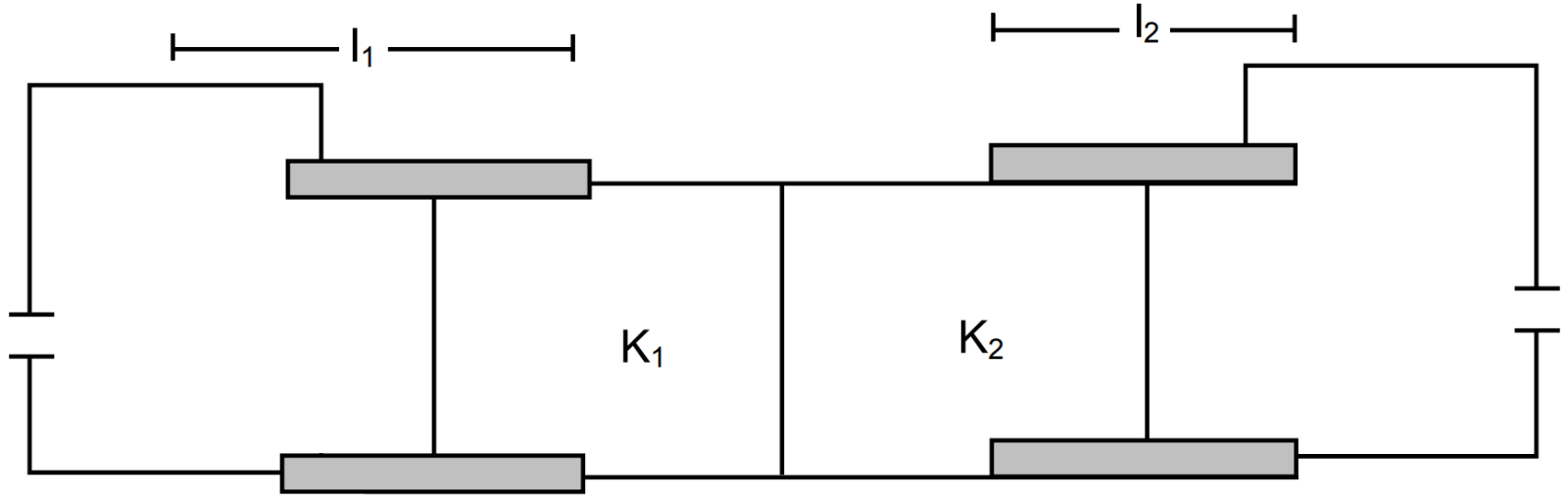
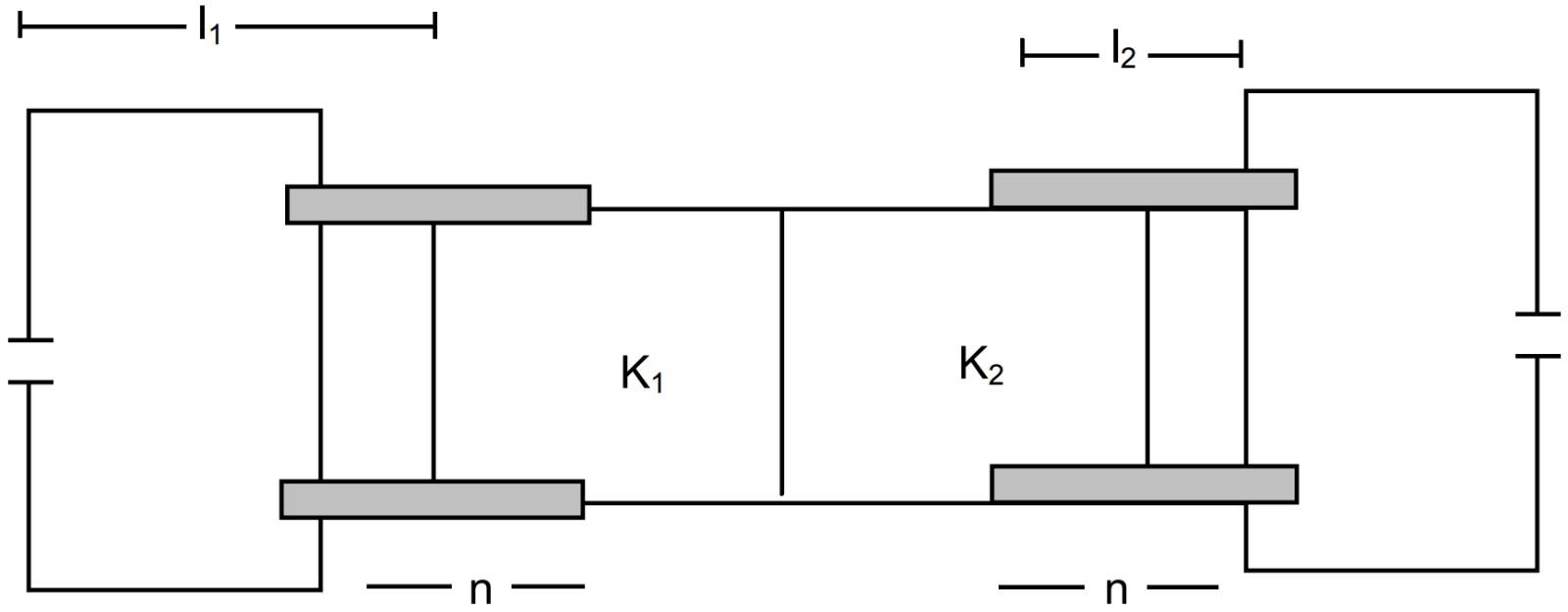
Figure shows two parallel plate capacitors with fixed plates and connected to two batteries. The separation between the plates is the same for the two capacitors. The plates are rectangular in shape with width b and lengths $l_1$ and $l_2$ The left half of the dielectric slab has a dielectric constant $K_1$ and the right half $K_2.$ Neglecting any friction, find the ratio of the emf of the left. battery to that of the right battery for which the dielectric slab may remain in equilibrium.
Answer


Consider the left side
The plate area of the part with the dielectric is by its capacitance $\text{C}_1=\frac{\text{K}_1\in_0\text{bx}}{\text{d}}$ and with out dielectric $\text{C}_2=\frac{\in_0\text{b}(\text{L}_1-\text{x})}{\text{d}}$
These are connected in parallel
$\text{C}=\text{C}_1+\text{C}_2$
$=\frac{\in_0\text{b}}{\text{d}}[\text{L}_1+\text{x}(\text{k}_1-1)]$
Let the potential $V_1$​​​​​​​
$\text{U}=\Big(\frac{1}{2}\Big)\text{CV}_1^2=\frac{\in_0\text{bv}_1^2}{2\text{d}}[\text{L}_1+\text{x}(\text{k}-1)]\ \dots(1)$
Suppose dielectric slab is attracted by electric field and an external force F consider the part dx which makes inside further, As the potential difference remains constant at V.
The charge supply, dq = (dc)v to the capacitor.
The work done by the battery is $dw_b = v.dq = (dc)v^2​​​​​​​$​​​​​​​
The external force F does a work dwe = (–f.dx) during a small displacement.
The total work done in the capacitor is $dw_b + dw_e = (dc)v^2 - fdx$
This should be equal to the increase dv in the stored energy.
Thus $\Big(\frac{1}{2}\Big)(\text{dk})\text{v}^2=(\text{dc})\text{v}^2-\text{fdx}$
$\text{f}=\frac{1}{2}\text{v}^2\frac{\text{dc}}{\text{dx}}$
from equation (1)
$\text{F}=\frac{\in_0\text{bv}^2}{2\text{d}}(\text{k}_1-1)$
$\Rightarrow\text{V}_1^2=\frac{\text{F}\times2\text{d}}{\in_0\text{b}(\text{k}_1-1)}$
$\Rightarrow\text{V}_1=\sqrt{\frac{\text{F}\times2\text{d}}{\in_0\text{b}(\text{k}_1-1)}}$
For the right side, $\text{V}_2=\sqrt{\frac{\text{F}\times2\text{d}}{\in_0\text{b}(\text{k}_2-1)}}$
$\frac{\text{V}_1}{\text{V}_2}=\frac{\sqrt{\frac{\text{F}\times2\text{d}}{\in_0\text{b}(\text{k}_1-1)}}}{\sqrt{\frac{\text{F}\times2\text{d}}{\in_0\text{b}(\text{k}_2-1)}}}$
$\frac{\text{V}_1}{\text{V}_2}=\frac{\sqrt{\text{k}_2-1}}{\sqrt{\text{k}_1-1}}$
$\therefore$ The ratio of the emf of the left battery to the right battery $=\frac{\sqrt{\text{k}_2-1}}{\sqrt{\text{k}_1-1}}$

Need a full question paper?

Generate a complete, print-ready paper with questions like this in minutes — across 16+ boards, with answer keys.

Start Generating Free

Similar questions

A $5.0\mu\text{F}$ capacitor is charged to 12V. The positive plate of this capacitor is now connected to the negative terminal of a 12V battery and vice versa. Calculate the heat developed in the connecting wires.
A long, straight wire carries a current i. Let $B_1$, be the magnetic field at a point Pat a distance d from the wire. Consider a section of length l of this wire such that the point P lies on a perpendicular bisector of the section. Let B2 be the magnetic field at this point due to this section only. Find the value of $\frac{\text{d}}{\text{l}}$ so that $B_2$ differs from $B_$1, by 1%.
How much work has to be done in assembling three charged particles at the vertices of an equilateral triangle as shown in figure?
The 2.0Ω resistor shown in the figure is dipped into a calorimeter containing water. The heat capacity of the calorimeter together with water is $2000JK^{-1}.$
  1. If the circuit is active for 15 minutes, what would be the rise in the temperature of the water?
  2. Suppose the 6.0Ω resistor gets burnt. What would be the rise in the temperature of the water in the next 15 minutes?
Figure shows a plane mirror M placed at a distance of 10cm from a concave lens L. A point object is placed at a distance of 60cm from the lens. The image formed due to refraction by the lens and reflection by the mirror is 30cm behind the mirror. What is the focal length of this lens?
Calculate force pair required to deflect a bar magnet by $\theta^{\circ}$ in a uniform magnetic field and on this basis define magnetic moment and calculate torque at $\theta=0^{\circ}$ and $\theta=90^{\circ}$.###Calculate moment of force acting on a bar magnet which is deflected by an angle in a uniform magnetic field by drawing a diagram and on this basis define magnetic moment and calculate torque at $\theta=0^{\circ}$ and $\theta$ $=90^{\circ}$.
A piano wire A vibrates at a fundamental frequency of 600Hz. A second identical wire B produces 6 beats per second with it when the tension in A is slightly increased. Find the ratio of the tension in A to the tension in B.
A 12pF capacitor is connected to a 50V battery. How much electrostatic energy is stored in the capacitor?
The refractive index of a material $M_1$ changes by 0.014 and that of another material $M_2$ changes by 0.024 as the colour of the light is changed from red to violet. Two thin prisms one made of $M_1(A = 5.3^\circ)$ and other made of $M_2(A = 3.7^\circ)$ are combined with their refracting angles oppositely directed.
  1. Find the angular dispersion produced by the combination.
  2. The prisms are now combined with their refracting angles similarly directed. Find the angular dispersion produced by the combination.
A calorimeter of negligible heat capacity contains 100cc of water at 40°C. The water cools to 35°C in 5 minutes. The water is now replaced by K-oil of equal volume at 40°C. Find the time taken for the temperature to become 35°C under similar conditions. Specific heat capacities of water and K-oil are $4200Jkg^{-1}K^{-1}$ and $2100Jkg^{-1}K^{-1}$ respectively. Density of K-oil $= 800kgm^3.$