Question
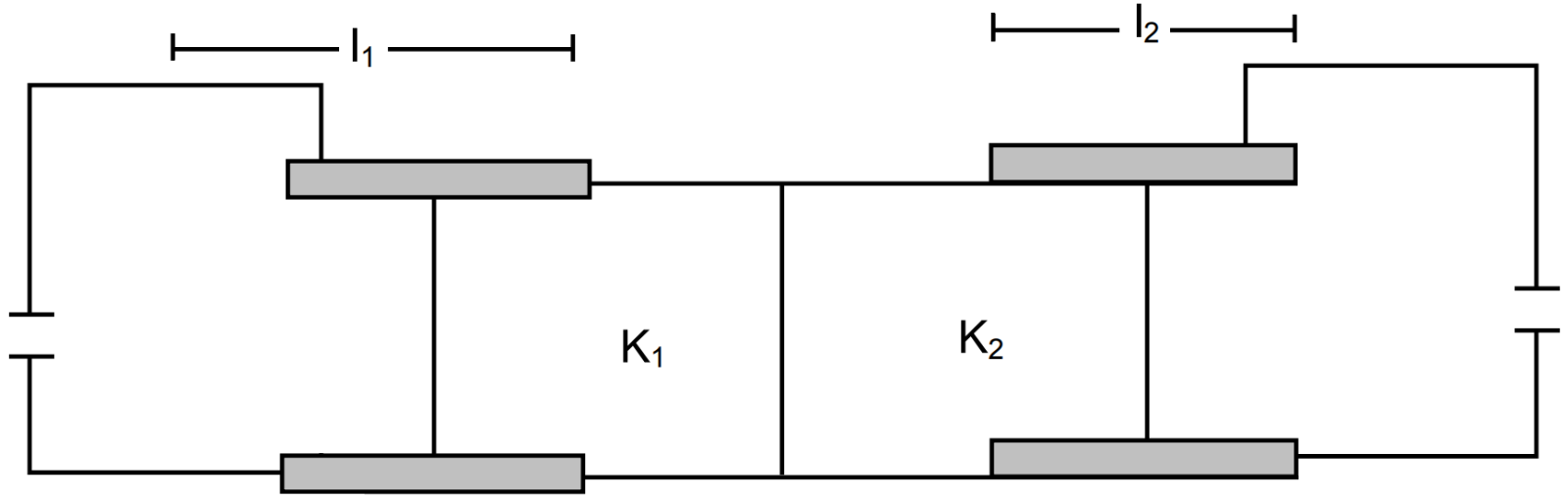
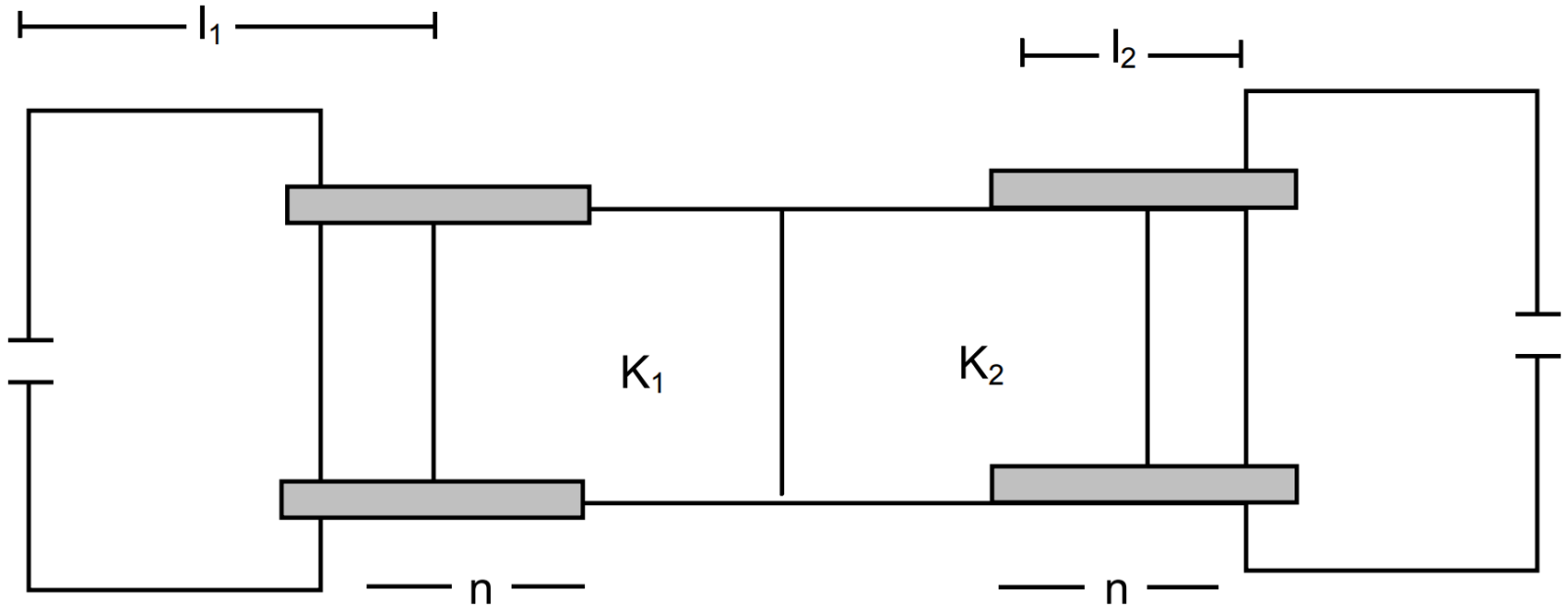
Figure shows two parallel plate capacitors with fixed plates and connected to two batteries. The separation between the plates is the same for the two capacitors. The plates are rectangular in shape with width b and lengths $l_1$ and $l_2$ The left half of the dielectric slab has a dielectric constant $K_1$ and the right half $K_2$. Neglecting any friction, find the ratio of the emf of the left. battery to that of the right battery for which the dielectric slab may remain in equilibrium.
Answer


Consider the left side
The plate area of the part with the dielectric is by its capacitance $\text{C}_1=\frac{\text{K}_1\in_0\text{bx}}{\text{d}}$ and with out dielectric $\text{C}_2=\frac{\in_0\text{b}(\text{L}_1-\text{x})}{\text{d}}$
These are connected in parallel
$\text{C}=\text{C}_1+\text{C}_2$
$=\frac{\in_0\text{b}}{\text{d}}[\text{L}_1+\text{x}(\text{k}_1-1)]$
Let the potential $V_1$
$\text{U}=\Big(\frac{1}{2}\Big)\text{CV}_1^2=\frac{\in_0\text{bv}_1^2}{2\text{d}}[\text{L}_1+\text{x}(\text{k}-1)]\ \dots(1)$
Suppose dielectric slab is attracted by electric field and an external force F consider the part dx which makes inside further, As the potential difference remains constant at V.
The charge supply, dq = (dc)v to the capacitor.
The work done by the battery is $dw_b = v.dq = (dc)v^2$​​​​​​​
The external force F does a work dwe = (–f.dx) during a small displacement.
The total work done in the capacitor is $dw_b + dw_e = (dc)v^2 - fdx$
This should be equal to the increase dv in the stored energy.
Thus $\Big(\frac{1}{2}\Big)(\text{dk})\text{v}^2=(\text{dc})\text{v}^2-\text{fdx}$
$\text{f}=\frac{1}{2}\text{v}^2\frac{\text{dc}}{\text{dx}}$
from equation (1)
$\text{F}=\frac{\in_0\text{bv}^2}{2\text{d}}(\text{k}_1-1)$
$\Rightarrow\text{V}_1^2=\frac{\text{F}\times2\text{d}}{\in_0\text{b}(\text{k}_1-1)}$
$\Rightarrow\text{V}_1=\sqrt{\frac{\text{F}\times2\text{d}}{\in_0\text{b}(\text{k}_1-1)}}$
For the right side, $\text{V}_2=\sqrt{\frac{\text{F}\times2\text{d}}{\in_0\text{b}(\text{k}_2-1)}}$
$\frac{\text{V}_1}{\text{V}_2}=\frac{\sqrt{\frac{\text{F}\times2\text{d}}{\in_0\text{b}(\text{k}_1-1)}}}{\sqrt{\frac{\text{F}\times2\text{d}}{\in_0\text{b}(\text{k}_2-1)}}}$
$\frac{\text{V}_1}{\text{V}_2}=\frac{\sqrt{\text{k}_2-1}}{\sqrt{\text{k}_1-1}}$
$\therefore$ The ratio of the emf of the left battery to the right battery $=\frac{\sqrt{\text{k}_2-1}}{\sqrt{\text{k}_1-1}}$

Need a full question paper?

Generate a complete, print-ready paper with questions like this in minutes — across 16+ boards, with answer keys.

Start Generating Free

Similar questions

The energy of a silver atom with a vacancy in K shell is 25.31keV, in L shell is 3.56keV and in M shell is 0.530keV higher than the energy of the atom with no vacancy. Find the frequency of $\text{K}_\alpha\text{K}_\beta$ and $\text{L}_\alpha$ X-rays of silver.
Consider a thin lens placed between a source (S) and an observer (O) (Fig). Let the thickness of the lens vary as $\text{w}\text{(b)}=\text{w}_0-\frac{\text{b}^2}{\alpha}$, where b is the verticle distance from the pole. $w_0$ is a constant. Using Fermat’s principle i.e. the time of transit for a ray between the source and observer is an extremum, find the condition that all paraxial rays starting from the source will converge at a point O on the axis. Find the focal length.
A U-tube having unequal arm-lengths has water in it. A tuning fork of frequency 440Hz can set up the air in the shorter arm in its fundamental mode of vibration and the same tuning fork can set up the air in the longer arm in its first overtone vibration. Find the length of the air columns. Neglect any end effect and assume that the speed of sound in air = 330m/s.
A small block of mass 200g is kept at the top of a frictionless incline which is 10m long and 3.2m high. How much work was required.
What is magnetic flux. Explain factors on which it depends.
In Fig. the energy stored in $C _4$ is $27 J$ . Calculate the total energy stored in the system.
Image
Calculate the electric field in a copper wire of cross-sectional area $2.0mm^2$ carrying a current of 1A.
The resistivity of copper $=1.7\times10^{-8}\Omega\text{-m}.$
An optical instrument used for angular magnification has a 25D objective and a 20D eyepiece. The tube length is 25cm when the eye is least strained.
  1. Whether it is a microscope or a telescope?
  2. What is the angular magnification produced?
Find the currents through the three reaiators shown in figure.
Consider a particle moving in simple harmonic motion according to the equation $\text{x}=2.0\cos(50\pi\text{t}+\tan^{-1}0.75)$ where x is in centimetre and t in second. The motion is started at $t = 0.$
  1. When does the particle come to rest for the first time?
  2. When does the acceleration have its maximum magnitude for the first time?
  3. When does the particle come to rest for the second time?