Question
Find a cubic polynomial whose zeros are $3, 5$ and $-2$

Answer

Let $\alpha,\ \beta$ and $\gamma$ be the zeros of the required polynomial.
Then we have:
$\alpha+\beta+\gamma$
$=3+5+(-2)=6$
$\alpha\beta+\beta\gamma+\gamma\alpha$
$=3\times5+5\times(-2)+(-2)\times3=-1$
and $\alpha\beta\gamma=3\times5\times-2=-30$
Now, $\text{p}(\text{x})=\text{x}^3-\text{x}^2(\alpha+\beta+\gamma)+\text{x}(\alpha\beta+\beta\gamma+\gamma\alpha)-\alpha\beta\gamma$
$=\text{x}^3-\text{x}^2\times6+\text{x}\times(-1)-(- 30)$
$=\text{x}^3-\text{6x}^2-\text{x}=30$
So, the required polynomial is $p(x)=x^3-6 x^2-x+30$

Need a full question paper?

Generate a complete, print-ready paper with questions like this in minutes — across 16+ boards, with answer keys.

Start Generating Free

Similar questions

The frequency distribution table of more than type is as follows:
Production yield (kg/ha) (lower class limits) Cumulative frequency (cf)
More than 50 2 + 98 = 100
More than 55 8 + 90 = 98
More than 60 12 + 78 = 90
More than 65 24 + 54 = 78
More than 70 38 + 16 = 54
More than 75 16
Taking the lower class limits on x-axis and their respective cumulative frequencies on y-axis, its ogive can be obtained as follows:
The sum of the digits of a two-digit number is 12. The number obtained by interchanging its digits exceeds the given number by 18. Find the number.
Draw the graphs of the following equations on the same graph paper:
2x + y = 2, 2x + y = 6
Find the coordinates of the vertices of the trapezium formed by these lines. Also, find the area of the trapezium so formed.
Hint: The line 2x + y = 2 cuts the x-axis at A(1, 0) and the y-axis at B(0, 2).
The line 2x + y = 6 cuts the x-axis at C(3, 0) and the y-axis at D(0, 6).
Area of trap. ABCD $=\text{ar}(\triangle\text{OCD})-\text{ar}(\triangle\text{OAB})$
$=\Big(\frac{1}{2}\times3\times6\Big)-\Big(\frac{1}{2}\times1\times2\Big)$
$=8\ \text{sq. units}$
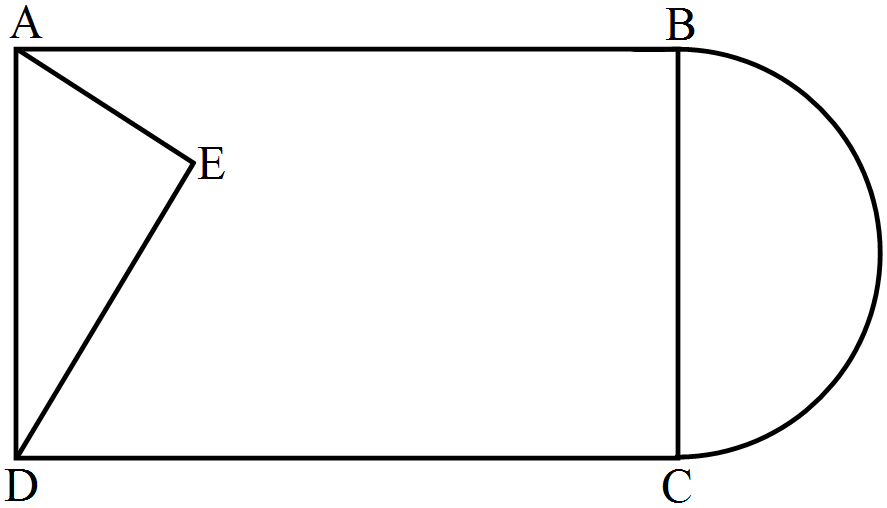
In the given figure, from a rectangular region $ABCD$ with $AB = 20cm$, a right triangle $AED$ with $AE = 9cm$ and $DE = 12cm$, is cut off. On the other end, taking $BC$ as diameter, a semicircle is added on outside the region. Find the area of the shaded region. $\big[\text{Use }\pi=3.14\big]$
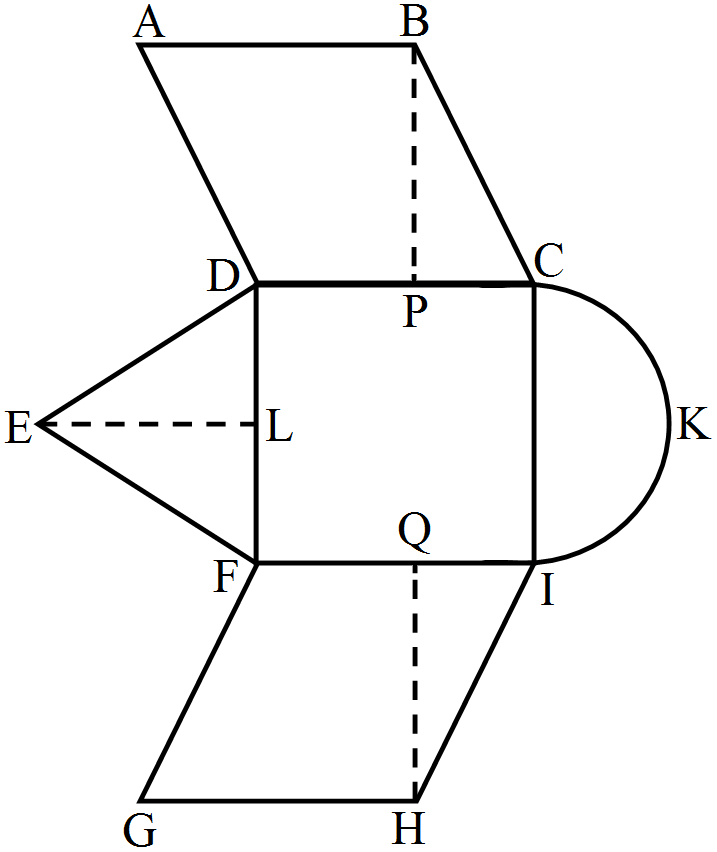
A child draws the figuie of an aeroplane as shown. Here, the wings $ABCD$ and FGHI are parallelograms, the tail $DEF$ is an sosceles triangle, the cockpit $CKI$ is a semicircle and $CDFI$ is a square. In the given figure, $\text{BP}\perp\text{CD},\ \text{HQ}\perp\text{FI}$ and $\text{EL}\perp\text{DF}.$ if $\text{CD}=8\text{cm},\ \text{BP}=\text{HQ}=4\text{cm}$ and $\text{DE}=\text{EF}=5\text{cm},$ find the area of the whole figure. $\big[\text{Take }\pi=3.14\big]$
A right triangle whose sides are 15cm and 20cm (other than hypotenuse), is made to revolve about its hypotenuse. Find the volume and surface area of the double cone so formed. (Choose value of $\pi$ as found appropriate)
Draw a line segment $AB$ of length $7\ cm$. Using ruler and compasses, find a point $P$ on $AB$ such that $\frac{\text{AP}}{\text{AB}}=\frac{3}{5}.$
If $\text{a}\not=\text{b}\not=\text{c},$ prove that $(a, a^2), (b. b^2), (0, 0)$ will not be collinear.
Prove that the points $A(a, 0), B(0, b)$ and $C(1, 1)$ are collinear, if $\frac{1}{\text{a}{}}+\frac{1}{\text{b}}=1.$
Prove that $5\sqrt2$ is an irrational number.