Question
If $\text{a}\not=\text{b}\not=\text{c},$ prove that $(a, a^2), (b. b^2), (0, 0)$ will not be collinear.
Answer

Missing

Need a full question paper?

Generate a complete, print-ready paper with questions like this in minutes — across 16+ boards, with answer keys.

Start Generating Free

Similar questions

Solve for x and y:
$\frac{1}{2(\text{x}+\text{2y)}}+\frac{5}{3(3\text{x}-\text{2y)}}=\frac{-3}{2},$
$\frac{5}{4(\text{x}+\text{2y)}}-\frac{3}{5(3\text{x}-\text{2y)}}=\frac{61}{60}$
Solve each of the following given systems of equations graphically and find the vertices and area of the triangle formed by these lines and the x-axis:
x - y + 1 = 0, 3x + 2y - 12 = 0
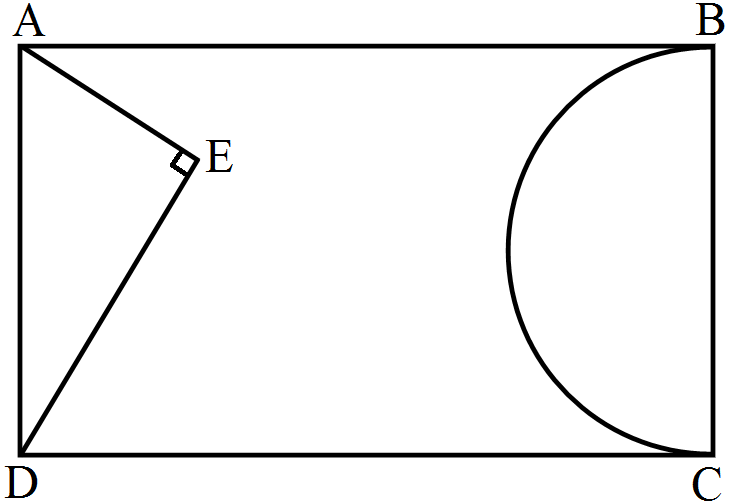
In the given figure, $ABCD$ is a rectangle with $\text{AB}=80\text{cm}$ and $\text{BC}=70\text{cm},$ $\angle\text{AED}=90^\circ$ and $\text{DE}=42\text{cm}$ A semicircle is dn wn, taking BC as diameter. Find the area o the shaded region.
Solve the following system of equations graphically:
2x - 3y + 13 = 0,
3x - 2y + 12 = 0
Solve for x and y:
$\frac{\text{x}-\text{y}-8}{2}=\frac{\text{x}+\text{2y}-14}{3}=\frac{\text{3x}+\text{y}-12}{11}$
Hint: a = b = c ⇒ a = b and b = c.
The $n^{th}$ term of an AP is $(7 - 4n).$ Find its common difference.
Solve the following quadratic equation:
$\Big(\frac{\text{4x}-3}{\text{2x}+1}\Big)-10\Big(\frac{\text{2x}+1}{\text{4x}-3}\Big)=3,$ $\text{x}\neq\frac{-1}{2},\ \frac{3}{4}$
Solve the following quadratic equation:
$3\Big(\frac{\text{3x}-1}{\text{2x}+3}\Big)-2\Big(\frac{\text{2x}+3}{\text{3x}-1}\Big)=5$ $\text{x}\neq\frac{1}{3},\ \frac{-3}{2}$
A sailor goes 8km downstream in 40 minutes and returns in 1 hour. Find the speed of the sailor in still water and the speed of the current.
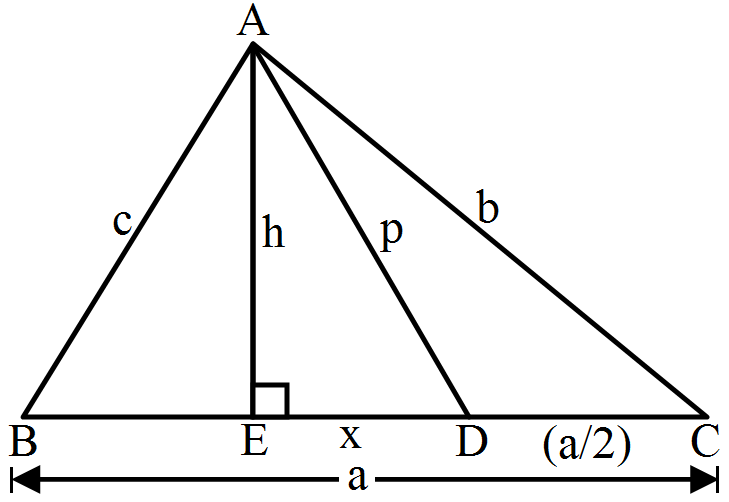
In the given figure, D is the midpoint of side BC and $\text{AE}\perp\text{BC}.$ If BC = a, AC = b, AB = c, ED = x, AD = p and AE = h, prove that.

$\text{b}^2=\text{p}^2+\text{ax}+\frac{\text{a}^2}{4}$