MCQ
Find angle between $\vec A = 3\hat i - \hat j + 4\hat k$ and $Z-$ axis
  • A
    ${\tan ^{ - 1}}\,\left( {\frac{{\sqrt {22} }}{4}} \right)$
  • ${\tan ^{ - 1}}\,\left( {\frac{{\sqrt {10} }}{4}} \right)$
  • C
    ${\sin ^{ - 1}}\,\left( {\frac{{\sqrt {10} }}{4}} \right)$
  • D
    ${\sin ^{ - 1}}\,\left( {\frac{4}{{\sqrt {26} }}} \right)$
Answer

Correct option: B.
${\tan ^{ - 1}}\,\left( {\frac{{\sqrt {10} }}{4}} \right)$
b
$\cos \theta=\frac{\overrightarrow{\mathrm{A}} \cdot \overrightarrow{\mathrm{B}}}{\mathrm{AB}}=\frac{(3 \hat{\mathrm{i}}-\hat{j}+4 \hat{\mathrm{k}}) \cdot(\hat{\mathrm{k}})}{\sqrt{(3)^{2}+(-1)^{2}+(4)^{2}} \sqrt{(1)^{2}}}=\frac{4}{\sqrt{26}}$

Base $=4,$ hypotenuse $=\sqrt{26} \cdot$ perpendicular $=\sqrt{10}$

$\tan \theta=\frac{\sqrt{10}}{4}, \quad \theta=\tan ^{-1}\left(\frac{\sqrt{10}}{4}\right)$

Need a full question paper?

Generate a complete, print-ready paper with questions like this in minutes — across 16+ boards, with answer keys.

Start Generating Free

Similar questions

The tones that are separated by three octaves have a frequency ratio of
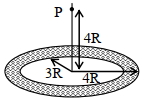
A thin uniform annular disc (see figure) of mass $M$ has outer radius $4 R$ and inner radius $3 R$. The work required to take a unit mass from point $P$ on its axis to infinity is
A body cools from ${60^o}C$ to ${50^o}C$ in $10$ minutes. If the room temperature is ${25^o}C$ and assuming Newton's law of cooling to hold good, the temperature of the body at the end of the next $10$ minutes will be ......... $^oC$
Aball is thrown vertically down with velocity of $5m/s$. With what velocity should another ball be thrown down after $2$ seconds so that it can hit the $1^{st}$ ball in $2$ seconds.........$m/s$
A uniform string oflength $20\ m$ is suspended from a rigid support. A short wave pulse is introduced at its lowest end. It starts moving up the string. The time taken to reach the supports is (take $g= 10 $ $ms^{-2}$ )
Two particles of equal mass $m$ at $A$ and $B$ are connected by a rigid light rod $AB$ lying on a smooth horizontal table. An impulse $J$ is applied at $A$ in the plane of the table and perpendicular at $AB$. Then the velocity of particle at $A$ is:
A semiconducting device is connected in a series circuit with a battery and a resistance. A current is found to pass through the circuit. If the polarity of the battery is reversed, the current drops to almost zero. the device may be:
  1. An intrinsic semiconductor.
  2. A p-type semiconductor.
  3. An n-type semiconductor.
  4. A p-n junction.
The dimensions of surface tension are
A wheel of radius $r$ rolling on a straight line, the velocity of its centre being $v$ .At a certain instant the point of contact of the wheel with the grounds is $M$ and $N$ is the highest point on the wheel (diametrically opposite to $M$). The incorrect statement is:
A 1.00 × 10⁻²⁰kg particle is vibrating with SHM with a period of 1.00 × 10⁻⁵ second, and with maximum velocity 1.00 × 10m/s, then the maximum displacement from mean position is: