Question
Find five rational numbers between$\frac{1}{4}\ \text{and}\ \frac{1}{2}$

Answer

$\frac{1}{4}\text{ and }\frac{1}{2}$ can be represented as $\frac{8}{32}\text{ and }\frac{16}{32}$ respectively.
Therefore, five rational numbers between $\frac{1}{4}\text{ and }\frac{1}{2}$ are,
$\frac{9}{32},\frac{10}{32},\frac{11}{32},\frac{12}{32},\frac{13}{32}$

Need a full question paper?

Generate a complete, print-ready paper with questions like this in minutes — across 16+ boards, with answer keys.
Start Generating Free

Similar questions

Examine the following case study carefully and answer the given questions.
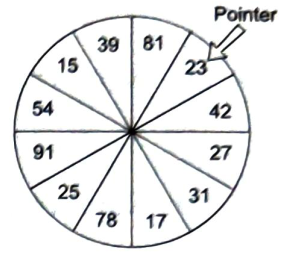
For a game, a fair circular spinner is divided into 12 equal parts are shown in the figure. These sectors are then numbered as shown. The spinner wheel is now ready to be spun during the game.
Image
1. If the wheel is spun once, the probability of getting an odd number is
(a) $\frac{1}{2}$$\quad$ (b) $\frac{1}{3}$$\quad$ (c) $\frac{2}{3}$$\quad$ (d) $\frac{3}{4}$$\quad$
2. The probability of getting a prime number is
(a) $\frac{1}{4}$$\quad$ (b) $\frac{1}{3}$$\quad$ (c) $\frac{5}{12}$$\quad$ (d) $\frac{1}{2}$$\quad$
3.The probability of getting a multiple of 7 is
(a) $\frac{1}{6}$$\quad$ (b) $\frac{1}{4}$$\quad$ (c) $\frac{1}{3}$$\quad$ (d) $\frac{1}{2}$$\quad$
4. The probability of getting a multiple of both 2 and 3 is
(a) $\frac{1}{4}$$\quad$ (b) $\frac{1}{3}$$\quad$ (c) $\frac{5}{12}$$\quad$ (d) $\frac{1}{2}$$\quad$
5. How many of the following events are possible (likely to happen)?
I. Getting an even prime number.
II. Getting an odd composite number.
III. Getting a multiple of both 3 and 5.
IV. Getting a multiple of both 3 and 7.
(a) 1$\quad$ (b) 2$\quad$ (c) 3$\quad$ (d) All of these$\quad$
For each of the following numbers, find the smallest whole number by which it should be divided so as to get a perfect square. Also find the square root of the square number so obtained.$2800$
Find five rational numbers between $\frac{-3}{2}\ \text{and}\ \frac{5}{3}$
Fill in the blanks to make the given statement true. For the point $(5, 2),$ the distance from the x-axis is ______ units.
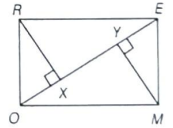
A rectangular MORE is shown below :
Image
Answer the following questions by giving appropriate reason.
(i) Is $R E=O M?$
(ii) Is $\angle MYO =\angle R X E?$
(iii) Is $\angle M O Y=\angle R E X?$
(iv) Is $\triangle M Y O \cong \triangle R X E?$
a, b, c are three different nonzero digits. Using these digits, different numbers are formed.
(1) If $a>b>c$ then the difference of three-digit number $a b c$ and the number obtained by reversing the digits is always divisible by
(a) 9 only$\quad$(b) 11 only$\quad$(c) both 9 and 11$\quad$(d) none of 9 and 11
(2) How many different three-digit numbers can be formed using the given digits it being given that repetition of digits is not allowed?
(a) 3$\quad$(b) 4$\quad$(c) 6$\quad$(d) 9
(3) The sum of all possible three-digit numbers formed above, is always divisible by
(a) 2 only$\quad$(b) 37 only$\quad$(c) 111 only$\quad$(d) each one of 2, 37 and 111
(4) Which of the following is not true?
(a) The number $a a b b$ is divisible by 11$\quad$
(b) The number $a b a b$ is divisible by 101$\quad$
(c) The number $a a b b c c$ is divisible by 11$\quad$
(d) The number $a b c a b c$ is divisible by 101
Find the square root of the following decimal numbers.$7.29$
Draw the front, side and top view of the given shapes.
Write five rational numbers greater then $-2.$
Find the square root of the following decimal numbers.
$2.56$