MCQ
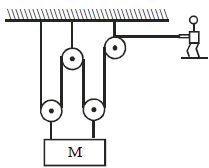
Find Mechanical advantage for pulling mass $M$ by the person
  • A
    $2$
  • $4$
  • C
    $8$
  • D
    $16$

Answer

Correct option: B.
$4$
b
$\mathrm{M.A.}=\frac{\mathrm{Load}}{\varepsilon \mathrm{ffort}}=\frac{\mathrm{Mg}}{\mathrm{T}}$

$\mathrm{Mg}=4 \mathrm{T}$

$\Rightarrow \mathrm{M.} \mathrm{A.}=4$

Need a full question paper?

Generate a complete, print-ready paper with questions like this in minutes — across 16+ boards, with answer keys.
Start Generating Free

Similar questions

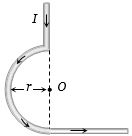
In the figure, what is the magnetic field at the point $O$
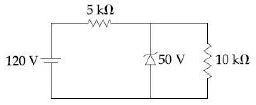
For the circuit shown below, the current through the Zener diode is......$mA$
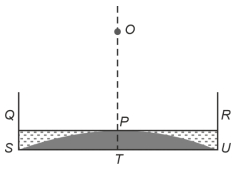
A glass beaker has a solid, plano-convex base of refractive index $1.60$ , as shown in the figure. The radius of curvature of the convex surface ($SPU$) is $9 cm$, while the planar surface ($STU$) acts as a mirror. This beaker is filled with a liquid of refractive index $n$ up to the level $QPR$. If the image of a point object $O$ at a height of $h$ (OT in the figure) is formed onto itself, then, which of the following option($s$) is (are) correct?

$(A)$ For $n=1.42, h=50 \ cm$   $(B)$ For $n=1.35, h=36 \ cm$   $(C)$ For $n=1.45, h=65 \ cm$   $(D)$ For $n=1.48, h=85 \ cm$
Different voltages are applied across a $P-N$ junction and the currents are measured for each value. Which of the following graphs is obtained between voltage and current
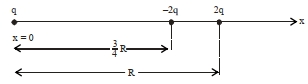
Three point charges $q,-2 q$ and $2 q$ are placed on $x$-axis at a distance $x=0, x=\frac{3}{4} R$ and $x=R$ respectively from origin as shown. If $q =2 \times 10^{-6}\,C$ and $R =2\,cm$, the magnitude of net force experienced by the charge $-2 q$ is .......... $N$
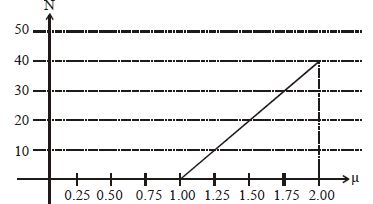
The slits in a double-slit interference experiment are illuminated by orange light $(\lambda  = 600\  nm)$. A thin transparent plastic of thickness $t$ is placed in front of one of the slits. The number of fringes $(N)$ shifting on screen is plotted versus the refractive index $μ$ of the plastic in graph shown. The value of $t$ is
Surface tension of soap solution is $ 2 ×10^{-2} N/m$. The work done in producing a soap bubble of radius $2 \,cm$ is
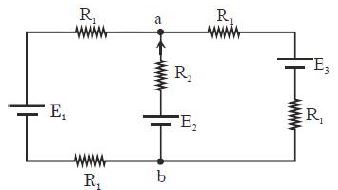
For the circuit shown, with ${R_1} = 1.0\,\Omega $, ${R_2} = 2.0\,\Omega $, ${E_1} = 2\,V$ and ${E_2} = {E_3} = 4\,V$, the potential difference between the points $‘a’$ and $‘b’$ is approximately (in $V$)
Two balls in free space are colliding with each other. Which of the following statement regarding linear momentum conservation of the system is true ?
The initial pressure and volume of an ideal gas are $P_0$ and $V_0$. The final pressure of the gas when the gas is suddenly compressed to volume $\frac{ V _0}{4}$ will be (Given $\gamma=$ ratio of specific heats at constant pressure and at constant volume)