Question
Find out magnetic force on parallel current carrying conductors and also state their special conditions.
Answer

SELF

Need a full question paper?

Generate a complete, print-ready paper with questions like this in minutes — across 16+ boards, with answer keys.

Start Generating Free

Similar questions

A glass surface is coated by an oil film of uniform thickness $1.00 \times 10^{-4}cm.$ The index of refraction of the oil is $1.25$ and that of the glass is $1.50.$ Find the wavelengths of light in the visible region $(400\ nm - 750\ nm)$ which are completely transmitted by the oil film under normal incidence.
Consider the situation of the previous problem. Consider the fastest electron emitted parallel to the large metal plate. Find the displacement of this electron parallel to its initial velocity before it strikes the large metal plate.
Prove that energy remains conserved in electromagnetic induction.
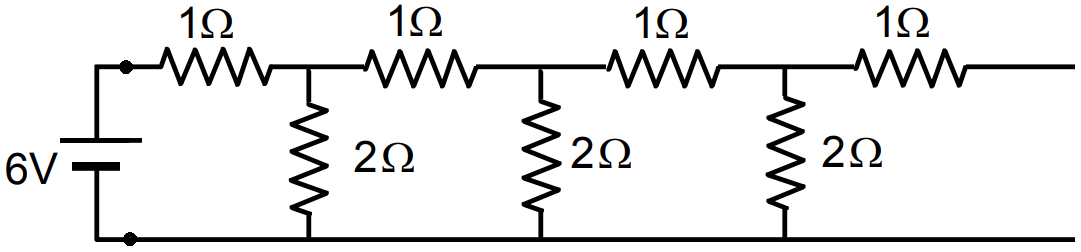
An infinite ladder is constructed with $1\Omega$ and $2\Omega$ resistors, as shown in the figure. (a) Find the effective resistance between the points A and B. (b) Find the current that passes through the $2\Omega$ resistor nearest to the battery.
What is the difference between cathode rays and beta rays? When the two are travelling in space, can you make out which is the cathode ray and which is the beta ray?
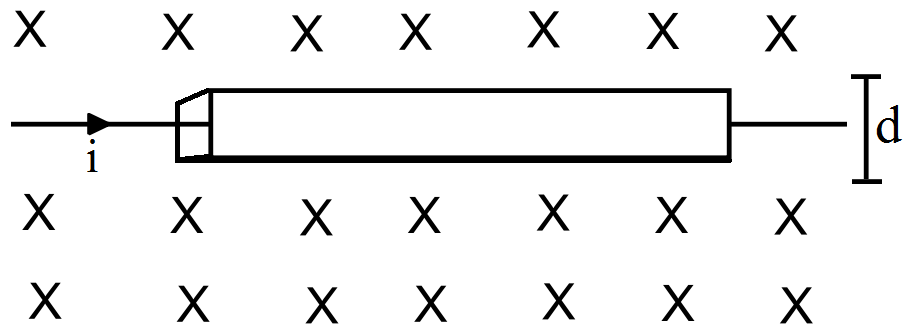
A current i is passed through a silver strip of width d and area of cross-section A. The number of free electrons per unit volume is n.
  1. Find the drift velocity v of the electrons.
  2. If a magnetic field B exists in the region, as shown in the figure, what is the average magnetic force on the free electrons?
  3. Due to the magnetic force, the free electrons get accumulated on one side of the conductor along its length. This produces a transverse electric field in the conductor, which opposes the magnetic force on the electrons. Find the magnitude of the electric field which will stop further accumulation of electrons.
  4. What will be the potential difference developed across the width of the conductor due to the electron-accumulation? The appearance of a transverse emf, when a current-carrying wire is placed in a magnetic field, is called Hall effect.
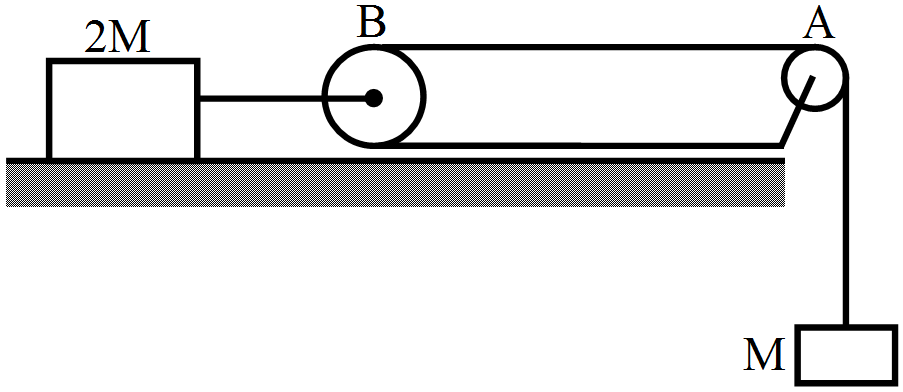
Consider the situation shown in figure. Both the pulleys and the string are light and all the surfaces are frictionless.
  1. Find the acceleration of the mass $M.$
  2. Find the tension in the string.
  3. Calculate the force exerted by the clamp on the pulley $A$ in the figure.
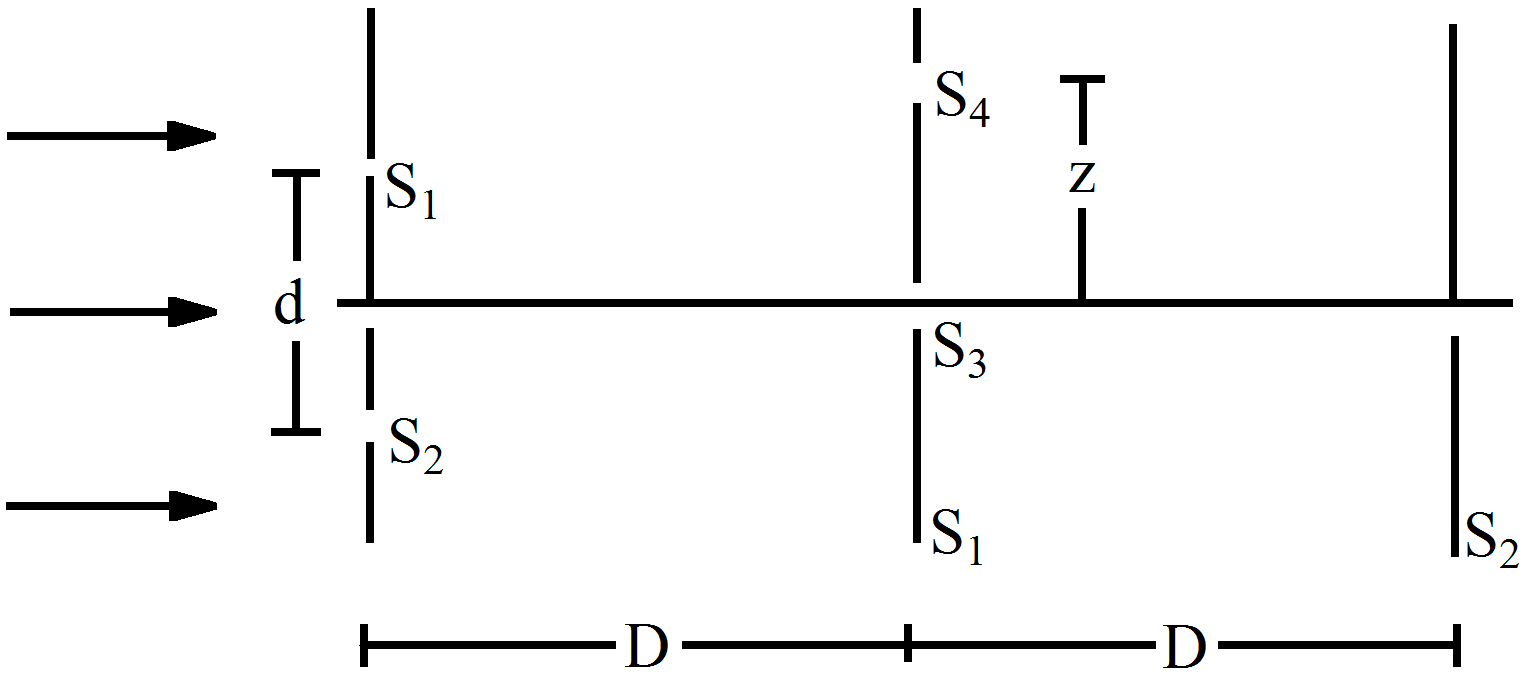
Consider the situation shown in figure $(17-E6).$ The two slits $S_1$ and $S_2$ p laced symmetrically around the central line are illuminated by a monochromatic light of wavelength $\lambda.$ The separation between the slits is $d.$ The light transmitted by the slits falls on a screen $E_1$ placed at a distance $D$ from the slits. The slit $S_3$ is at the central line and the slit $S_4$ is at a distance $z$ from $S_3.$ Another screen $\sum_2$ is placed a further distance $D$ away from $\sum_1$. Find the ratio of the maximum to minimum intensity observed on $\sum_2$, if z is equal to,
  1. $\text{z}=\frac{\lambda\text{D}}{2\text{d}}$
  2. $\frac{\lambda\text{D}}{\text{d}}$
  3. $\frac{\lambda\text{D}}{4\text{d}}$
A cubical metal block of edge 12cm floats in mercury with one fifth of the height inside the mercury. Water is poured till the surface of the block is just immersed in it. Find the height of the water column to be poured. Specific gravity of mercury = 13.6.
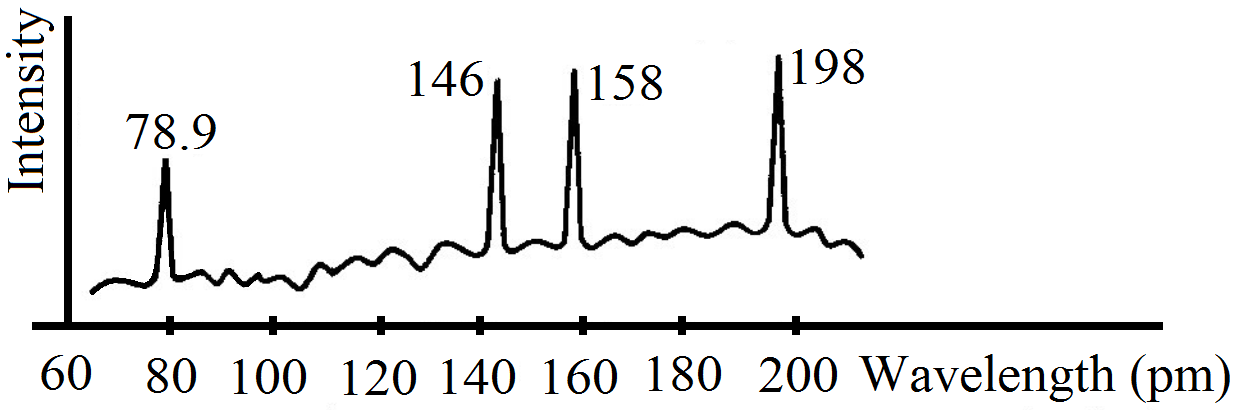
Continuous $X-$rays are made to strike a tissue paper soaked with polluted water. The incoming $X-$rays excite the atoms of the sample by knocking out the electrons from the inner shells. Characteristic $X-$rays are analysed and the intensity is plotted against the wavelength. Assuming that only $\text{K}_\alpha$ intensities are detected, list the elements present in the sample from the plot. Use Moseley's equation $v - (25 \times 10^{14}Hz)(Z - 1)^2.$​​​​​​​