Electromagnetic Induction and Alternating Current — Physics STD 12 — Question
Tamilnadu BoardEnglish MediumSTD 12PhysicsElectromagnetic Induction and Alternating Current5 Marks
Question
Find out the phase relationship between voltage and current in a pure capacitor circuit.
✓
Answer
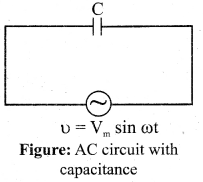
AC circuit containing only a capacitor:
Consider a circuit containing a capacitor of capacitance C connected across an alternating voltage source.
The alternating voltage is given by
$V_m \sin \omega t$......(1)
Let $q$ be the instantaneous charge on the capacitor. The emf across the capacitor at that instant is $\frac{q}{C}$. According to Kirchoff's loop rule,.
$u =\frac{q}{C}=0$
$\Rightarrow C V _{ m } \sin \omega t$
By the definition of current,
$i =\frac{d q}{d t}=\frac{d}{d t} CV _{ m } \frac{d}{d t}(\sin \omega t )$
$= CV _{ m } \sin \omega t$
$\text { or } i =\frac{\frac{ v _m}{1}}{\frac{1}{ C _\omega}} \sin \left(\omega t+\frac{\pi}{2}\right)$
$i = I _{ m } \sin \left(\omega t+\frac{\pi}{2}\right) \ldots . .(2)$
where $\frac{\frac{ v _m}{1}}{\frac{1}{ C _\omega}}=I_{ m }$, the peak value of the alternating current. From equation (1) and (2), it is clear that current leads the applied voltage by $\pi / 2$ in a capacitive circuit. The wave diagram for a capacitive circuit also shows that the current leads the applied voltage by $90^{\circ}$.
Need a full question paper?
Generate a complete, print-ready paper with questions like this in minutes — across 16+ boards, with answer keys.