MCQ
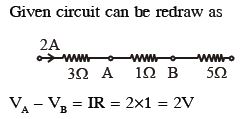
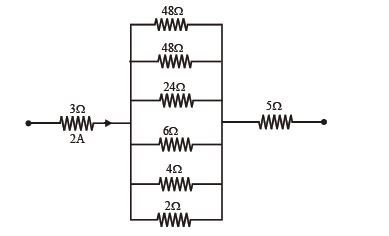
Find potential difference across $24\,\Omega $ ............. $\mathrm{volt}$
  • A
    $48$
  • $2$
  • C
    $4$
  • D
    $1$

Answer

Correct option: B.
$2$
b

Need a full question paper?

Generate a complete, print-ready paper with questions like this in minutes — across 16+ boards, with answer keys.

Start Generating Free

Similar questions

The graph which represents the relation between the total resistance R of a multi range moving coil voltmeter and its full scale deflection V is
Stopping potential for photoelectrons
In steady state heat conduction, the equations that determine the heat current $j ( r )$ [heat flowing per unit time per unit area] and temperature $T( r )$ in space are exactly the same as those governing the electric field $E ( r )$ and electrostatic potential $V( r )$ with the equivalence given in the table below.

Heat flow Electrostatics
$T( r )$ $V( r )$
$j ( r )$ $E ( r )$

We exploit this equivalence to predict the rate $Q$ of total heat flowing by conduction from the surfaces of spheres of varying radii, all maintained at the same temperature. If $\dot{Q} \propto R^{n}$, where $R$ is the radius, then the value of $n$ is
The wave-like character was experimentally proved for light by:
An electron of mass $\mathrm{m}$ and magnitude of charge $|e|$ initially at rest gets accelerated by a constant electric field $\mathrm{E}$. The rate of change of de-Broglie wavelength of this electron at time $t$ ignoring relativistic effects is 
If a current of 3.0 amperes flowing in the primary coil is reduced to zero in 0.001 second, then the induced e.m.f. in the secondary coil is 15000 volts. The mutual inductance between the two coils is
On moving a charge of $20$ coulombs by $2 \;cm , 2 \;J$ of work is done, then the potential difference between the points is (in $volt$)
Plutonium decays with a half-life of $24000 \,years$. If the plutonium is stored for $72000 \,years$, then the fraction of plutonium that remains is
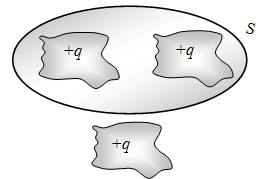
Shown below is a distribution of charges. The flux of electric field due to these charges through the surface S is
In the electrolysis of $\text{NaCl:}$