Question
Find rational numbers a and b such that:
$\frac{\sqrt{3}+\sqrt{2}}{\sqrt{3}-\sqrt{2}}=\text{a}+\text{b}\sqrt{6}$

Answer

$\frac{\sqrt{3}+\sqrt{2}}{\sqrt{3}-\sqrt{2}}=\text{a}+\text{b}\sqrt{6}$
we have,
$\frac{\sqrt{3}+\sqrt{2}}{\sqrt{3}-\sqrt{2}}$
$=\frac{\sqrt{3}+\sqrt{2}}{\sqrt{3}-\sqrt{2}}\times\frac{\sqrt{3}+\sqrt{2}}{\sqrt{3}+\sqrt{2}}$
$=\frac{\big(\sqrt{3}+\sqrt{2}\big)^2}{\big(\sqrt{3}\big)^2-\big(\sqrt{2}\big)^2}$
$=\frac{\big(\sqrt{3}\big)^2+2\times\sqrt{2}\times\sqrt{3}+\big(\sqrt{2}\big)^2}{3-2}$
$=\frac{3+2\sqrt{6}+2}{1}$
$=5+2\sqrt{6}$
Now,
$\frac{\sqrt{3}+\sqrt{2}}{\sqrt{3}-\sqrt{2}}=\text{a}+\text{b}\sqrt{6}$
$\Rightarrow\text{a}=5$ and $\text{b}=2$

Need a full question paper?

Generate a complete, print-ready paper with questions like this in minutes — across 16+ boards, with answer keys.
Start Generating Free

Similar questions

ABC is a Triangle. D is a point on Ab such that $\text{AD}=\frac{1}{4}\text{AD}$ and E is a point on AC such that $\text{AE}=\frac{1}{4}\text{AC.}$ prove that $\text{DE}=\frac{1}{4}\text{BC}.$
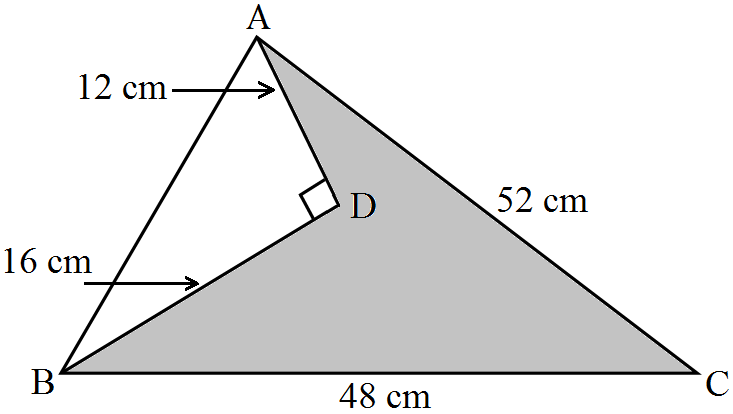
Find the area of the shaded region in fig. below

ABCD is a parallelogram in which BC is produced to E such that CE = BC. AE intersects CD at F.
  1. Prove that $\text{ar}(\triangle\text{ADF})=\text{ar}(\triangle\text{ECF}).$
  2. If the area of $\triangle\text{DFB}=3\text{cm}^2,$ find the area of ||gm ABCD.
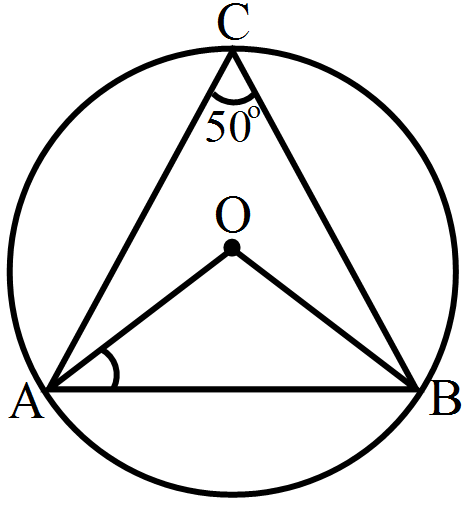
In the given figure, O is the centre of the circle. If $\angle\text{ACB}=50^\circ,$ find $\angle\text{OAB}.$

ABCD is quadrilateral such that AB = AD and CB = CD. Prove that AC is the perpendicular bisector of BD.
Three coins are tossed simultaneously 200 times with the following frequencies of different outcomes:
Outcome
3 heads
2 heads
1 head
No head
Frequency
23
72
77
28
Find the probability of getting at most two heads.
Rationalise the denominator of the following:
$\frac{1}{\sqrt{7}+\sqrt{6}-\sqrt{13}}$
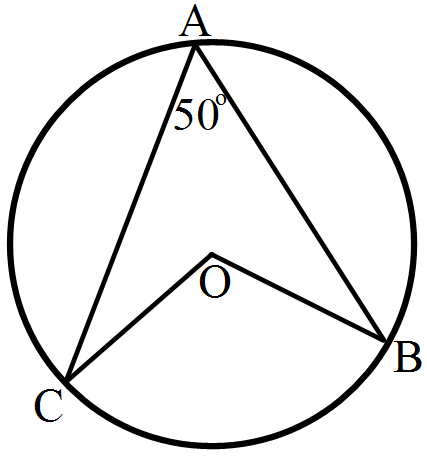
In figure, O is the centre of the circle. If $\angle\text{APB}=50^\circ,$ find $\angle\text{AOB}$ and $\angle\text{OAB}.$
A right angled triangles of which the sides containing the right angle are 6.3cm and 10cm in length, is made to turn round on the longer side. Find the volume of the solid, thus generated. Also, find its curved surface area.
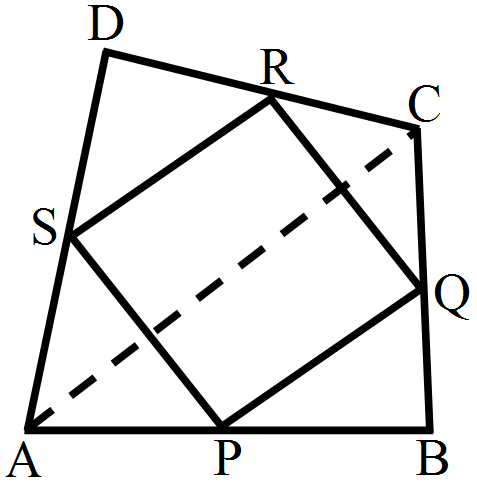
P , Q, R and S are respectively the midpoints of the sides AB, BC, CD and DA of a quadrilateral ABCD. Show that:
  1. PQ || AC and $\text{PQ}=\frac{1}{2}\text{AC}$
  2. PQ || SR
  3. PQRS is a parallelogram.