Question
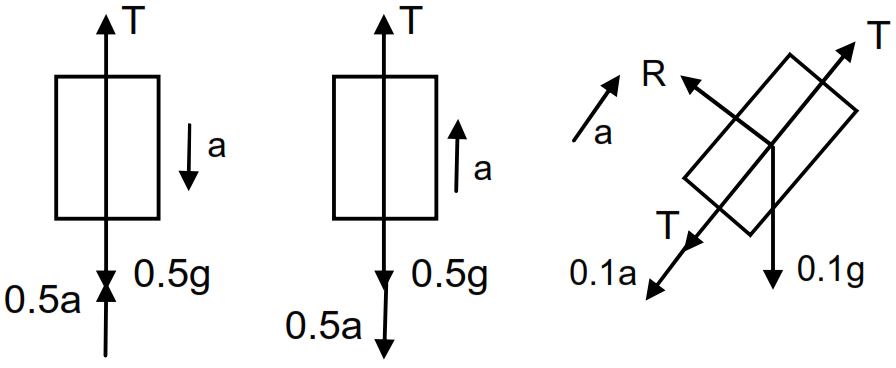
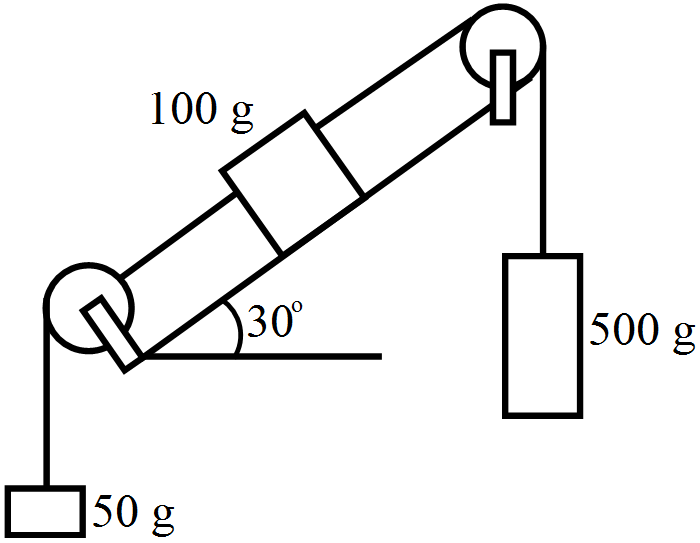
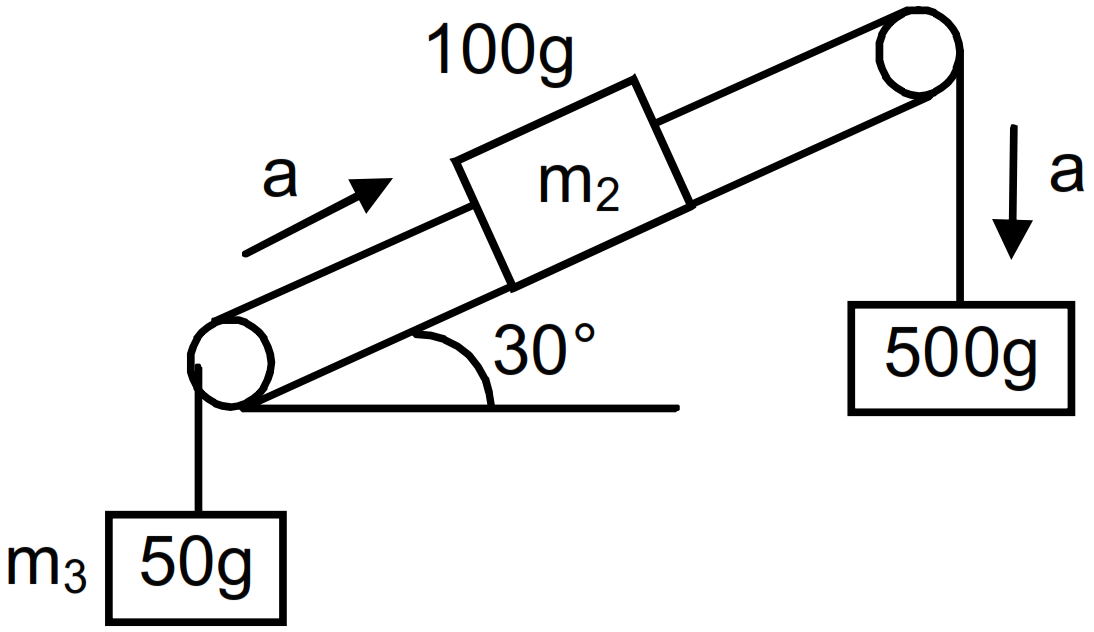
Find the acceleration of the $500g$ block in figure.

Answer


$m_1 = 100g = 0.1\ kg$
$m_2 = 500g = 0.5\ kg$
$m_3 = 50g = 0.05\ kg.$
$T + 0.5a - 0.5g = 0 ...(i)$
$T_1- 0.5a - 0.05g = a ...(ii)$
$T_1 + 0.1a - T + 0.05g = 0 ...(iii)$
From equn $(ii) \ T_1 = 0.05g + 0.05a ...(iv)$
From equn $(i) \ T_1 = 0.5g - 0.5a ...(v)$
Equn $(iii)$ becomes $T_1 + 0.1a - T + 0.05g = 0​​​​​​​$​​​​​​​

$\Rightarrow 0.05g + 0.05a + 0.1a - 0.5g + 0.5a + 0.05g = 0 \ [$From $(iv)$ and $(v)]$
$\Rightarrow0.65\text{a}=0.4\text{g}$
​​​​​​​$\Rightarrow\text{a}=\frac{0.4}{0.65}=\frac{40}{65}\text{g}=\frac{8}{13}\text{g}$ downward
Acceleration of $500gm$ block is $\frac{8\text{g}}{13\text{g}}$ downward

Need a full question paper?

Generate a complete, print-ready paper with questions like this in minutes — across 16+ boards, with answer keys.
Start Generating Free

Similar questions

A magnetic field of $(4.0\times10^{-3}\vec{\text{k}})$ T exerts a force of $(4.0\vec{\text{i}}+3.0\vec{\text{j}})\times10^{-10}$ N on a particle with a charge of $1.0\times10^{-9}\text{C}$ and going in the x−y plane. Find the velocity of the particle.
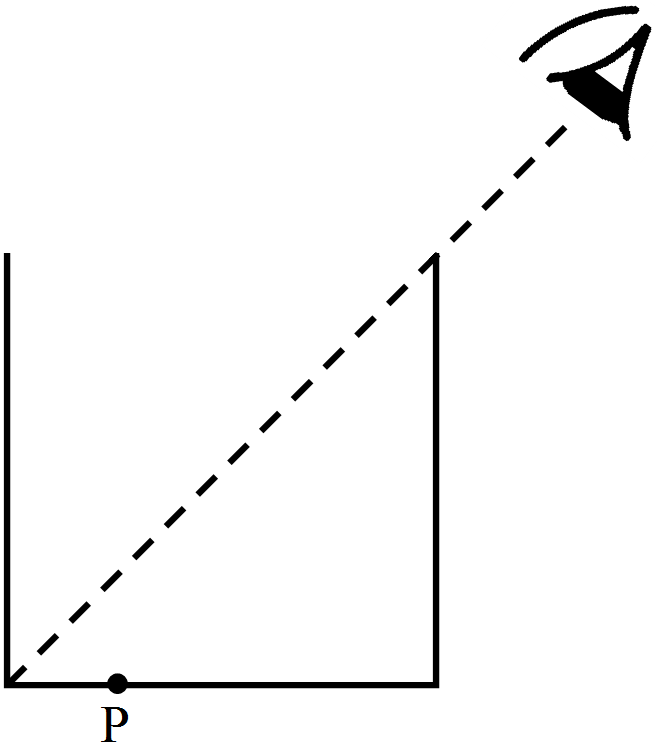
A cylindrical vessel, whose diameter and height both are equal to 30cm, is placed on a horizontal surface and a small particle P is placed in it at a distance of 5.0cm from the centre. An eye is placed at a position such that the edge of the bottom is just visible. The particle P is in the plane of drawing. Up to what minimum height should water be poured in the vessel to make the particle P visible?
A motorcycle has to move with a constant speed on an overbridge which is in the form of a circular arc of radius R and has a total length L. Suppose the motorcycle starts from the highest point.
  1. What can its maximum velocity be for which the contact with the road is not broken at the highest point?
  2. If the motorcycle goes at speed $\frac{1}{\sqrt2}$ times the maximum found in part (a), where will it lose the contact with the road?
  3. What maximum uniform speed can it maintain on the bridge if it does not lose contact anywhere on the bridge?
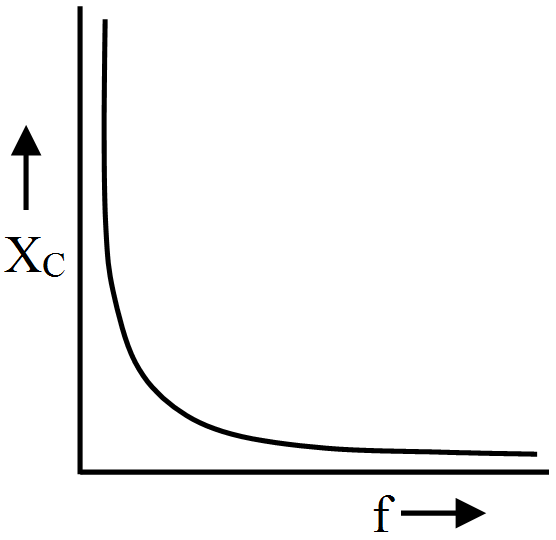
Define the term capacitive reactance. Show graphically the variation of capacitive reactance with frequency of applied alternating voltage. An ac voltage $\text{V = V}_0\sin\omega\text{t}$ is applied across a pure capacitor of capacitance $C.$ Find an expression for current flowing through it. Show mathematically the current flowing through it leads the applied voltage by angle $\frac{\pi}{2}.$
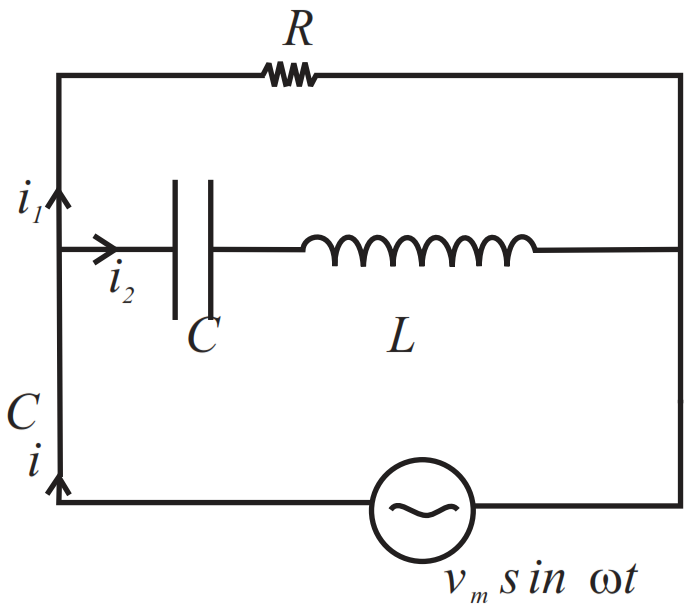
Consider the $\text{LCR}$ circuit shown in Fig. Find the net current $i$ and the phase of $i$. Show that . Find the impedence $Z$ for this circuit.
The volume of an ideal gas $(\gamma=1.5)$ is changed adiabatically from $4.00$ litres to $3.00$ litres. Find the ratio of,
  1. The final pressure to the initial pressure.
  2. The final temperature to the initial temperature.
Two spherical bodies, each of mass 50kg, are placed at a separation of 20cm. Equal charges are placed on the bodies and it is found that the force of Coulomb repulsion equals the gravitational attraction in magnitude. Find the magnitude of the charge placed on either body.
  1. For what kinetic energy of a neutron will the associated de Broglie wavelength be $1.40 \times 10^{–10} m$?
  2. Also find the de Broglie wavelength of a neutron, in thermal equilibrium with matter, having an average kinetic energy of $(3/2) kT at 300 K.$
Draw the complete I-V characteristic curve for an ideal P-N junction diode. Define the dynamic resistance in the forward bias state.
Establish the formula for the equivalent focal length of the combination of two thin lenses placed in contact.