A hoop of radius $2m$ weighs $100kg$. It rolls along a horizontal floor so that its centre of mass has a speed of $20cm/s$. How much work has to be done to stop it?
Exercise
Download our app for free and get started
Radius of the hoop, r = 2m Mass of the hoop, m = 100kg Velocity of the hoop, v = 20cm/s = 0.2m/s Total energy of the hoop = Translational KE + Rotational KE $\text{E}_{\text{r}}=\frac{1}{2}\text{mv}^{2}+\frac{1}{2}\text{I}\omega^2$ Moment of inertia of the hoop about its centre, $I = mr^2 \text{E}_{\text{r}}=\frac{1}{2}\text{mv}^{2}+\frac{1}{2}\text{mr}^2\omega^2$ But we have the relation, $\text{v}=\text{r}\omega$
$\therefore\ \text{E}_{\text{r}}=\frac{1}{2}\text{mv}^{2}+\frac{1}{2}\text{mr}^2\omega^2$
$\therefore\ \text{E}_{\text{r}}=\frac{1}{2}\text{mv}^{2}+\frac{1}{2}\text{mv}^2$
$\therefore\ \text{E}_{\text{r}}=\text{mv}^2$ The work required to be done for stopping the hoop is equal to the total energy of the hoop. $\therefore$ Required work to be done, $W = mv^2 = 100 \times (0.2)^2 = 4J$
$\therefore\ \text{E}_{\text{r}}=\frac{1}{2}\text{mv}^{2}+\frac{1}{2}\text{mr}^2\omega^2$
$\therefore\ \text{E}_{\text{r}}=\frac{1}{2}\text{mv}^{2}+\frac{1}{2}\text{mv}^2$
$\therefore\ \text{E}_{\text{r}}=\text{mv}^2$ The work required to be done for stopping the hoop is equal to the total energy of the hoop. $\therefore$ Required work to be done, $W = mv^2 = 100 \times (0.2)^2 = 4J$

Download our appand get started for free
Experience the future of education. Simply download our apps or reach out to us for more information. Let's shape the future of learning together!No signup needed.*
Similar Questions
- 1A uniform sphere of mass m and radius R is placed on a rough horizontal surface. The sphere is struck horizontally at a height h from the floor. Match the following:View Solution
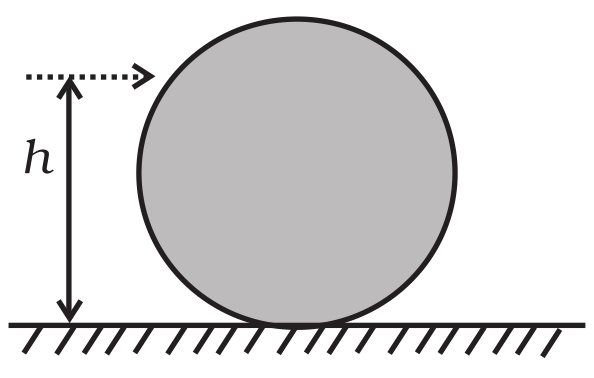
a. $\text{h}=\frac{\text{R}}{2}$ i. Sphere rolls without slipping with a constant velocity and no loss of energy. b. $\text{h}=\text{R}$ ii. Sphere spins clockwise, loses energy by friction. c. $\text{h}=\frac{3\text{R}}{2}$ iii. Sphere spins anti-clockwise, loses energy by friction. d. $\text{h}=\frac{7\text{R}}{5}$ iv. Sphere has only a translational motion, looses energy by friction. - 2Prove the result that the velocity v of translation of a rolling body (like a ring, disc, cylinder or sphere) at the bottom of an inclined plane of a height h is given by $\text{v}^2=\frac{2\text{gh}}{\Big(\frac{1+\text{k}^2}{\text{R}^2}\Big)}$ using dynamical consideration (i.e. by consideration of forces and torques).View Solution
Note: k is the radius of gyration of the body about its symmetry axis, and R is the radius of the body. The body starts from rest at the top of the plane. - 3View SolutionEstablish the relationship between Torque and Moment of Inertia.
- 4View SolutionA solid sphere rolls down two different inclined planes of the same heights but different angles of inclination.
- Will it reach the bottom with the same speed in each case?
- Will it take longer to roll down one plane than the other?
- If so, which one and why?
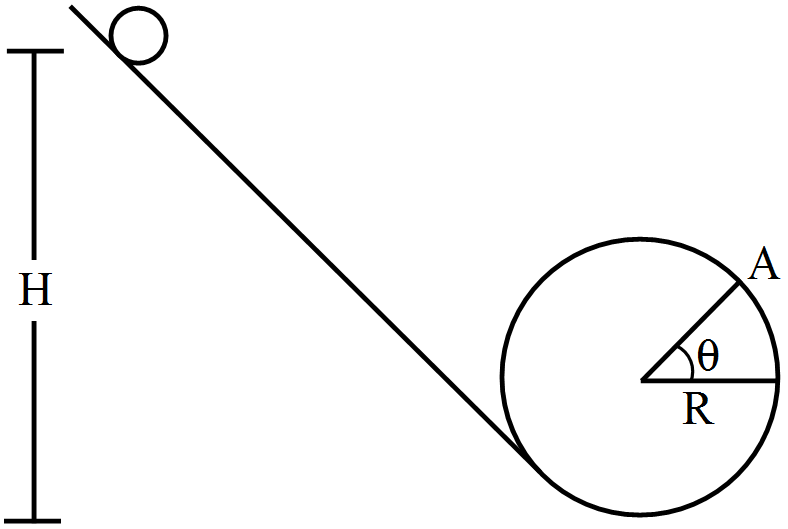
- 5Figure shows a small spherical ball of mass m rolling down the loop track. The ball is released on the linear portion at a vertical height H from the lowest point. The circular part shown has a radius R.View Solution
- Find the kinetic energy of the ball when it is at a point A where the radius makes an angle $\theta$ with the horizontal.
- Find the radial and the tangential accelerations of the centre when the ball is at A.
- Find the normal force and the frictional force acting on the ball if H = 60cm, R = 10cm, $\theta=0 $ and m = 70g.
- 6A solid disc and a ring, both of radius $10cm$ are placed on a horizontal table simultaneously, with initial angular speed equal to 10 π rad $s^{-1}$. Which of the two will start to roll earlier? The co-efficient of kinetic friction is $\mu_\text{k}=0.2$View Solution
- 7View SolutionA ball is whirled in a circle by attaching it to a fixed point with a string. Is there an angular rotation of the ball about its centre? If yes, is this angular velocity equal to the angular velocity of the ball about the fixed point?
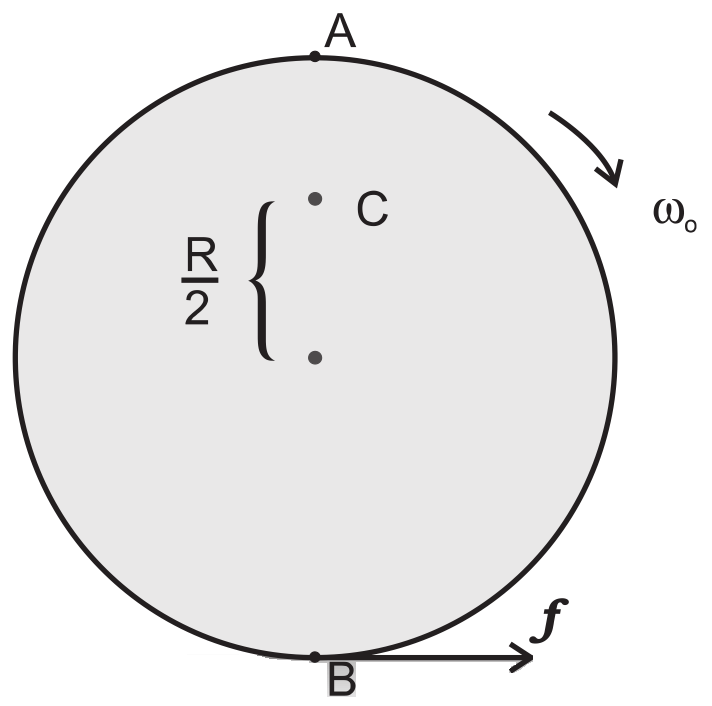
- 8A disc rotating about its axis with angular speed $\omega_0$ is placed lightly (without any translational push) on a perfectly frictionless table. The radius of the disc is R. What are the linear velocities of the points A, B and C on the disc shown in will the disc roll in the direction indicated?View Solution
- 9The angular speed of a motor wheel is increased from $1200$ rpm to $3120$ rpm in $16$ seconds. $(i)$ What is its angular acceleration, assuming the acceleration to be uniform? $(ii)$ How many revolutions does the engine make during this time?View Solution
- 10View SolutionA metal bar 70 cm long and 4.00 kg in mass supported on two knifeedges placed 10 cm from each end. A 6.00 kg load is suspended at 30 cm from one end. Find the reactions at the knife-edges. (Assume the bar to be of uniform cross section and homogeneous.)