Question
Find the angle between the pair of lines given by $\vec r = 3\hat i + 2\hat j - 4\hat k + \lambda (\hat i + 2\hat j + 2\hat k)$ and $\vec r = 5\hat i - 2\hat j + \mu (3\hat i + 2\hat j + 6\hat k)$

Answer

Given that, ${\vec b_1} = \hat i + 2\hat j + 2\hat k$
${\vec b_2} = 3\hat i + 2\hat j + 6\hat k$
$\cos \theta = \left| {\frac{{{{\vec b}_1}.{{\vec b}_2}}}{{\left| {{{\vec b}_1}} \right|\left| {{{\vec b}_2}} \right|}}} \right| = \frac{{19}}{{21}}$
$=\left| \frac{(\hat i +2\hat j+2\hat k).(3\hat i+2\hat j+6\hat k)}{\sqrt{1+4+4}\sqrt{9+4+36}}\right|$
$ =\frac{{3+4+12}}{3×7}$
$=\frac{19}{21}$
$\therefore \theta=cos^{-1}\frac{19}{21}$

Need a full question paper?

Generate a complete, print-ready paper with questions like this in minutes — across 16+ boards, with answer keys.
Start Generating Free

Similar questions

Show that the relation R in R defined as R = {(a, b) : a $\leq$ b}, is reflexive and transitive but not symmetric.
Evaluate the following integrals:$\int\text{e}^{\text{}x}\Big(\frac{1+\sin\text{x}}{1+\cos\text{x}}\Big)\text{dx}$
Find a vector of magnitude 5 units and parallel to the resultant of the vectors $\vec a = 2\hat i + 3\hat j - \hat k$ and $\vec b = \hat i - 2\hat j + \hat k$
Let $\vec{\text{a}}=5\hat{\text{i}}-\hat{\text{j}}+7\hat{\text{k}}$ and $\vec{\text{b}}=\hat{\text{i}}-\hat{\text{j}}+\lambda\hat{\text{k}}.$ Find $\lambda$ such that $\vec{\text{a}}+\vec{\text{b}}$ is orthonal to $\vec{\text{a}}-\vec{\text{b}}.$
Let * be a binary operation on Q - {-1} defined by a * b = a + b + ab for all a, b ∈ Q - {-1}. Then,
Show that every element of Q − {−1} is invertible. Also, find the inverse of an arbitrary element.
Prove that the given vectors are coplanar:
$2\hat{\text{i}}-\hat{\text{j}}+\hat{\text{k}},\ \hat{\text{i}}-3\hat{\text{j}}-5\hat{\text{k}}$ and $3\hat{\text{i}}-4\hat{\text{j}}-4\hat{\text{k}}$
Evaluate the following integrals:
$\int\limits^{{\pi}}_0\cos^5\text{x dx}$
If $\text{A}=\begin{bmatrix}2 & 3 \\ 5 & -2 \end{bmatrix}$ be sech that $A^{-1} = kA,$ then find the value of $k.$
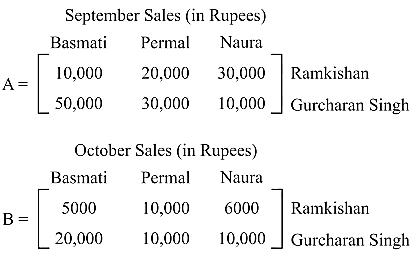
Two farmers Ramkishan and Gurcharan Singh cultivates only three varieties of rice namely Basmati, Permal and Naura. The sale (in Rupees) of these varieties of rice by both the farmers in the month of September and October are given by the following matrices A and B.

  1. Find the combined sales in September and October for each farmer in each variety.
  2. Find the decrease in sales from September to October.
  3. If both farmers receive 2% profit on gross sales, compute the profit for each farmer and for each variety sold in October.
The mathematics department has 8 graduate assistants who are assigned to the same office. Each assistant is just as likely to study at home as in office. How many desks must there be in the office so that each assistant has a desk at least 90% of the time?