Question
Find the area enclosed by the circle x2 + y2 = a2

Answer

The equation of circle is x2 + y2 = a2 .... (i)
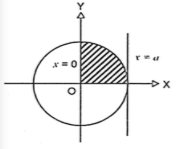
Its centre is origin and radius a. We know that circle x+ y2 = a2 is symmetrical about both axes.
$\therefore$ required area = $4 \int \limits_{0}^{2} y d x=4 \int \limits_{0}^{2} \sqrt{a^{2}-x^{2}} d x$
$=4\left[\frac{x \sqrt{a^{2}-x^{2}}}{2}+\frac{a^{2}}{2} \sin ^{-1} \frac{x}{a}\right]_{0}^{a}$
$=4\left[\left(0+\frac{\mathrm{a}^{2}}{2} \sin ^{-1} 1\right)-\left(0+\frac{\mathrm{a}^{2}}{2} \sin ^{-1} 0\right)\right]$
$=4\left[\left(0+\frac{a^{2}}{2} \sin ^{-1} 1\right)-\left(0+\frac{a^{2}}{2} \sin ^{-1} 0\right)\right]$
$=4\left[\frac{a^{2}}{2} \times \frac{\pi}{2}\right]$ $\left[\because \sin ^{-1} 0=0\right]$
$=\pi a$
Need a full question paper?

Generate a complete, print-ready paper with questions like this in minutes — across 16+ boards, with answer keys.

Start Generating Free

Similar questions

Write the projection of $\vec{\text{b}}+\vec{\text{c}}$ on $\vec{\text{a}}$ when $\vec{\text{a}}=2\hat{\text{i}}-2\hat{\text{j}}+\hat{\text{k}},\vec{\text{b}}=\hat{\text{i}}+2\hat{\text{j}}-2\hat{\text{k}}$ and $\vec{\text{c}}=2\hat{\text{i}}-\hat{\text{j}}+4\hat{\text{k}}.$
Solve for x:

2 tan-1(cos x) = tan-1 (2 cosec x).

Show that the line through the points (4, 7, 8) and (2, 3, 4) is parallel to the line through the points (-1, -2, 1) and, (1, 2, 5).
Find the area of the triangle with vertices at the points:
(2, 7), (1, 1) and (10, 8)
Find the cartesian equation of the line which passes through the point (-2, 4, -5) and parallel to the line given by $\frac{\text{x}+3}{3}=\frac{\text{y}-4}{5}=\frac{\text{z}+8}{6}.$
Find the value of $\lambda$ so that the following vectors are coplanar:
$\vec{\text{a}}=2\hat{\text{i}}-\hat{\text{j}}++\hat{\text{k}},\vec{\text{b}}=\hat{\text{i}}+2\hat{\text{j}}-3\hat{\text{k}},\vec{\text{c}}=\lambda\hat{\text{i}}+\lambda\hat{\text{j}}+5\hat{\text{k}}$
A function f(x) is defined as, $​​​​​​​​​​\text{f}\text{(x)}=\begin{cases}\frac{\text{x}^2-9}{\text{x}-3},&\text{if }\text{x}\neq3\\6,&\text{if }\text{ x}=3\end{cases}$ show that f(x) is continuous that x = 3
If $\text{A}=\begin{bmatrix}1&2\\4&1\end{bmatrix},$ then find A2 + 2A + 7I.
Using determinants, find the equation of the line joining the points:
(1, 2) and (3, 6)
Evaluate the following integrals:
$\int\text{x e}^{\text{x}^2}=\text{dx}$