Question types

Application of Integrals question types

58 questions across 7 question groups — pick any mix to generate a Maths paper with step-by-step answer keys.

58
Questions
7
Question groups
5
Question types
Sample Questions

Application of Integrals questions

One sample from each question group in this chapter. Select any group above to see the full set with answer keys.
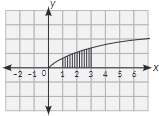
Shown below is the curve defined by the equation $y=\log (x+1)$ for $x \geq 0$.
Image
Which of these is the area of the shaded region?
  • $6 \log (2)-2$
  • B
    $6 \log (2)-6$
  • C
    $6 \log (2)$
  • D
    $5 \log (2)$

Answer: A.

View full solution
The area enclosed by the curve $\frac{x^2}{25}+\frac{y^2}{9}=1$ is
  • A
    $10 \pi$ sq. units
  • $15 \pi$ sq. units
  • C
    $5 \pi$ sq. units
  • D
    $4 \pi$ sq. units

Answer: B.

View full solution
Area of the ellipse $\frac{x^2}{a^2}+\frac{y^2}{b^2}=1$ is
  • A
    $4 \pi a b$ sq. units
  • B
    $2 \pi a b$ sq. units
  • $\pi a b$ sq. units
  • D
    $\frac{\pi a b}{2}$ sq. units

Answer: C.

View full solution
The area $S$ is bounded by the curve $y=x^2+4 x+5$, the axes of coordinates and minimum ordinate. Which of these is the value of $S$ ?
  • A
    $3 \frac{2}{3}$ sq. units
  • $4 \frac{2}{3}$ sq. units
  • C
    $5 \frac{2}{3}$ sq. units
  • D
    $6 \frac{2}{3}$ sq. units

Answer: B.

View full solution
Assertion (A) : The area bounded by the curve $y=2 \cos x$ and the $x$-axis from $x=0$ to $x=2 \pi$ is 8 sq. units.
Reason (R) : Maximum value of the curve $y=2 \cos x$ is 2 .
  • A
    Both (A) and (R) are true and (R) is the correct explanation of (A).
  • Both (A) and (R) are true but (R) is not the correct explanation of (A).
  • C
    (A) is true but (R) is false.
  • D
    (A) is false but (R) is true.

Answer: B.

View full solution
Assertion (A): The area bounded by the parabola $y^2=4 a x$ and the line $x=a$ and $x=4 a$ is $\frac{56 a^2}{3}$ sq. units.
Reason (R) : The area bounded by the parabola $y^2=49 x$ and $y=m x$ is $8 a^2 / 3 m^3$ sq. units.
  • A
    Both (A) and (R) are true and (R) is the correct explanation of (A).
  • B
    Both (A) and (R) are true but (R) is not the correct explanation of (A).
  • (A) is true but (R) is false.
  • D
    (A) is false but (R) is true.

Answer: C.

View full solution
Assertion (A): The area bounded by the curves $y^2=4 a^2(x-1)$ and lines $x=1$ and $y=4 a$ is $\frac{8 a}{3}$ sq. units.
Reason (R) : The area enclosed between the parabola $y^2=49 x$ and its latus rectum $\frac{8 a^2}{3}$ sq. units.
  • A
    Both (A) and (R) are true and (R) is the correct explanation of (A).
  • Both (A) and (R) are true but (R) is not the correct explanation of (A).
  • C
    (A) is true but (R) is false.
  • D
    (A) is false but (R) is true.

Answer: B.

View full solution
Assertion (A) : The area of the smaller region bounded by the ellipse $\frac{x^2}{9}+\frac{y^2}{4}=1$ and the line $\frac{x}{3}+\frac{y}{2}=1$ is $\frac{3}{2}(\pi-2)$ sq. units.
Reason (R) : Formula to calculate the area of the smaller region bounded by the ellipse $\frac{x^2}{a^2}+\frac{y^2}{b^2}=1$ and the line $\frac{x}{a}+\frac{y}{b}=1$ is $\frac{a b}{4}(\pi-2)$ sq. units.
  • Both (A) and (R) are true and (R) is the correct explanation of (A).
  • B
    Both (A) and (R) are true but (R) is not the correct explanation of (A).
  • C
    (A) is true but (R) is false.
  • D
    (A) is false but (R) is true.

Answer: A.

View full solution
Assertion (A) : The area of the region bounded by the curve $y^2=4 x$ and the line $x=3$ is $8 \sqrt{3}$ sq. units.
Reason (R): The area is symmetric about $x$ and $y$ axes.
  • A
    Both (A) and (R) are true and (R) is the correct explanation of (A).
  • B
    Both (A) and (R) are true but (R) is not the correct explanation of (A).
  • (A) is true but (R) is false.
  • D
    (A) is false but (R) is true.

Answer: C.

View full solution
Q 172 Marks2 Marks
Find the area of the region bounded by the line y = 3x + 2, the x-axis and the ordinates x = - 1 and x = 1
View full solution
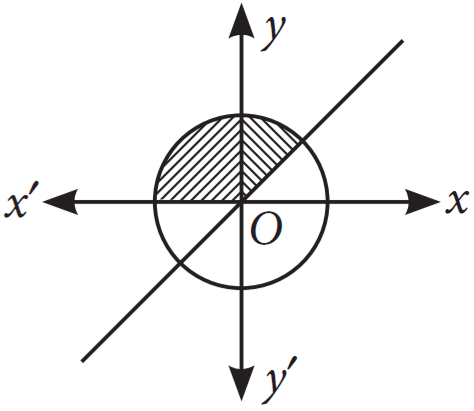
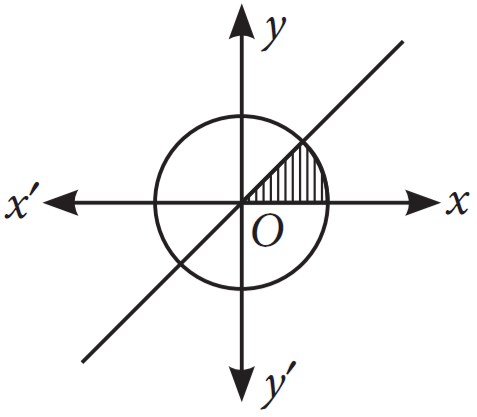
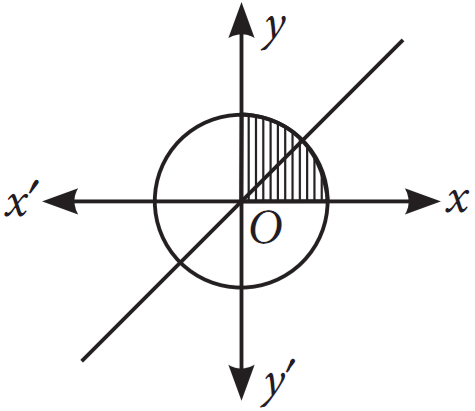
Consider the curve x2 + y2 = 16 and line y = x in the first quadrant.
Based on the above information, answer the following questions.
  1. Point of intersection of both the given curves is.
  1. $(0, 4)$
  2. $(0, 2\sqrt{2})$
  3. $(2\sqrt{ 2},2\sqrt{2})$
  4. $(2,\sqrt{2},4)$
  1. Which of the following shaded portion represent the area bounded by given two curves?
  1. None of these
  1. The value of the integral $\int\limits_{0}^{2\sqrt{2}}\text{x}\text{dx}$ is.
  1. 0
  2. 1
  3. 2
  4. 4
  1. The value of the integral $\int\limits_{2\sqrt{2}}^{0}\sqrt{16-\text{x}^2}\text{ dx}$ is.
  1. $2(\pi-2)$
  2. $2(\pi-8)$
  3. $4(\pi-2)$
  4. $4(\pi+2)$
  1. Area bounded by the two given curves is.
  1. $3\pi\text{ sq.units}$
  2. $\frac{\pi}{2}\text{ sq.units}$
  3. $\pi\text{ sq.units}$
  4. $2\pi\text{ sq.units}$
View full solution
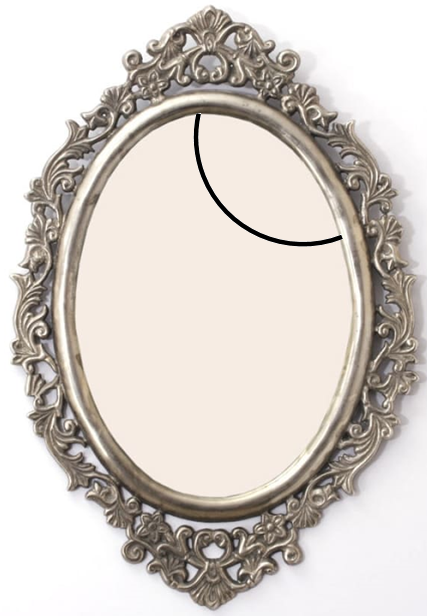
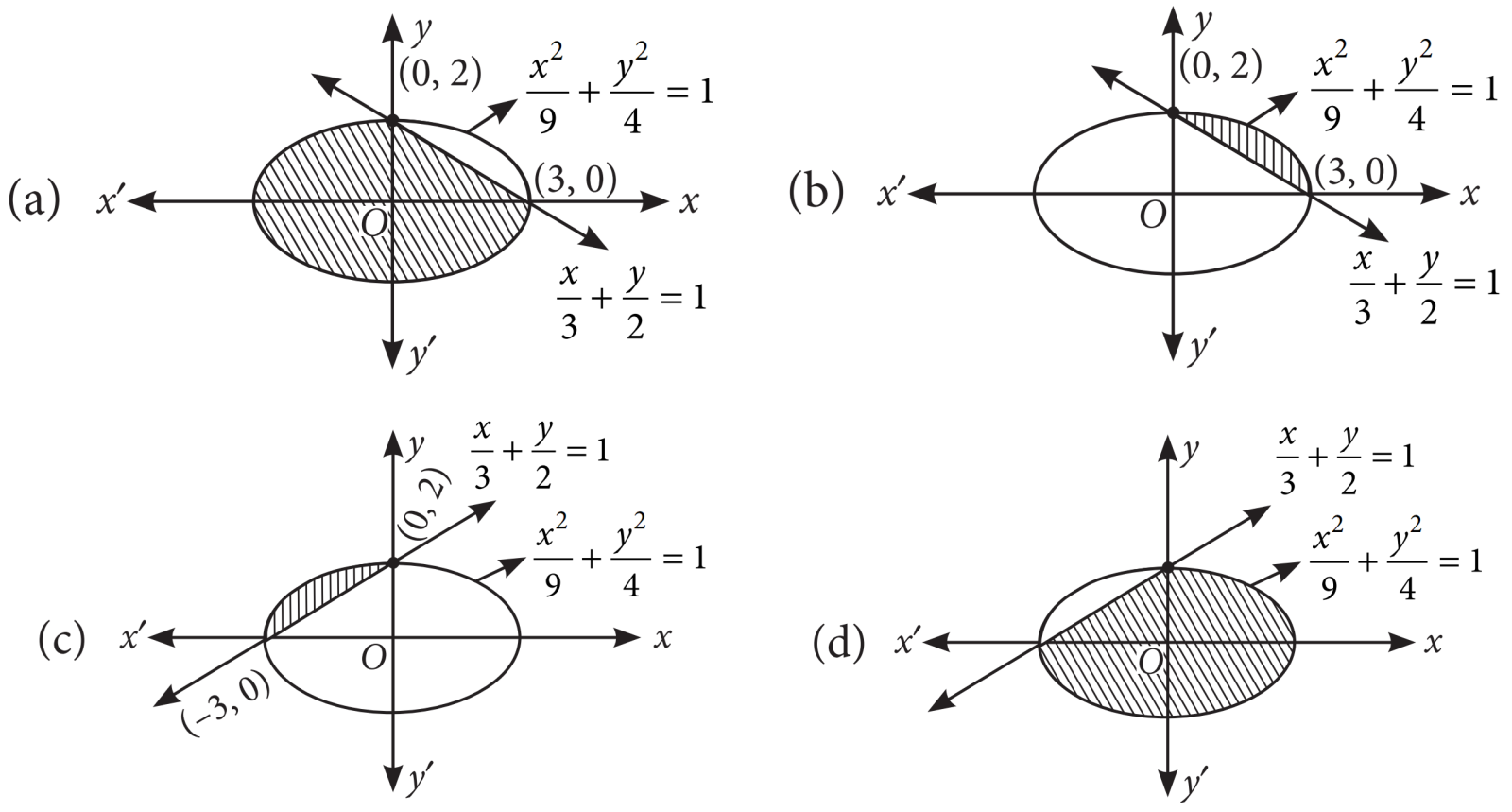
A mirror in the shape of an ellipse represented by $\frac{\text{x}^2}{9}+-\frac{\text{y}^2}{4}=1$ was hanging on the wall. Arun and his sister were playing with ball inside the house, even their mother refused to do so. All of sudden, ball hit the mirror and got a scratch in the shape of line represented by $\frac{\text{x}}{3}+\frac{\text{y}}{2}=1$

Based on the above information, answer the following questions.
  1. Point(s) of intersection of ellipse and scratch (straight line) is (are).
  1. (0, 2), (3, 0)
  2. (2, 0), (3, 0)
  3. (2, 3), (0, 0)
  4. (0, 3), (3, 0)
  1. Area of smaller region bounded by the ellipse and line is represented by.

  1. The value of $\frac{2}{3}\int\limits_{0}^{3}\sqrt{9-\text{x}^2}\text{dx}$ is.
    1. $\frac{\pi}{2}$

    2. $\pi$

    3. $\frac{3\pi}{2}$

    4. $\frac{\pi}{4}$

  1. The value of  $2\int\limits_{0}^{3}\bigg(1-\frac{\text{x}}{3}\bigg)\text{dx}$ is.
    1. 0
    2. 1
    3. 2
    4. 3
  1. Area of the smaller region bounded by the mirror and scratch is.
  1. $3\Big(\frac{\pi}{2}+1\Big)\text{ sq.units}$

  2. $\Big(\frac{\pi}{2}+1\Big)\text{ sq.units}$

  3. $\Big(\frac{\pi}{2}-1\Big)\text{ sq.units}$

  4. $3\Big(\frac{\pi}{2}-1\Big)\text{ sq.units}$

View full solution
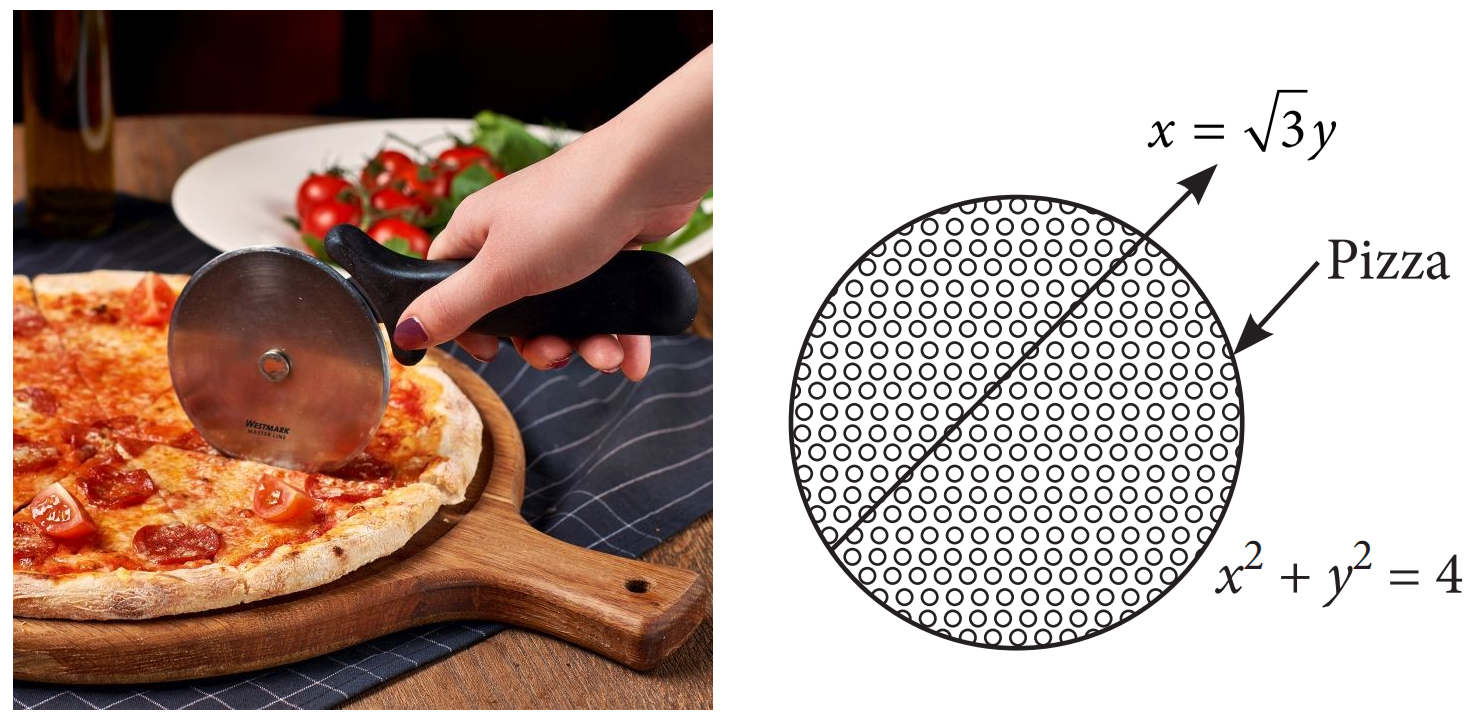
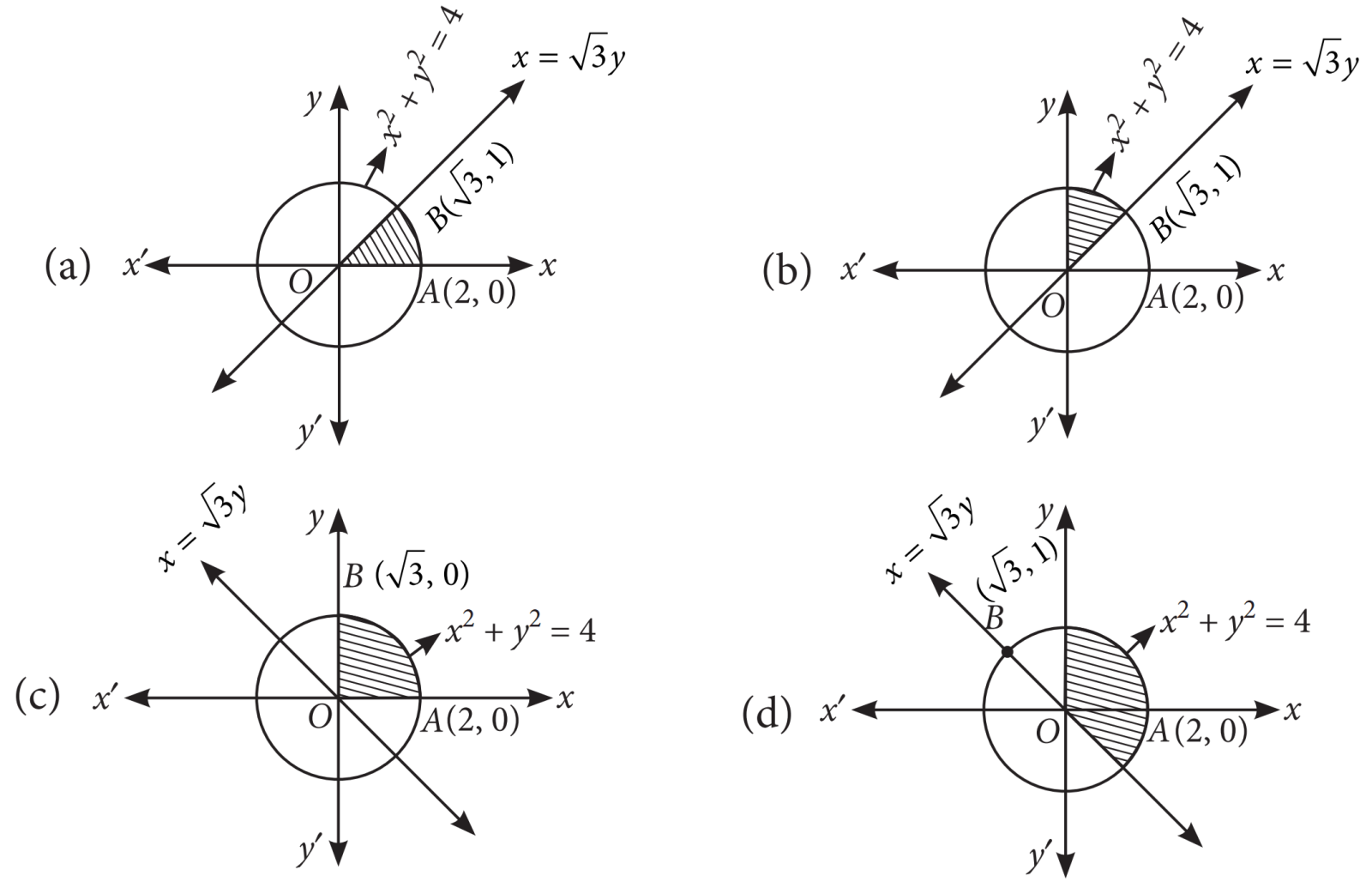
A child cut a pizza with a knife. Pizza is circular in shape which is represented by x2 + y2 = 4 and sharp edge of knife represents a straight line given by $\text{x}=\sqrt{3\text{y}}$

Based on the above information, answer the following questions.
  1. The point(s) of intersection of the edge of knife (line) and pizza shown in the figure is (are).
  1. $(1, \sqrt{3}),(-1,-\sqrt{3})$

  2. $(\sqrt{3},1),(-\sqrt{3,}-1)$

  3. $(\sqrt{2,}0),(0,\sqrt{3})$

  4. $(-\sqrt{3,}),(1,-\sqrt{3})$

  1. Which of the following shaded portion represent the smaller area bounded by pizza and edge of knife in first quadrant?

  1. Value of area of the region bounded by circular pizza and edge of knife in first quadrant is.
  1. $\frac{\pi}{2}\text{ sq.units}$

  2. $\frac{\pi}{3}\text{ sq.units}$

  3. $\frac{\pi}{5}\text{ sq.units}$

  4. $\pi\text{ sq.units}$

  1. Area of each slice of pizza when child cut the pizza into 4 equal pieces is.
  1. $\pi\text{ sq.units}$

  2. $\frac{\pi}{2}\text{ sq.units}$

  3. $3\pi\text{ sq.units}$

  4. $2\pi\text{ sq.units}$

  1. Area of whole pizza is.
  1. $3\pi\text{ sq.units}$

  2. $2\pi\text{ sq.units}$

  3. $5\pi\text{ sq.units}$

  4. $4\pi\text{ sq.units}$

View full solution
Graphs of two function $\text{f}(\text{x})=\text{sin}\text{ x}$ and $\text{(g)}\text{x}=\text{cos}\text{ x}$ is given below:

Based on the above information, answer the following questions.
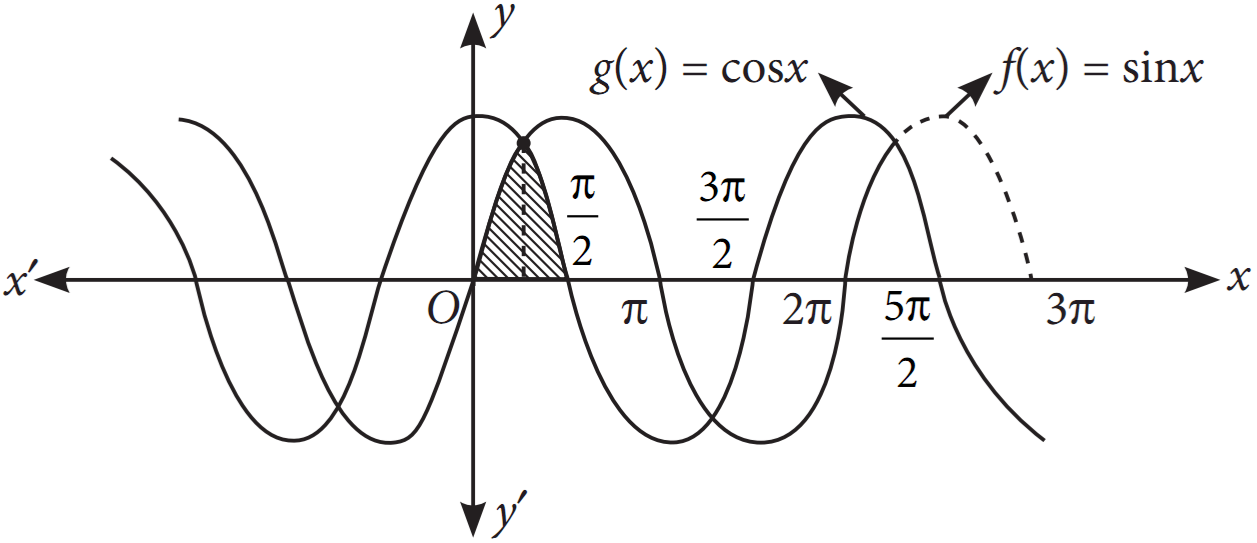
  1. In $(0, \pi)$, the curves $\text{f}(\text{x})=\text{sin}\text{ x}$ and $\text{g}\text{ (x)}=\text{cos}\text{ x}$ at $\text{x}=$ 
    1. $\frac{\pi}{2}$
    2. $\frac{\pi}{3}$
    3. $\frac{\pi}{4}$
    4. ${\pi}$
  2. Value of $\int\limits_{0}^{\frac{\pi}{4}}\text{sin}\text{ x}\text{ dx}$ is.
    1. $1-\frac{1}{\sqrt{2}}$
    2. $1+\frac{1}{\sqrt{2}}$
    3. $2-\frac{1}{\sqrt{2}}$
    4. $2+\frac{1}{\sqrt{2}}$
  1. Value of $\int\limits_\frac{\pi}{4}^{\frac{\pi}{2}}\text{cos}\text{ x}\text{ dx}$ is.
    1. $1+\frac{1}{\sqrt{2}}$
    2. $1-\frac{1}{\sqrt{2}}$
    3. $2-\sqrt{2}$
    4. $2+\sqrt{2}$
  2. Value of $\int\limits_{0}^{\pi}\text{sin}\text{ x}\text{ dx}$ is.
  1. 0
  2. 1
  3. 2
  4. -2
  1. Value of $\int\limits_{0}^\frac{\pi}{2}\text{sin}\text{ x}\text{ dx}$ is.
  1. 0
  2. 1
  3. 3
  4. 4
View full solution
Consider the following equations of curves x2 = y and y = x.

On the basis of above information, answer the following questions.
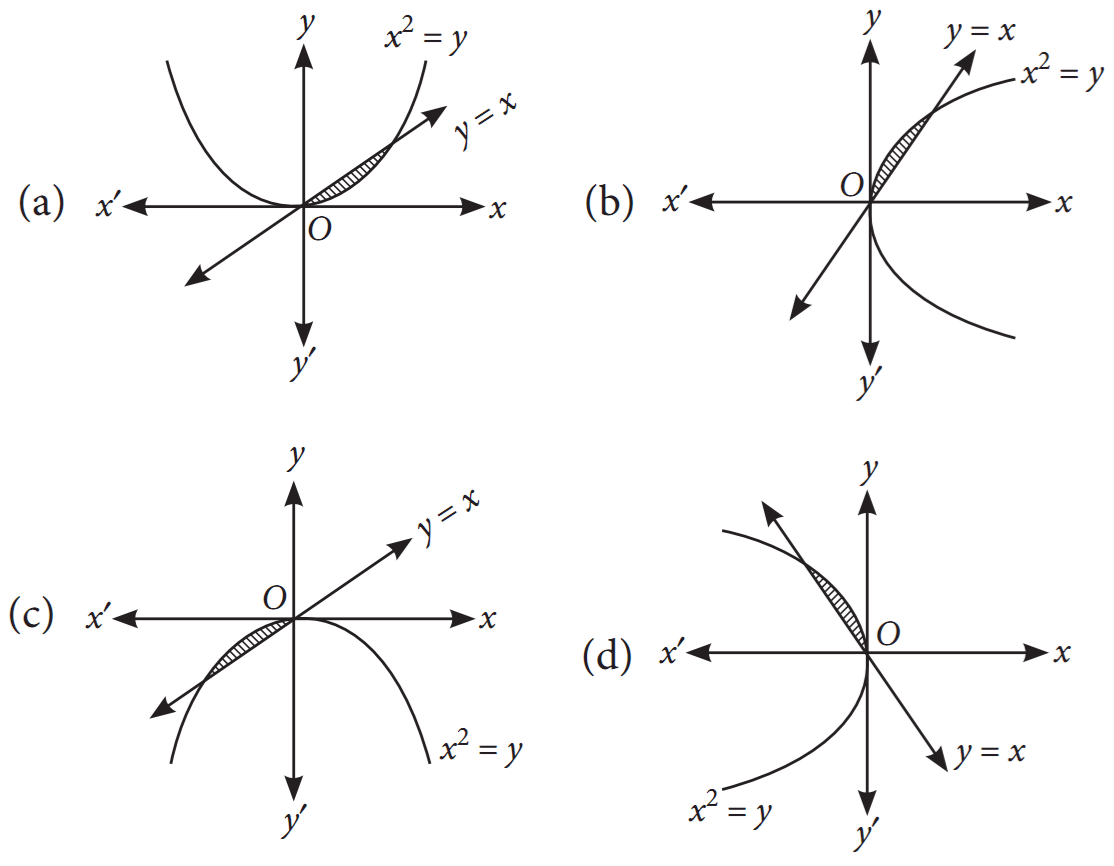
  1. The point(s) of intersection of both the curves is (are).
  1. (0, 0)(2, 2)
  2. (0, 0)(1, 1)
  3. (0, 0)(-1, -1)
  4. (0, 0)(-2, -2)
  1. Area bounded by the curves is represented by which of the following graph?

  1. The value of the integral $\int\limits_{1}^{0}\text{x}\ \text{dx}$ is.
  1. $\frac{1}{4}$

  2. $\frac{1}{3}$

  3. $\frac{1}{2}$

  4. $1$

  1. The value of the integral $\int\limits_{0}^{1}\text{x}^2\ \text{dx}$ is.
  1. $\frac{1}{4}$

  2. $\frac{1}{3}$

  3. $\frac{1}{2}$

  4. $1$

  1. The value of area bounded by the curves x2 = y and x = y is.
  1. $\frac{1}{6}\text{ sq}.\text{unit}$

  2. $\frac{1}{3}\text{ sq}.\text{unit}$

  3. $\frac{1}{2}\text{ sq}.\text{unit}$

  4. ${1}\text{ sq}.\text{unit}$

View full solution

Generate a Application of Integrals paper free

Pick question groups from the list above, set marks and difficulty, and export a branded PDF with step-by-step answer keys. First 3 chapters free — no signup.

Download App