Question
Find the area of given figure ABCDEFGH as per dimensions given in it.

Answer

In the right $\triangle ABC$,
$AB^2=BC^2+AC^2$
$\Rightarrow(5)^2=(4)^2+AC^2$
$25=16+AC^2$
$AC^2=25-16=9=(3)^2$
$AC=3 cm$
$\therefore AD=AC+CD=3+4=7 cm$
$BG=BC+CF+FG$
$=4+8+4=16$
$AH=DE=8 cm$
Now area of rectangle CDEF,
$=8 \times 4=32 cm^2$
And area of rectangle $A B G H$,
$=\frac{1}{2}(AH+BG) \times AC$
$=\frac{1}{2} \times(8+16) \times 3 cm^2$
$=\frac{1}{2} \times 24 \times 3=36 cm^2$
$\therefore$ Total area of the figure,
$=32+36$
$=68 cm^2$​​​​​​​

Need a full question paper?

Generate a complete, print-ready paper with questions like this in minutes — across 16+ boards, with answer keys.

Start Generating Free

Similar questions

The following table gives the distances travelled by a car at various time-intervals. Study the table and draw a linear graph for the same.
Time
6 a.m.
7 a.m.
8 a.m.
9 a.m.
Distance (in km)
40
80
120
160
From your graph, answer the questions given below:
  1. How much distance did the car cover during the period from 7:30 a.m. to 8 a.m.
  2. What was the time when the car had covered a distance of 100km, since its start?
  3. How much distance had the car covered by 8:30 a.m.?
Construct a quadrilateral ABCD in which BC = 4cm, CA = 5.6cm, AD = 4.5cm, CD = 5cm and BD = 6.5cm.
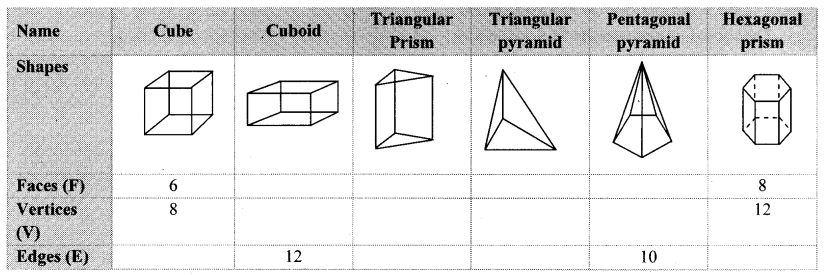
Leonard Euler, discovered an interesting formula regarding the faces, vertices and edges of solid figures.
Count and write the faces, vertices and edges of the following figures and complete the table. From the table verify Euler’s formula, F + V = E + 2.
Image
Draw a line. Take a point outside the line. Draw a perpendicular from the point to the line with the help of a set-square
Lengths of diagonals of a rhombus ABCD are 16 cm and 12 cm. Find the side and perimeter of the rhombus.
The areas of three adjacent faces of a cuboid are $v, y$ and $z$. If the volume is $V^1$ prove that $V^2=x y z$.
Toshiba bought 100 hens for Rs. 8000 and sold 20 of these at a gain of 5%. At what gain percent she must sell the remaining hens so as to gain 20% on the whole?
$\frac{2\text{x}-1}{3}-\frac{6\text{x}-2}{5}=\frac{1}{3}$
Construct a kite ABCD in which AB = 4cm, BC = 4.9cm and AC = 7.2cm.
Solve the following equation and also check your result in case:
$(3\text{x}-8)(3\text{x+2})-(4\text{x}-11)(2\text{x}+1)=(\text{x}-3)(\text{x}+7)$