MCQ
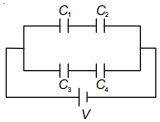
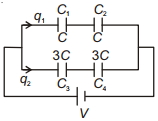
Find the charge on capacitor $C_3$

Given, that $C_1=C_2=C$ and $C_3=C_4=3 C$.
  • $\frac{3}{2} CV$
  • B
    $\frac{C V}{2}$
  • C
    $3 CV$
  • D
    $2 CV$

Answer

Correct option: A.
$\frac{3}{2} CV$
a
(a)

$C_{\text {net }}=2 C$

$q=2 C V$

$\frac{q_1}{q_2}=\frac{1}{3}$

$3 q_1=q_2$

$q_1+q_2=2 CV$

$q_1=\frac{C V }{2}$

$q_2=\frac{3 CV }{2}$
Need a full question paper?

Generate a complete, print-ready paper with questions like this in minutes — across 16+ boards, with answer keys.
Start Generating Free

Similar questions

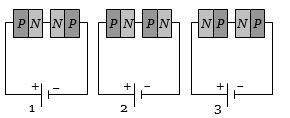
Two $ PN-$junctions can be connected in series by three different methods as shown in the figure. If the potential difference in the junctions is the same, then the correct connections will be
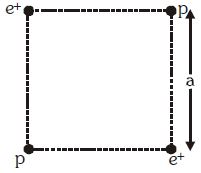
Two positrons $(e^+)$ and two protons $(p)$ are kept on four corners of a square of side $a$ as shown in figure. The mass of proton is much larger than the mass of positron. Let $q$ denotes the charge on the proton as well as the positron then the kinetic energies of one of the positrons and one of the protons respectively after a very long time will be-
A particle initially at rest moves along the $x$-axis. Its acceleration varies with time as $a=4\,t$. If it starts from the origin, the distance covered by it in $3\,s$ is $...........\,m$
At temperature $T$ , the power radiated by a body is $Q$ watts. At the temperature $3T$ the power radiated by it will be
There are some passengers inside $a$ stationary railway compartment. The track is frictionless. The centre of mass of the compartment itself (without the passengers) is $C_1$, while the centre of mass of the 'compartment plus passengers' system is $C_2$. If the passengers move about inside the compartment along the track.
On the basis of kinetic theory of gases, the gas exerts pressure because its molecules:
A closed vessel contains $8\,gm$ of oxygen and $7\,gm$ of nitrogen. The total pressure is $10\, atm$ at a given temperature. If now oxygen is absorbed by introducing a suitable absorbent the pressure of the remaining gas in atm will be
Three weights $W, 2W$ and $3W$ are connected to identical springs suspended from a rigid horizontal rod. The assembly of the rod and the weights fall freely. The positions of the weights from the rod are such that
A body falling on the ground from $a$ height of $10\, m$, rebounds to a height $2.5\, m,$ then the ratio of the velocities of the body just before and after the collision will be
Thermal neutrons can cause fission in