Question
Find the common difference and write the next four terms of the following arithmetic progressions:
$0, -3, -6, -9, .....$

Answer

Here, first term $(a_1) = 0$
Common difference $(d) = a_2 - a_1$
$= -3 - 0$
$= -3$
Now, we need to find the next four terms of the given A.P.
That is we need to find $a_5, a_6, a_7, a_8$​​​​​​​
So, using the formula $a_n = a + (n - 1)d$
Substituting n = 5, 6, 7, 8 in the above formula
Substituting n = 5, we get
$a_5 = 0 + (5 - 1)(-3)$
$a_5 = 0 - 12$
$a_5 = -12$
Substituting n = 6, we get
$a_6 = 0 + (6 - 1)(-3)$
$a_6 = 0 - 15$
$a_6 = -15$
Substituting n = 7, we get
$a_7 = 0 + (7 - 1)(-3)$
$a_7 = 0 - 18$
$a_7 = -18$
Substituting n = 8, we get
$a_8 = 0 + (8 - 1)(-3)$
$a_8 = 0 - 21$
$a_8 = -21$
Therefore, the common difference is d = -3 and the next four terms are $-12, -15, -18, -21.$

Need a full question paper?

Generate a complete, print-ready paper with questions like this in minutes — across 16+ boards, with answer keys.

Start Generating Free

Similar questions

If we add $1$ to the numerator and subtract $1$ from the denominator, a fraction reduces to $1$ . It becomes $\frac{1}{2}$ if we only add $1$ to the denominator. What is the fraction? Solve the pair of the linear equation obtained by the elimination method.
The $13^{\text {th }}$ term of an AP is 4 times its $3^{\text {rd }}$ term. If its $5^{\text {th }}$ term is 16 , find the sum of its first 10 terms.
The height of a solid cylinder is $15\ cm$ and the diameter of its base is $7\ cm$. Two equal conical holes each of radius $3\ cm$, and height $4\ cm$ are cut off. Find the volume of the remaining solid.
Find the value of k for which the following equation have real root:
$x^2 - 4kx + k = 0$
The difference between the outer and inner radii of a hollow right circular cylinder of length $14 \ cm$ is $1 \ cm$ . If the volume of the metal used in making the cylinder is $176 \ cm^3$, find the outer and inner radii of the cylinder.
A triangle has sides 5cm, 12cm and 13cm. Find the length to one decimal place, of the perpendicular from the opposite vertex to the side whose length is 13cm.

In an AP: a = 3, n = 8, s = 192, find d.
The sum of $n$ term of an $A.P$ is $3 n^2+5 n$. Find the $A.P$ and its $15^{\text {th }}$ term.
The corresponding altitudes of two similar triangles are 6cm and 9cm respectively, Find the ratio of their areas.
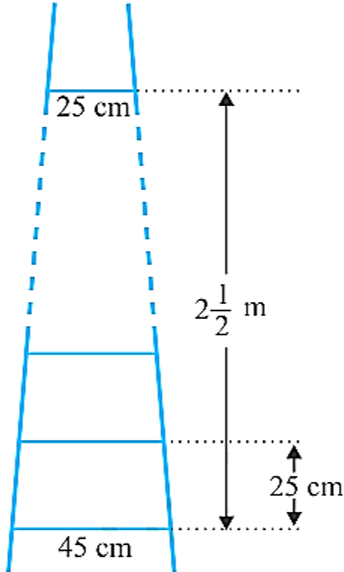
A ladder has rungs $25$ cm apart. The rungs decrease uniformly in length from $45$ cm at the bottom to $25$ cm at the top. If the top and bottom rungs are $2\frac 12$m apart, what is the length of the wood required for the rungs?
[Hint: Number of rungs = $\frac{250}{25} + 1$]
Image