MCQ
Find the correct answer from the alternatives given. Different expenditures incurred on the construction of a building were shown by a pie diagram. The expenditure $Rs. 45,000$ on cement was shown by a sector of central angle of $75^\circ$ . What was the total expenditure of the construction?
  • $2,16,000$
  • B
    $3,60,000$
  • C
    $4,50,00$
  • D
    $7,50,000$

Answer

Correct option: A.
$2,16,000$
The pie diagram shows, the central angle for expenditure on cement $= 75^\circ$
Also, expenditure on cement $= Rs. 45,000$
We know that,
Central angle for expenditure on cement  $=\frac{\text { Expenditure on cement }}{\text { Total expenditure on the contruction }} \times 360^{\circ} $
$ \Rightarrow \text { Total expenditure on the construction }=\frac{\text { Expenditure on cement }}{\text { Central angle for expenditure on cement }} \times 360^{\circ} $
$ \Rightarrow \text { Total expenditure on the construction }=\frac{45000}{75^{\circ}} \times 360^{\circ}$
$\Rightarrow$ Total expenditure on the construction $= 216000$
Thus, the correct option is $(A).$

Need a full question paper?

Generate a complete, print-ready paper with questions like this in minutes — across 16+ boards, with answer keys.

Start Generating Free

Similar questions

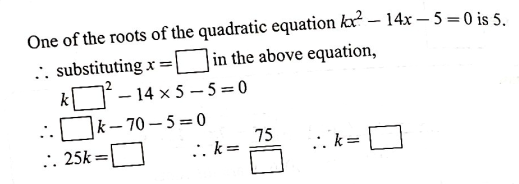
If $x=5$ is a root of the quadratic equation $k x^2-14 x-5=0$, then find the value of $k$ by completing the following activity :
Image
In the following table, the toll paid by drivers and the number of vehicles is shown. Find the mean of the toll by 'assumed mean' method.
Decide which of the following are quadratic equations?
1. $3 x^2-5 x+3=0$
2. $9 y^2+5=0$
3. $m^3-5 m^2+4=0$
4. $(1+2)(1-5)=0$
Solution :
Solution:
1.In the equation $3 x^2-5 x+3=0, x$ is the only variable and maximum
index of the variable is 2
It is a quadratic equation.
2. In the equation $9 y^2+5=0$, Image is the only variable and maximum index of the variable isImage
it Image a quadratic equation.
3.In the equation $m ^3-5 m^2+4=0$,Image is the only variable but maximum index of the variable is not $2.$
It Image quadratic equation.
$4((\mid+2)(\mid-5)=0$
$1(1-5)+2(\mid-5)=0$
$I^2-5|+2|-10=0$
$I^2-3 \mid-10=0$, In this equation.​​​​​​​ Image is the only variable and maximum index of the variable isImage
it Image a quadratic equation.
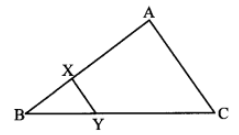
In the adjoining figure, XY || seg AC. If 2 AX = 3 BX and XY = 9, complete the activity to find the value of AC.
Image
Complete the following table.
No.EquationIs the equation a linear equation in 2 variables ?
14m+3n=12Yes
23x^(2)-7y=13
3sqrt2x-sqrt5y=16
40x+6y-3=0
50.3 x+0y-36=0
6(4)/(x)+(5)/(y)=4
74xy-5y-8=0
Do the following activity to draw tangents to the circle without using the center of the circle.
  1. Draw a circle with radius 3.5 cm and take any point C on it.
  2. Draw chord CB and an inscribed angle CAB.
  3. With the center A and any convenient radius, draw an arc intersecting the sides of angle BAC in points M and N.
  4. Using the same radius, draw an arc intersecting the chord CB at point R.
  5. Taking the radius equal to d(MN) and center R, draw an arc intersecting the arc drawn in the previous step. Let D be the point of intersection of these arcs. Draw line CD. Line CD is the required tangent to the circle.
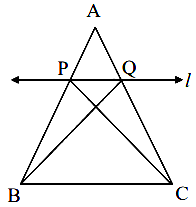
A line is parallel to one side of triangle which intersects remaining two sides in two distinct points then that line divides sides in same proportion.

Given: In $\triangle A B C$ line I || side $B C$ and line I intersect side $A B$ in $P$ and side $A C$ in $Q$.
To prove: $\frac{ AP }{ PB }=\frac{ AQ }{ QC }$
Construction: Draw $CP$ and $BQ$
Proof: $\triangle APQ$ and $\triangle PQB$ have equal height.
$\left.\frac{ A (\Delta APQ )}{ A (\Delta PQB )}=\frac{[}{ PB } \quad \ldots . . \text { (i) [areas in proportion of base }\right]$
$\frac{ A (\Delta APQ )}{ A (\Delta PQC )}=\frac{[}{ QC } \ldots . . . \text { (ii) [areas in proportion of base] }$
$\triangle P Q C$ and $\triangle P Q B$ have [____ ] is common base.
Seg PQ \| Seg BC, hence height of $\triangle A P Q$ and $\triangle P Q B$.
$A (\triangle PQC )= A (\Delta \ldots, \ldots \text {.....(iii) }$
$\frac{ A (\Delta APQ )}{ A (\Delta PQB )}=\frac{ A (\Delta \ldots)}{ A (\Delta \ldots \ldots[( i ) \text {, (ii), and (iii)] }}$
$\frac{ AP }{ PB }=\frac{ AQ }{ QC } \quad \ldots . . .[( i ) \text { and (iii)] }$
The following frequency table shows the demand for a sweet and the number of customers. Find the mode of demand of sweet.
Complete the following activity - 

Image
Complete the following table.
EquationNo. of variableswhether linear or not
$\frac{3}{x}-\frac{4}{y}=8$2Not linear
$\frac{6}{x-1}+\frac{3}{y-2}=0$
$\frac{7}{2 x+1}+\frac{13}{y+2}=0$
$\frac{14}{x+y}+\frac{3}{x-y}=5$