MCQ
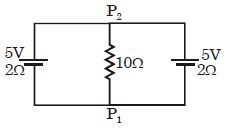
Find the current in the $10\, \Omega$ resistance
  • A
    $0.27\, A \,P_2$ to $P_1$
  • B
    $0.03 \,A \,P_2$ to $P_1$
  • $0.45\, A \,P_2$ to $P_1$
  • D
    $0.27\, A\, P_1$ to $P_2$

Answer

Correct option: C.
$0.45\, A \,P_2$ to $P_1$
c
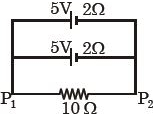
The circuit can be redrawn as:

$\varepsilon_{\mathrm{eq}}=\frac{\frac{\varepsilon_{1}}{\mathrm{r}_{1}}+\frac{\varepsilon_{2}}{\mathrm{r}_{2}}}{\frac{1}{\mathrm{r}_{1}}+\frac{1}{\mathrm{r}_{2}}}=\frac{\frac{5}{2}+\frac{5}{2}}{\frac{1}{2}+\frac{1}{2}}$

$\varepsilon_{\mathrm{eq}}=5 \mathrm{\,V}$

$\frac{1}{r_{e q}}=\frac{1}{r_{1}}+\frac{1}{r_{2}}=\frac{1}{2}+\frac{1}{2} \Rightarrow r_{e q}=1 \,\Omega$

$\therefore \mathrm{i}=\frac{\varepsilon}{\mathrm{r}+\mathrm{R}}=\frac{5}{10+1}=0.45 \mathrm{\,A}$
Need a full question paper?

Generate a complete, print-ready paper with questions like this in minutes — across 16+ boards, with answer keys.

Start Generating Free

Similar questions

What is the phase difference between electric and magnetic fields in an electromagnetic wave?
An electric dipole of moment $\overrightarrow p $ placed in a uniform electric field $\overrightarrow E $ has minimum potential energy when the angle between $\overrightarrow p $ and $\overrightarrow E $ is
For a crystal system, $a = b = c,\alpha = \beta = \gamma, \neq 90^{0}$, the system is
The ratio of the intensity at the centre of a bright fringe to the intensity at a point one-quarter of the distance between two fringe from the centre is
When connected across the terminals of a cell, a voltmeter measures $5\,V$ and a connected ammeter measures $10\, A$ of current. A resistance of $2\, ohms$ is connected across the terminals of the cell. The current flowing through this resistance will be ............ $A$
Meena draws magnetic field lines of the field close to the axis of a current carrying circular loop. As she moves away from the center of the circular loop she observes that the lines keep ?
Instead of angular momentum quantisation a student gives predicts that energy is quantised as $E=\frac{-E_{\bullet}}{n},\left(E_{0}>0\right)$ and $n$ is a positive integer. Which of the following options is correct?
The ratio of electrostatic and gravitational forces acting between electron and proton separated by a distance $5 \times {10^{ - 11}}\,m,$ will be (Charge on electron $=$ $1.6 \times 10^{-19}$ $C$, mass of electron = $ 9.1 \times 10^{-31}$ $kg$, mass of proton = $1.6 \times {10^{ - 27}}\,kg,$ $\,G = 6.7 \times {10^{ - 11}}\,N{m^2}/k{g^2})$
Two coherent light sources $S_1$ and $S_2$ ($\lambda= 6000 Å$) are $1mm$ apart from each other. The screen is placed at a distance of $25 \,cm$ from the sources. The width of the fringes on the screen should be
Two lithium nuclei in a lithium vapour at room temperature do not combine to form a carbon nucleus because: