Question
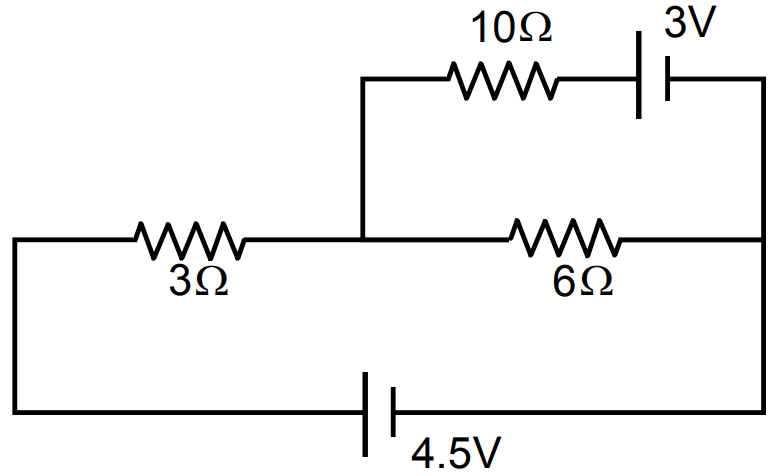
Find the current through the $10\Omega$ resistor shown in figure.

Answer

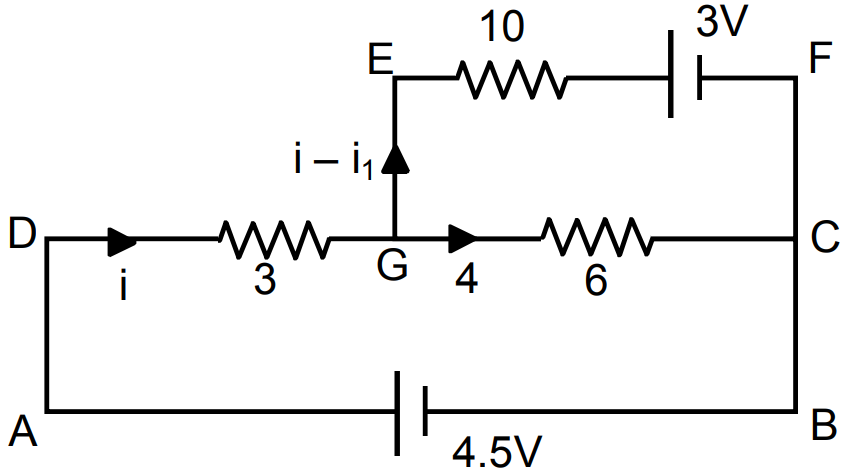
In the circuit ADCBA,

$3\text{i}+6\text{i}_1-4.5=0$
In the circuit GEFCG,
$3\text{i}+6\text{i}_1=4.5$
$=10\text{i}-10\text{i}_1-6\text{i}_1=-3$
$\Rightarrow[10\text{i}+16\text{i}_1=-3]3\ ...(1)$
$[3\text{i}+6\text{i}_1=4.5]10\ ...(2)$
From (1) and (2)
$-108\text{i}_1=-54$
$\Rightarrow\text{i}_1=\frac{54}{108}=\frac{1}{2}=0.5$
$3\text{i}+6\times\frac{1}{2}-4.5=0$
$3\text{i}-1.5=0\Rightarrow\text{i}=0.5$
Current through $10\Omega$ resistor = 0A.

Need a full question paper?

Generate a complete, print-ready paper with questions like this in minutes — across 16+ boards, with answer keys.
Start Generating Free

Similar questions

The conduction band of a solid is partially filled at 0K. Will it be a conductor, a semiconductor or an insulator?
A thin paper of thickness 0.02mm having a refractive index 1.45 is pasted across one of the slits in a Young's double slit experiment. The paper transmits $\frac{4}{9}$ of the light energy falling on it.
  1. Find the ratio of the maximum intensity to the minimum intensity in the fringe pattern.
  2. How many fringes will cross through the centre if an identical paper piece is pasted on the other slit also? The wavelength of the light used is 600nm.
Define electric flux. Find the expression for the electric field intensity due to the electric dipole at its axial point. Draw a diagram.
How many time constants will elapse before the energy stored in the capacitor reaches half of its equilibrium value in a charging RC circuit?
A ball is thrown horizontally from a point 100m above the ground with a speed of 20m/s. Find:
  1. The time it takes to reach the ground.
  2. The horizontal distance it travels before reaching the ground.
  3. The velocity (direction and magnitude) with which it strikes the ground.
  1.  
  1. State the principle on which a potentiometer works. How can a given potentiometer be made more sensitive?
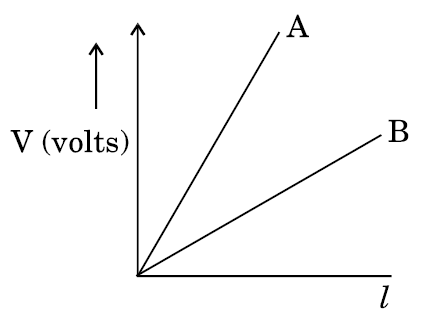
  2. In the graph shown below for two potentiometers, state with reason which of the two potentiometers, A or B, is more sensitive.
  1. Two metallic wires, $P_1$ and $P_2$ of the same material and same length but different cross-sectional areas, $A_1$ and $A_2$​​​​​​​ are joined together and connected to a source of emf. Find the ratio of the drift velocities of free electrons in the two wires when they are connected (i) in series, and (ii) in parallel.
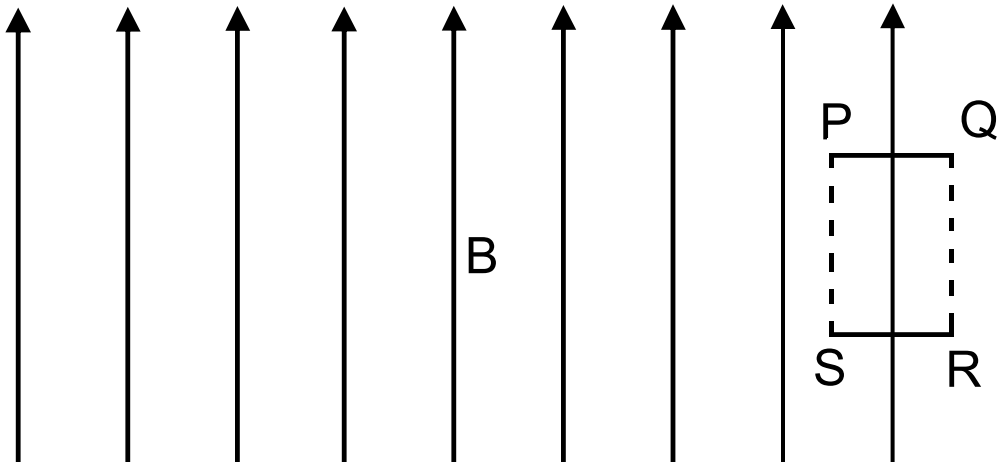
Sometimes we show an idealised magnetic field which is uniform in a given region and falls to zero abruptly. One such field is represented in figure. Using Ampere's law over the path PQRS, show that such a field is not possible.
A capacitor having a capacitance of $100\mu\text{F}$ is charged to a potential difference of 50V.
  1. What is the magnitude of the charge on each plate?
  2. The charging battery is disconnected and a dielectric of dielectric constant 2.5 is inserted. Calculate the new potential difference between the plates.
  3. What charge would have produced this potential difference in absence of the dielectric slab.
  4. Find the charge induced at a surface of the dielectric slab.
A metal block of heat capacity $80J^\circ C^{-1} $ placed in a room at 20°C is heated electrically. The heater is switched off when the temperature reaches 30°C. The temperature of the block rises at the rate of $2^\circ Cs^{-1}$ just after the heater is switched on and falls at the rate of $0.2^\circ Cs^{-1}$ just after the heater is switched off. Assume Newton's law of cooling to hold.
  1. Find the power of the heater.
  2. Find the power radiated by the block just after the heater is switched off.
  3. Find the power radiated by the block when the temperature of the block is 25°C.
  4. Assuming that the power radiated at 25°C represents the average value in the heating process, find the time for which the heater was kept on.
A proton and an α-particle are accelerated, using the same potential difference. How are the de-Broglie wavelengths $\lambda _p$ and $\lambda _a$​​​​​​​ related to each other?