Question
  1.  
  1. State the principle on which a potentiometer works. How can a given potentiometer be made more sensitive?
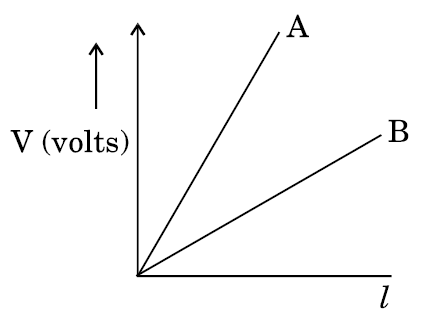
  2. In the graph shown below for two potentiometers, state with reason which of the two potentiometers, A or B, is more sensitive.
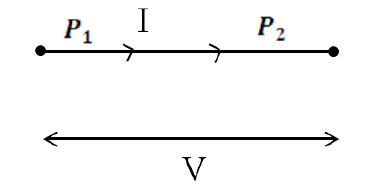
  1. Two metallic wires, $P_1$ and $P_2$ of the same material and same length but different cross-sectional areas, $A_1$ and $A_2$​​​​​​​ are joined together and connected to a source of emf. Find the ratio of the drift velocities of free electrons in the two wires when they are connected (i) in series, and (ii) in parallel.
Answer

  1.  
  1. The potential difference across any length of wire is directly proportional to the length provided current and area of cross section are constant i.e., ? ? = ?? where ? is the potential drop per unit length.
It can be made more sensitive by decreasing current in the main circuit/decreasing potential gradient/increasing resistance put in series with the potentiometer wire.
  1. Potentiometer B
Has smaller value of $\text{ }^V/_l$ (slope/potential gradient).
  1. In series, the current remains the same.

$I=neA_1V_{d1}=neA_2V_{d2}$
$\therefore\frac{V_{d1}}{V_{d2}}=\frac{A_2}{A_1}$
In parallel potential difference is same but currents are different.
$V=I_1R_1=neA_1V_{d1}\frac{\rho l}{A_1}=ne\rho V_{d1}l$
Similarly, $V=I_2R_2=ne\rho V_{d2}l$
$I_1R_1=I_2R_2$
$\therefore\frac{V_{d1}}{V_{d2}}=1$

Need a full question paper?

Generate a complete, print-ready paper with questions like this in minutes — across 16+ boards, with answer keys.

Start Generating Free

Similar questions


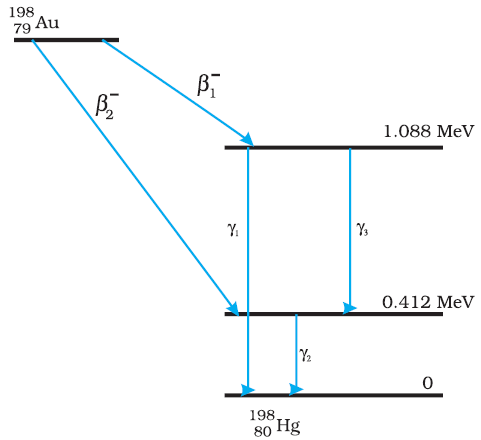
Obtain the maximum kinetic energy of $\beta$-particles, and the radiation frequencies of $\gamma$ decays in the decay scheme shown in Fig. 13.6. You are given that:
$\text{m}(^{198}\text{Au})=197.968233\text{ u}$
$\text{m}(^{198}\text{Hg})=197.9667602\text{ u}$
The densities of wood and benzene at $0^{\circ} \mathrm{C}$ are $880 \mathrm{~kg} \mathrm{~m}^{-3}$ and $900 \mathrm{~kg} \mathrm{~m}^{-3}$ respectively. The coefficients of volume expansion are $1.2 \times 10^{-3}{ }^{\circ} \mathrm{C}^{-1}$ for wood and $1.5 \times 10^{-3}{ }^{\circ} \mathrm{C}^{-1}$ for benzene. At what temperature will a piece of wood just sink in benzene?
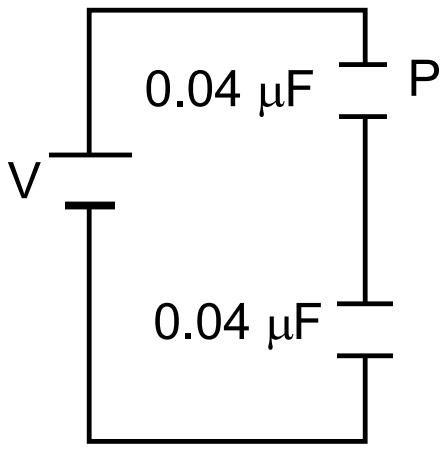
The particle P shown in figure has a mass of 10mg and a charge of $-0.01\mu\text{C}.$ Each plate has a surface area $100cm^2$ on one side. What potential difference V should be applied to the combination to hold the particle P in equilibrium?
A neutron star has a density equal to that of the nuclear matter. Assuming the star to be spherical, find the radius of a neutron star whose mass is $4.0 \times 10^{30}kg$ (twice the mass of the sun).
In a Geiger-Marsden experiment, what is the distance of closest approach to the nucleus of a $7.7 MeV \alpha$-particle before it comes momentarily to rest and reverses its direction?
Two wires carrying equal currents i each, are placed perpendicular to each other, just avoiding a contact. If one wire is held fixed and the other is free to move under magnetic forces, what kind of motion will result?
A point source emitting alpha particles is placed at a distance of 1m from a counter which records any alpha particle falling on its $1cm^2$ window. If the source contains $6.0 \times 10^{16}$ active nuclei and the counter records a rate of 50000 counts/ second, find the decay constant. Assume that the source emits alpha particles uniformly in all directions and the alpha particles fall nearly normally on the window.
A source contains two phosphorous radio nuclides $^{32}_{15}\text{P }(\text{T}_{1/2}=14.3\text{d})$ and $^{33}_{15}\text{P }(\text{T}_{1/2}=25.3\text{d})$ Initially, 10% of the decays come from $^{33}_{15}\text{P}.$ How long one must wait until 90% do so?
Trace the rays of light showing the formation of an image due to a point object placed on the axis of a spherical surface separating the two media of refractive indices $n_1$ and $n_2$. Establish the relation between the distances of the object, the image and the radius of curvature from the central point of the spherical surface. Hence derive the expression of the lens maker’s formula.
Explain why elemental semiconductor cannot be used to make visible LEDs.