Question
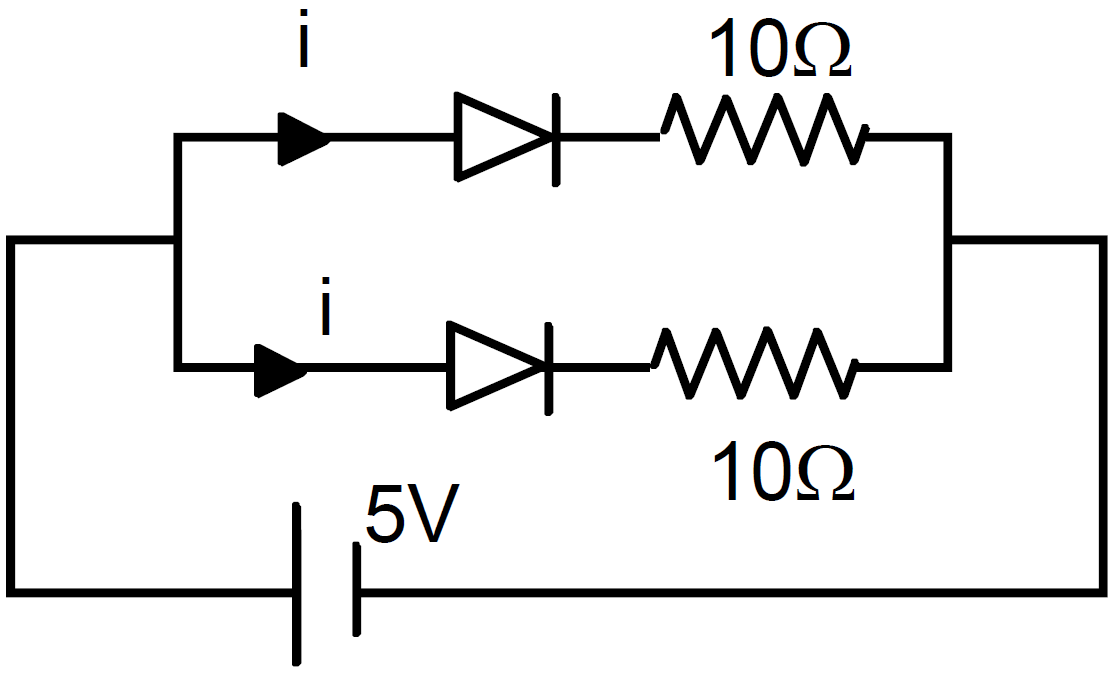
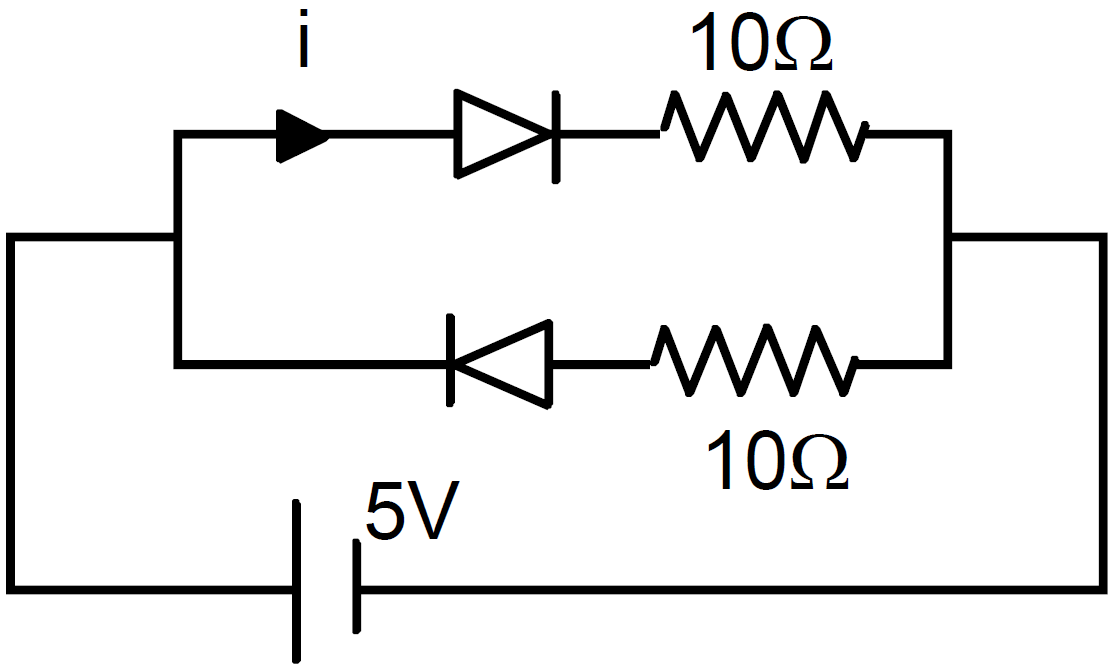
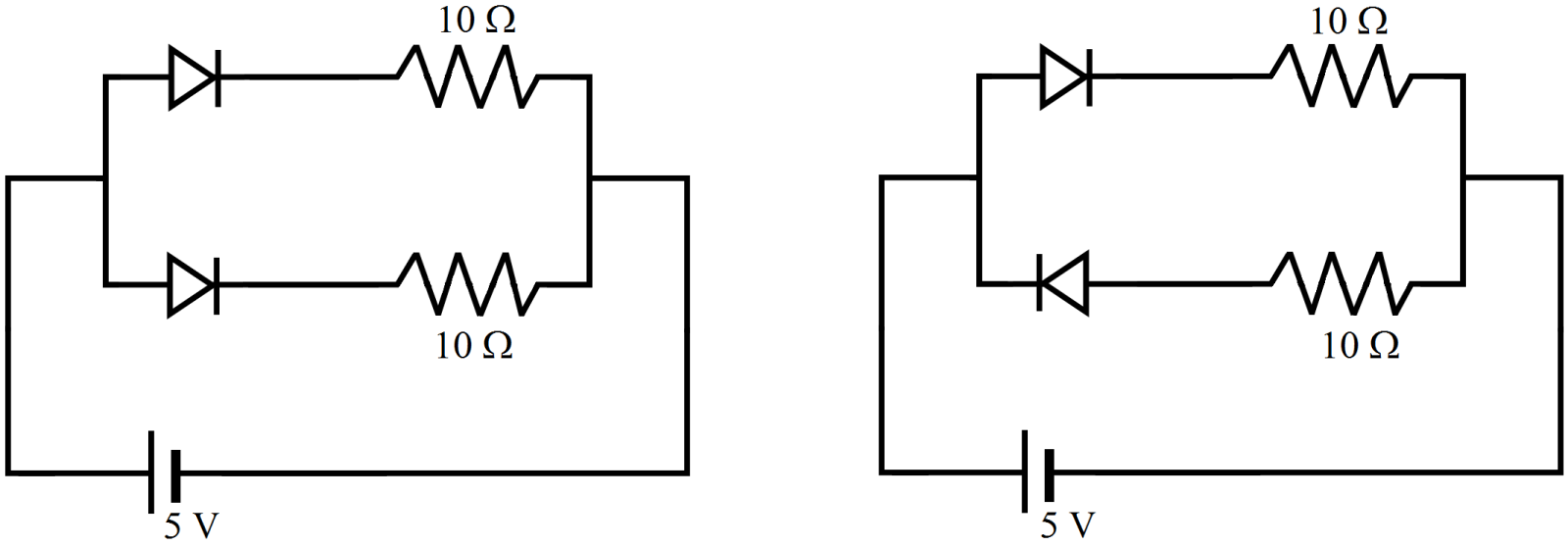
Find the current through the battery circuits shown in figure.

Answer

Both diodes are forward biased. Thus the net diode resistance is 0.

$\text{i}=\frac{5}{\frac{10\times10}{10+10}}=\frac{5}{5}=1\text{A}$
One diode is forward biased and other is reverse biased.

$\text{i}=\frac{\text{V}}{\text{R}_\text{net}}=\frac{5}{10+0}=\frac{1}{2}=0.5\text{A}$

Need a full question paper?

Generate a complete, print-ready paper with questions like this in minutes — across 16+ boards, with answer keys.

Start Generating Free

Similar questions

Obtain an expression for induced electromotive force due to rotational motion of a disc in a uniform magnetic field.
The time constant of an LR circuit is 40ms. The circuit is connected at t = 10 and the steady-state current is found to be 2.0A. Find the current at:
  1. t = 10ms
  2. t = 20ms
  3. t = 100ms
  4. t = 1s.
A uniform rod pivoted at its upper end hangs vertically. It is displaced through an angle of $60^\circ$ and then released. Find the magnitude of the force acting on a particle of mass dm at the tip of the rod when the rod makes an angle of $37^\circ$ with the vertical.
  1. Draw the circuit diagram of a fullwave rectifier using $p-n$ junction diode. Explain its working and show the output, input waveforms.
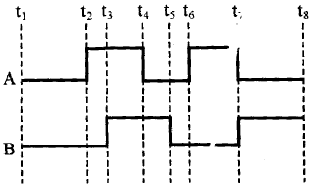
  2. Show the output waveforms $(Y)$ for the following inputs $A$ and $B$ of
    1. $OR$ gate.
    2. $\ce{NAND}$ gate.
A thin lens made of a material of refractive index $\mu_2$ has a medium of refractive index $\mu_1$ on one side and a medium of refractive index $\mu_3$ on the other side. The lens is biconvex and the two radii of curvature have equal magnitude $R.$ A beam of light travelling parallel to the principal axis is incident on the lens. Where will the image be formed if the beam is incident from:
  1. The medium $\mu_1$
  2. From the medium $\mu_3?$
In the previous problem, suppose $m_2 = 2.0\ kg$ and $m_3 = 3.0\ kg$. What should be the mass $m$ so that it remains at rest?
Find the change in the internal energy of $2\ kg$ of water as it is heated from $0^\circ C$ to $4^\circ C$. The specific heat capacity of water is $4200Jkg^{-1} K^{-1}$ and its densities at $0^\circ C $and $4^\circ C$ are $999.9\ kgm^{-3}$ and $1000\ kgm^{-3}$ respectively. Atmospheric pressure $= 10^{-6}Pa.$
The current in a conductor and the potential difference across its ends are measured by an ammeter and a voltmeter. The meters draw negligible currents. The ammeter is accurate but the voltmeter has a zero error (that is, it does not read zero when no potential difference is applied). Calculate the zero error if the readings for two different conditions are 1.75A, 14.4V and 2.75A, 22.4V.
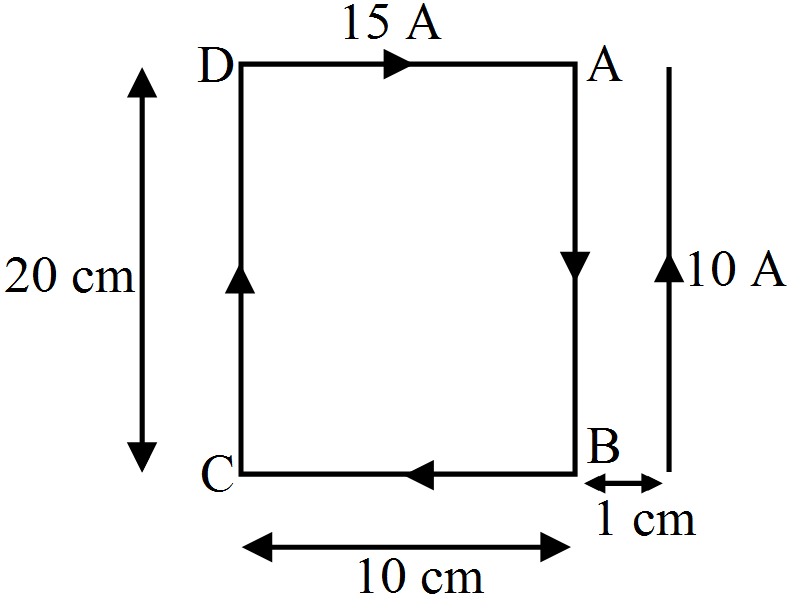
A rectangular current carrying loop is placed $1\ cm$ away from a long straight current$-$carrying conductor as shown.
  1. Will the net force acting on the loop due to straight conductor be attractive or repulsive in nature? Justify your answer. Calculate the magnitude of this force.
An electric field is uniform, and in the positive $x$ direction for positive $x$, and uniform with the same magnitude but in the negative $x$ direction for negative $x$. It is given that $E =200 \hat{ i } N / C$ for $x>0$ and $E =-200 \hat{ i } N / C$ for $x<0$. A right circular cylinder of length $20 \ cm$ and radius $5 \ cm$ has its centre at the origin and its axis along the $x-$ axis so that one face is at $x=+10 \ cm$ and the other is at $x=-10 \ cm$ (Fig. $1.25). (a)$ What is the net outward flux through each flat face? $(b)$ What is the flux through the side of the cylinder? $(c)$ What is the net outward flux through the cylinder? $(d$) What is the net charge inside the cylinder?