Question
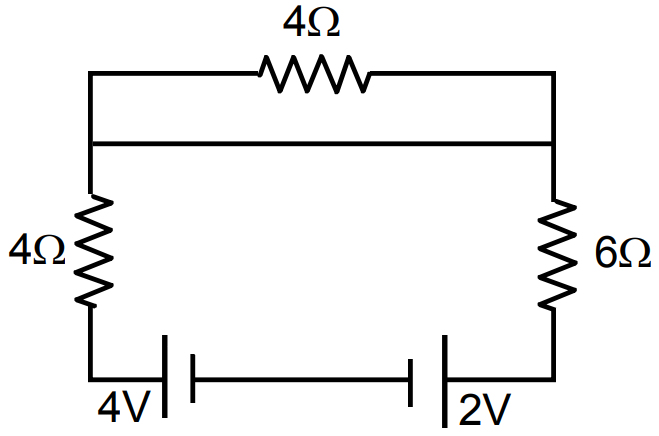
Find the currents through the three reaiators shown in figure.

Answer


  1. Current through (1) $4\Omega$ resistor = 0
  2. Current through (2) and (3)
net E = 4V - 2V = 2V

(2) and (3) are in series,

$\text{R}_\text{eff}=4+6=10\Omega$

$\text{i}=\frac{2}{10}=0.2\text{A}$

Current through (2) and (3) are 0.2A.

Need a full question paper?

Generate a complete, print-ready paper with questions like this in minutes — across 16+ boards, with answer keys.
Start Generating Free

Similar questions

The time period of oscillation of simple pendulum is given by $\text{t}=2\pi\sqrt{\frac{\text{l}}{\text{g}}}$ What is the accuracy in the determination of g if 10cm length is known to 1 mm accuracy and 0.5s, time period is measured from time of 100 oscillations with a watch of 1s resolution?
Shows plot of $\frac{\text{PV}}{\text{T}}$ versus P for $1.00 \times 10^{-3}kg$ of oxygen gas at two different temperatures: If we obtained similar plots for $1.00 \times 10^{-3}$kg of hydrogen, would we get the same value of $\frac{\text{PV}}{\text{T}}$ at the point where the curves meet on the y-axis? If not, what mass of hydrogen yields the same value of $\frac{\text{PV}}{\text{T}}$ (for low pressure high temperature region of the plot)? (Molecular mass of $H_2 = 2.02u, of O_2 = 32.0u, R = 8.31J mo1^{-1}K^{-1}$).
What are the arithmatic operations of significant figures. What are the rules for rounding off a number? Explain each rule with example.
The driver of a three-wheeler moving with a speed of 36km/h sees a child standing in the middle of the road and brings his vehicle to rest in 4.0s just in time to save the child. What is the average retarding force on the vehicle ? The mass of the three-wheeler is 400kg and the mass of the driver is 65kg.
Separation of Motion of a system of particles into motion of the centre of mass and motion about the centre of mass: Show $\text{K}=\text{K}'+\frac{1}{2}\text{M}\text{V}^2$ where K' is the total kinetic energy of the system of particles, K′ is the total kinetic energy of the system when the particle velocities are taken with respect to the centre of mass and $\frac{\text{MV}^2}{2}$ is the kinetic energy of the translation of the system as a whole (i.e. of the centre of mass motion of the system). The result has been used in $\sec7.14$
Given Avogadro number $=6.02 \times 10^{23}$ and Boltzmann's constant $=1.38 \times 10^{-23}$ joule/ (molecule-K). Calculate (a) the average kinetic energy of translation of an oxygen molecule at $27^{\circ} \mathrm{C}$, (b) the total kinetic energy of an oxygen molecule at $27^{\circ} \mathrm{C}$ (c) the total kinetic energy in joules of a gram-molecule of oxygen at $27^{\circ} \mathrm{C}$.
We have $0.5g$ of hydrogen gas in a cubic chamber of size $3cm$ kept at NTP. The gas in the chamber is compressed keeping the temperature constant till a final pressure of $100atm$. Is one justified in assuming the ideal gas law, in the final state? (Hydrogen molecules can be consider as spheres of radius 1 A).
Draw a graph to show the variation of P.E., K.E. and total energy of a simple harmonic oscillator with displacement.
Two objects of masses $m_1$ and $m_2$ are moving with velocities $u_1$ and $u_2$ respectively collide in an inelastic collision. If after the collision both the objects move together then calculate the change in the value of energy
A car weighs $1800kg$. The distance between its front and back axles is $1.8m$. Its centre of gravity is $1.05m$ behind the front axle. Determine the force exerted by the level ground on each front wheel and each back wheel.