Find the fundamental frequency of a closed pipe, if the length of the air column is $42 m$. (speed of sound in air $= 332 \,m/sec$) .... $Hz$
Easy
Download our app for free and get started
(a) For closed pipe $n = \frac{v}{{4l}}$$ \Rightarrow $$n = \frac{{332}}{{4 \times 42}} = 2\,Hz$.

Download our appand get started for free
Experience the future of education. Simply download our apps or reach out to us for more information. Let's shape the future of learning together!No signup needed.*
Similar Questions
- 1A train moving at a speed of $220\, ms^{-1}$ towards a stationary object, emits a sound of frequency $1000\, Hz$. Some of the sound reaching the object gets reflected back to the train as echo. The frequency of the echo as detected by the driver of the train is .... $ Hz$ (speed of sound in air is $330\, ms^{-1}$)View Solution
- 2Two uniform strings $A$ and $B$ made of steel are made to vibrate under the same tension. if the first overtone of $ A$ is equal to the second overtone of $B$ and if the radius of $A$ is twice that of $B,$ the ratio of the lengths of the strings isView Solution
- 3The equation of a simple harmonic wave is given by $y = 3sin\frac{\pi }{2}\left( {50t - x} \right)\, $View Solution
where $x$ and $y$ are in metres and $t$ is in seconds. The ratio of maximum particle velocity to the wave velocity is
- 4A wave is propagating along $x$-axis. The displacement of particles of the medium in $z$-direction at $t = 0$ is given by: $z =$ exp$[ -(x + 2)^2]$ , where $‘x’$ is in meters. At $t = 1s$, the same wave disturbance is given by: $z =$ exp $ [ - (2 - x)^2 ]$. Then, the wave propagation velocity isView Solution
- 5When two tuning forks (fork $1$ and fork $2$ ) are sounded together, $4$ beats per second are heard. Now some tape is attached on the prong of the fork $2$. When the tuning forks are sounded again, $6$ beats per second are heard. If the frequency of fork $1$ is $200 \,Hz$, then the original frequency of fork $2$ is ........... $Hz$View Solution
- 6A bus is moving with a velocity of $5 m/s$ towards a huge wall. the driver sounds a horn of frequency $165 Hz.$ If the speed of sound in air is $355 m/s,$ the number of beats heard per second by a passenger on the bus will beView Solution
- 7The superposing waves are represented by the following equations :${y_1} = 5\sin 2\pi (10\,t - 0.1x)$, ${y_2} = 10\sin 2\pi (20\,t - 0.2x)$ Ratio of intensities $\frac{{{I_{\max }}}}{{{I_{\min }}}}$ will beView Solution
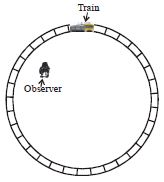
- 8An engine is moving with uniform speed along a circular track emitting a sound of frequency $400\, Hz$ as shown in the figure. Speed of engine is $30\, m/sec$ and speed of sound is $330\, m/sec$. An observer is standing inside the track. Maximum frequency observed by the observer isView Solution
- 9If the velocity of sound in air is $336 m/s$. The maximum length of a closed pipe that would produce a just audible sound will beView Solution
- 10$16$ tunning forks are arranged in the order of increasing frequencies. Any two successive forks give $8$ beats per sec when sounded together. If the frequency of the last fork is twice the first, then the frequency of the first fork isView Solution