If the velocity of sound in air is $336 m/s$. The maximum length of a closed pipe that would produce a just audible sound will be
Easy
Download our app for free and get started
(b) Minimum audible frequency $= 20 Hz$.
$ \Rightarrow $ $\frac{v}{{4l}} = 20 \Rightarrow l = \frac{{336}}{{4 \times 20}} = 4.2$$m$
$ \Rightarrow $ $\frac{v}{{4l}} = 20 \Rightarrow l = \frac{{336}}{{4 \times 20}} = 4.2$$m$

Download our appand get started for free
Experience the future of education. Simply download our apps or reach out to us for more information. Let's shape the future of learning together!No signup needed.*
Similar Questions
- 1A man standing in front of a mountain beats a drum at regular intervals. The rate of drumming is generally increased and he finds that the echo is not heard distinctly when the rate becomes $40$ per minute. He then moves nearer to the mountain by $90 m$ and finds that echo is again not heard when the drumming rate becomes $60$ per minute. The distance between the mountain and the initial position of the man is .... $m$View Solution
- 2A stationary source is emitting sound at a fixed frequency $\mathrm{f}_0$, which is reflected by two cars approaching the source. The difference between the frequencies of sound reflected from the cars is $1.2 \%$ of $f_0$. What is the difference in the speeds of the cars (in $\mathrm{km}$ per hour) to the nearest integer? The cars are moving at constant speeds much smaller than the speed of sound which is $330 \mathrm{~ms}^{-1}$.View Solution
- 3Oxygen is $16$ times heavier than hydrogen. Equal volumes of hydrogen and oxygen are mixed. The ratio of speed of sound in the mixture to that in hydrogen isView Solution
- 4The wave equation is $y = 0.30\sin (314t - 1.57x)$ where $t, x$ and $y$ are in second, meter and centimeter respectively. The speed of the wave is ..... $m/s$View Solution
- 5The equation of progressive wave is $y = a\sin (200\,t - x)$. where $x$ is in meter and $t$ is in second. The velocity of wave is ..... $m/sec$View Solution
- 6A closed organ pipe of length $l$ is sounded together with another closed organ pipe of length $l + x (x << l)$ both in fundamental mode. If $v$ = speed of sound, the beat frequency heard isView Solution
- 7Three sound waves of equal amplitudes have frequencies $(n - 1 ), n, (n + 1 ).$ They superimpose to give beats. The number of beats produced per second will beView Solution
- 8When two progressive waves $\mathrm{y}_1=4 \sin (2 \mathrm{x}-6 \mathrm{t})$ and $\mathrm{y}_2=3 \sin \left(2 \mathrm{x}-6 \mathrm{t}-\frac{\pi}{2}\right)$ are superimposed, the amplitude of the resultant wave isView Solution
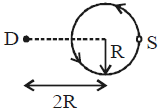
- 9A whistle $S$ of frequency $f$ revolves in a circle of radius $R$ at a constant speed $v$. What is the ratio of largest and smallest frequency detected by a detector $D$ at rest at a distance $2R$ from the centre of circle as shown in figure ? (take $c$ as speed of sound)View Solution
- 10An engine whistling at a constant frequency $n_0$ and moving with a constant velocity goes past a stationary observer. As the engine crosses him, the frequency of the sound heard by him changes by a factor $f$. The actual difference in the frequencies of the sound heard by him before and after the engine crosses him isView Solution