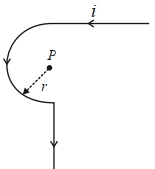
Find the magnetic field at the point $P$ in figure. The curved portion is a semicircle connected to two long straight wires.
JEE MAIN 2023, Medium
Download our app for free and get started
$B_{ P }=\left(\frac{\mu_0 i}{4 r}+\frac{\mu_0 i}{4 \pi r}\right)=\frac{\mu_0 i}{2 r}\left(\frac{1}{2}+\frac{1}{2 \pi}\right)$

Download our appand get started for free
Experience the future of education. Simply download our apps or reach out to us for more information. Let's shape the future of learning together!No signup needed.*
Similar Questions
- 1The magnetic field existing in a region is given by $\vec{B}=B_0\left(1+\frac{x}{l}\right) \hat{k}$. A square loop of edge I and carrying a current $i$, is placed with its edge parallel to the $x-y$ axes. Find the magnitude of the net magnetic force experienced by the loopView Solution
- 2If number of turns, area and current through a coil is given by $N, A$ and $I$ respectively then its magnetic moment will beView Solution
- 3In a hydrogen atom, an electron moves in a circular orbit of radius $5.2 \times {10^{ - 11}}\,m$ and produces a magnetic induction of $12.56\, T$ at its nucleus. The current produced by the motion of the electron will be (Given ${\mu _0} = 4\pi \times {10^{ - 7}}\,Wb/A - m)$View Solution
- 4View SolutionTwo free parallel wires carrying currents in opposite direction
- 5View SolutionA loop of irregular shape carrying current is located in an external magnetic field. If wire is flexible it will take the shape of
- 6A long straight wire carrying current of $30\,A$ is placed in an external uniform magnetic field of induction $4 \times 10^{-4}$ $T$. The magnetic field is acting parallel to the direction of current. The magnitude of the resultant magnetic induction in tesla at a point $2.0\, cm$ away from the wire isView Solution
- 7A charge particle of $2\,\mu\,C$ accelerated by a potential difference of $100\,V$ enters a region of uniform magnetic field of magnitude $4\,m\,T$ at right angle to the direction of field. The charge particle completes semicircle of radius $3\,cm$ inside magnetic field. The mass of the charge particle is $........\times 10^{-18}\,kg$.View Solution
- 8A long straight wire carries a current of $35\; A$. What is the magnitude of the field $B$ at a point $20\; cm$ from the wire?View Solution
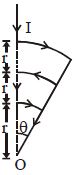
- 9Shown in the figure is a conductor carrying a current $I$. The magnetic field intensity at the point $O$ (common centre of all the three arcs) isView Solution
- 10The magnetic moment of a bar magnet is $0.5 \mathrm{Am}^2$. It is suspended in a uniform magnetic field of $8 \times 10^{-2} \mathrm{~T}$. The work done in rotating it from its most stable to most unstable position is:View Solution