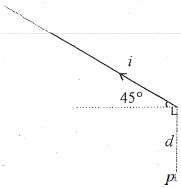
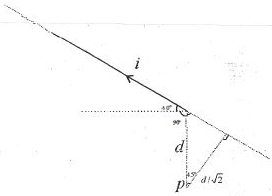
Find the magnitude of magnetic field at point $p$ due to a semi - infinite wire given below
Diffcult


Download our appand get started for free
Experience the future of education. Simply download our apps or reach out to us for more information. Let's shape the future of learning together!No signup needed.*
Similar Questions
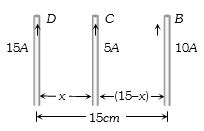
- 1Three long, straight and parallel wires carrying currents are arranged as shown in the figure. The wire $C$ which carries a current of $5.0\, amp$ is so placed that it experiences no force. The distance of wire $C$ from wire $D$ is thenView Solution
- 2A particle of charge $q$ and mass $m$ is moving with a velocity $-v \hat{ i }(v \neq 0)$ towards a large screen placed in the $Y - Z$ plane at a distance $d.$ If there is a magnetic field $\overrightarrow{ B }= B _{0} \hat{ k },$ the minimum value of $v$ for which the particle will not hit the screen isView Solution
- 3The acceleration of an electron at a moment in a magentic field $\vec B\, = \,2\hat i + 3\hat j + 4\hat k$ is $\vec a\, = \,x\hat i - 2\hat j + \hat k$. The value of $x$ isView Solution
- 4A galvanometer having a resistance of $9\, ohm$ is shunted by a wire of resistance $2\, ohm$. If the total current is $1\, amp$, the part of it passing through the shunt will be ............ $amp$View Solution
- 5A square loop of side $2\, a ,$ and carrying current I, is kept in $XZ$ plane with its centre at origin. A long wire carrying the same current $I$ is placed parallel to the $z-$axis and passing through the point $(0, b, 0),(b>>a)$. The magnitude of the torque on the loop about $z-$axis is given by:View Solution
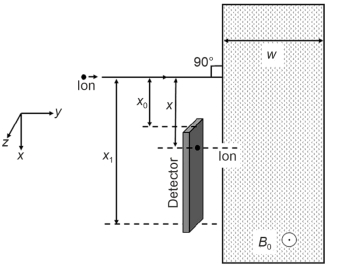
- 6A positive, singly ionized atom of mass number $A_M$ is accelerated from rest by the voltage $192 V$. Thereafter, it enters a rectangular region of width $w$ with magnetic field $B_0=0.1 \hat{k}$ Tesla, as shown in the figure. The ion finally hits a detector at the distance $x$ below its starting trajectory.View Solution
[Given: Mass of neutron/proton $=(5 / 3) \times 10^{-27} kg$, charge of the electron $=1.6 \times 10^{-19} C$.]
Which of the following option($s$) is(are) correct?
$(A)$ The value of $x$ for $H^{+}$ion is $4 cm$.
$(B)$ The value of $x$ for an ion with $A_M=144$ is $48 cm$.
$(C)$ For detecting ions with $1 \leq A_M \leq 196$, the minimum height $\left(x_1-x_0\right)$ of the detector is $55 cm$.
$(D)$ The minimum width $w$ of the region of the magnetic field for detecting ions with $A_M=196$ is $56 cm$.
- 7An electron, moving in a uniform magnetic field of induction of intensity $\vec B,$ has its radius directly proportional toView Solution
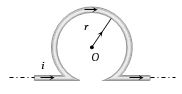
- 8An infinitely long straight conductor is bent into the shape as shown in the figure. It carries a current of $i$ $ampere$ and the radius of the circular loop is $r$ $metre$. Then the magnetic induction at its centre will beView Solution
- 9A charged particle is moving in a circular orbit of radius $6\, cm$ with a uniform speed of $3 \times 10^6\, m/s$ under the action of a uniform magnetic field $2 \times 10^{-4}\, Wb/m^2$ which is at right angles to the plane of the orbit. The charge to mass ratio of the particle isView Solution
- 10Two straight horizontal parallel wires are carrying the same current in the same direction, $d$ is the distance between the wires. You are provided with a small freely suspended magnetic needle. At which of the following positions will the orientation of the needle be independent of the magnitude of the current in the wiresView Solution