Question
Find the matrix A satisfying the matrix equation:$\begin{bmatrix}2&1\\3&2\end{bmatrix}\text{A}\begin{bmatrix}-3&2\\5&-3\end{bmatrix}=\begin{bmatrix}1&0\\0&1\end{bmatrix}.$

Answer

We have, $\begin{bmatrix}2&1\\3&2\end{bmatrix}\text{A}\begin{bmatrix}-3&2\\5&-3\end{bmatrix}=\begin{bmatrix}1&0\\0&1\end{bmatrix}$ Or PAQ = I, where $\text{P}=\begin{bmatrix}2&1\\3&2\end{bmatrix}$ and $\text{Q}=\begin{bmatrix}-3&2\\5&-3\end{bmatrix}$ $\therefore\ \text{P}^{-1}\text{PAQ}=\text{P}^{-1}\text{I}$ $\Rightarrow\ \text{IAQ}=\text{P}^{-1}$ $\Rightarrow\ \text{AQ}=\text{P}^{-1}$ $\Rightarrow\ \text{AQQ}^{-1}=\text{P}^{-1}\text{Q}^{-1}$ $\Rightarrow\ \text{AI}=\text{P}^{-1}\text{Q}^{-1}$ $\Rightarrow\ \text{A}=\text{P}^{-1}\text{Q}^{-1}$ Now adj. $\text{P}=\begin{bmatrix}2&-1\\-3&2\end{bmatrix}$ and $|\text{P}|=1$ $\therefore\ \text{P}^{-1}=\begin{bmatrix}2&-1\\-3&2\end{bmatrix}$ Also adj. $\text{Q}=\begin{bmatrix}-3&-2\\-5&-3\end{bmatrix}$ and $|\text{Q}|=-1$ $\therefore\ \text{Q}^{-1}=\begin{bmatrix}3&2\\5&3\end{bmatrix}$$\Rightarrow\ \text{A}=\text{P}^{-1}\text{Q}^{-1}$
$=\begin{bmatrix}2&-1\\-3&2\end{bmatrix}\begin{bmatrix}3&2\\5&3\end{bmatrix}$
$=\begin{bmatrix}6-5&4-3\\-9+10&-6+6\end{bmatrix}=\begin{bmatrix}1&1\\1&0\end{bmatrix}$

Need a full question paper?

Generate a complete, print-ready paper with questions like this in minutes — across 16+ boards, with answer keys.
Start Generating Free

Similar questions

Solve the following differential equation:
$\frac{\text{dy}}{\text{dx}}\cos(\text{x}-\text{y})=1$
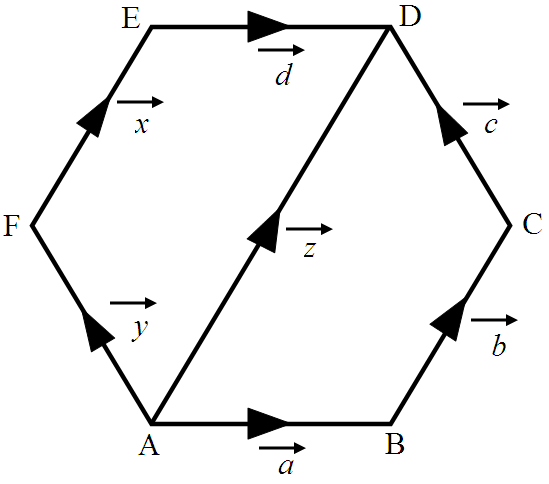
In Figure ABCD is a regular hexagon, which vectors are:
  1. Collinear.
  2. Equal.
  3. Co-initial.
  4. Collinear but not equal.
Solve the following initial value problems:
$\text{x}\frac{\text{dy}}{\text{dx}}-\text{y}=\log\text{x},\text{ y}(1)=0$
Show that $\begin{vmatrix}\text{x}-3&\text{x}-4&\text{x}-\alpha\\\text{x}-2&\text{x}-3&\text{x}-\beta\\\text{x}-1&\text{x}-2&\text{x}-\gamma\end{vmatrix}=0,$ where $\alpha,\beta,\gamma$ are in A.P.
A class has 15 students whose ages are 14, 17, 15, 14, 21, 17, 19, 20, 16, 18, 20, 17, 16, 19 and 20 years. One student is selected in such a manner that each has the same chance of being chosen and the age X of the selected student is recorded. What is the probability distribution of the random variable X? Find mean, variance and standard deviation of X.
The position vectors of points A, B and C are $\lambda\hat{\text{i}}+3\hat{\text{j}},12\hat{\text{i}}+\mu\hat{\text{j}}\text{ and }11\hat{\text{i}}-3\hat{\text{j}}$ respectively. If C divides the line segment joining A and B in the ratio 3:1, find the value of $\lambda\text{ and }\mu$
Solve the following differential equation:$(\text{x}^{2} - 1 ) \frac{\text{dy}}{\text{dx}} + 2 \text{xy} = \frac{2}{\text{x}^{2} - 1 }.$
Evaluate the following:
$\begin{vmatrix}0&\text{xy}^2&\text{xz}^2\\\text{x}^2\text{y}&0&\text{yz}^2\\\text{x}^2\text{z}&\text{zy}^2&0\end{vmatrix}$
Prove that the semi $-$ vertical angle of the right circular cone of given volume and least curved surface area is $\cot ^{-1} \sqrt{2}$
Solve the following differential equation
$\text{x}\cos\text{y dy}=(\text{xe}^\text{x}\log\text{x}+\text{e}^\text{x})\text{dx}$