Question
In Figure ABCD is a regular hexagon, which vectors are:
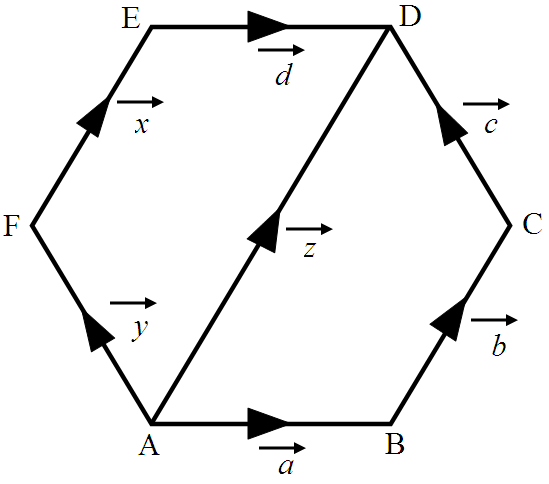
  1. Collinear.
  2. Equal.
  3. Co-initial.
  4. Collinear but not equal.

Answer

  1. Vectors having the same or parallel supports are called collinear vector. In the given figure the collinear vectors are,
$\vec{\text{a}},\ \vec{\text{d}};\ \vec{\text{x}},\ \vec{\text{z}},\ \vec{\text{b}};\ \vec{\text{c}},\ \vec{\text{y}}$
  1. vectors having the same magnitude and direction are called equal vector. In the given figure the equal vectors are,
$\vec{\text{b}},\ \vec{\text{x}};\ \vec{\text{c}},\ \vec{\text{y}};\ \vec{\text{a}},\ \vec{\text{d}}$
  1. Vectors having the same initial point are called co-initial vector. In the given figure the co-initial vectors are,
$\vec{\text{a}},\ \vec{\text{y}},\ \vec{\text{z}}$
  1. The vectors which are collinear but not equal are $\vec{\text{b}},\ \vec{\text{z}};\ \vec{\text{x}},\ \vec{\text{z}}$

Need a full question paper?

Generate a complete, print-ready paper with questions like this in minutes — across 16+ boards, with answer keys.

Start Generating Free

Similar questions

Solve the follwing system of equations by matrix method: $x + y + z = 3 , 2x - y + z = -1 , 2x + y - 3z = -9$
If x and y are connected parametrically by the equations given in Exercise without eliminating the parameter, Find $\frac{\text{dy}}{\text{dx}}.$
$\text{x}=\frac{\sin^3\text{t}}{\sqrt{\cos2\text{t}}},\text{y}\frac{\cos^3\text{t}}{\sqrt{\cos2\text{t}}}$
Probability of solving specific problem independently by A and B are $\frac{1}{2}\ \text{and}\ \frac{1}{3}$ respectively.If both try to solve the problem independently, find the probability that
  1. The problem is solved.
  2. Exactly one of them solves the problem.
Evaluate the following integrals:
$\int\text{cosec x}\log({\text{cosec x}-\cot\text{x})}\text{dx}$
Find the vector equation of the line passing through (1, 2, 3) and perpendicular to the plane $\vec{\text{r}}\cdot(\hat{\text{i}}+2\hat{\text{j}}-5\hat{\text{k}})+9=0.$
If the area bounded by the parabola $\text{y}^{2} = 16\text{ax}$ and the line $\text{y = 4 mx}$ is  $\frac{\text{a}^{2}}{12}$ sq. units, then using integration, find the value of m.
Solve the following differential equation:
$(1+\text{y}^2)+(\text{x}-\text{e}^{\tan^{-1}\text{y}})\frac{\text{dy}}{\text{dx}}=0$
If $f(x) = x^3 + ax^2 + bx + c$ has a maximum at $x = -1$ and minimum at $x = 3.$ Determine $a, b$ and $c.$
Let, X denote the number of colleges where you will apply after your results and P (X = x) denotes your probability of getting admission in x number of colleges. It is given that
$ \text{P(x = }x) = \begin{cases} \text{K}x\text{ }\text{ }\text{ }\text{ }\text{ }\text{ }\text{ }\text{ }\text{ }\text{ }\text{ }\text{ }\text{ }, & \text{if } x = 0 \text{ or 1}\\ 2\text{k}x\text{ }\text{ }\text{ }\text{ }\text{ }\text{ }\text{ }\text{ }\text{ }\text{ }\text{ }\text{ }, & \text{if } x = 2\\ \text{k} (5 - x)\text{ }\text{ }\text{ }\text{ }, &\text{if } x = 3 \text{ or 4'}\\ 0\text{ }\text{ }\text{ }\text{ }\text{ }\text{ }\text{ }\text{ }\text{ }\text{ }\text{ }\text{ }\text{ }\text{ }\text{ }\text{ }\text{ }, & \text{if } x > 4 \end{cases}$
where k is a positive constant. Find the value of k. Also find the probability that you will get admission in (i) exactly one college (ii) at most 2 colleges (iii) at least 2 colleges.
Show that $\text{f(x)}=\cos\text{x}^2$ is a continuous function.