Question
A sonometer wire is vibrating in resonance with a tuning fork. Keeping the tension applied same, the length of the wire is doubled. Under what conditions would the tuning fork still be is resonance with the wire?

Answer

Wire of sonometer is twice the length which it vibrates in its second harmonic. Thus, if the tuning fork resonates at L, it will resonate at 2L. This can be explained as below: The frequency of sonometer is given by$\text{f}=\frac{\text{n}}{2\text{L}}\sqrt{\frac{\text{T}}{\mu}}=\frac{\text{nv}}{2\text{L}}$ (n = number of loops)
For a given sonometer velocity of wave will be constant. if after chaning the leggth of wire the tuing fork still be in resonance witrh the wire. then, $\frac{\text{n}}{\text{L}}=\text{constant}\Rightarrow\frac{\text{n}^2}{\text{L}^2}$$\frac{\text{n}^1}{\text{L}^1}=\frac{\text{n}^2}{2\text{L}^2}\Rightarrow\text{n}_2=2\text{n}_1$
Hence, when the wire is doubled the number of loops also get doubled to produce the resonance. That is it resonates in second harmonic.

Need a full question paper?

Generate a complete, print-ready paper with questions like this in minutes — across 16+ boards, with answer keys.
Start Generating Free

Similar questions

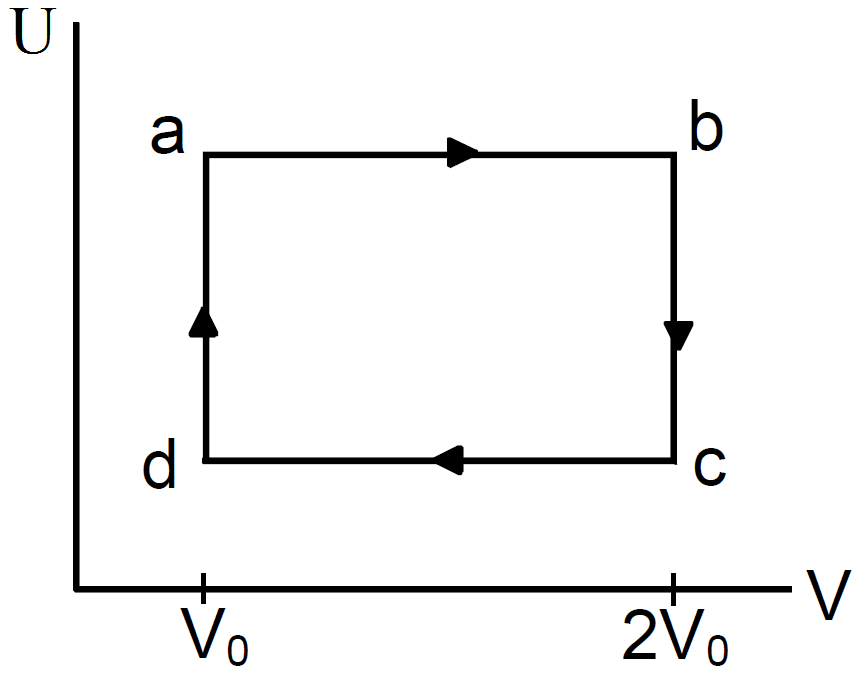
Figure. shows the variation in the internal energy U with the volume V of $2.0mol$ of an ideal gas in a cyclic process abcda. The temperatures of the gas at b and c are $500K$ and $300K$ respectively. Calculate the heat absorbed by the gas during the process.
What are stationary waves? How are they formed in strings? Draw the various modes of vibration in them.
k transparent slabs are arranged one over another. The refractive indices of the slabs are $\mu_1,\mu_2,\mu_3, \ ...\mu_{\text{k}}$ and the thicknesses are $t_1, t_2, t_3, ... t_k$. An object is seen through this combination with nearly perpendicular light. Find the equivalent refractive index of the system which will allow the image to be formed at the same place.
Why length, mass and time are chosen as base quantities in mechanics?
Explain the shape of the surface of water and mercury in a glass tube.
An object of mass $0.4kg$ moving with a velocity of $4ms^{-1}$ collides with another object of mass $0.6kg$ moving in same direction with a velocity of $2ms^{-1}$. If the collision is prefectly inelastic, what is the loss of K.E. due to impact?
Suppose the gravitational potential due to a small system is $\frac{\text{k}}{\text{r}^2}$ at a distance r from it. What will be the gravitational field? Can you think of any such system? What happens if there were negative masses?
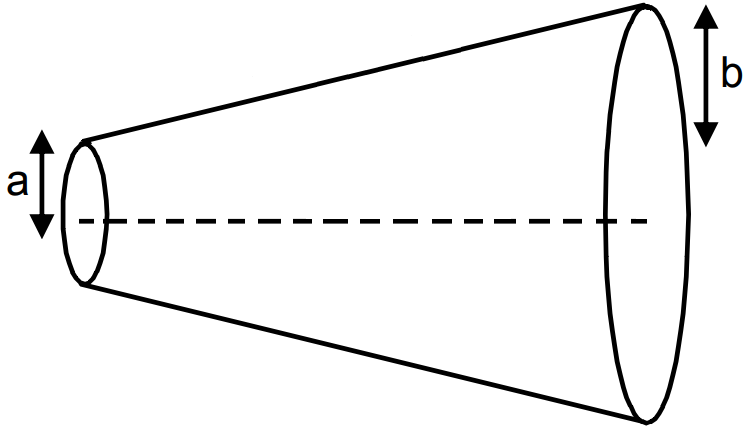
Figure. shows a conductor of length l with a circular cross-section. The radius of the cross-section varies linearly from a to b. The resistivity of the material is ρ. Assuming that b - a << l, find the resistance of the conductor.
A parallel-plate capacitor having plate area $400cm^2$ and separation between the plates $1.0mm$ is connected to a power supply of 100V. A dielectric slab of thickness $1.0mm$ and dielectric constant $5.0$ is inserted into the gap:
  1. Find the increase in electrostatic energy.
  2. If the power supply is now disconnected and the dielectric slab is taken out, find the further increase in energy.
  3. Why does the energy increase in inserting the slab as well as in taking it out?
What do you understand by resonance? Explain the sharpness of resonance of a driven oscillator. Mention some phenomena related to resonance in daily life.