Question
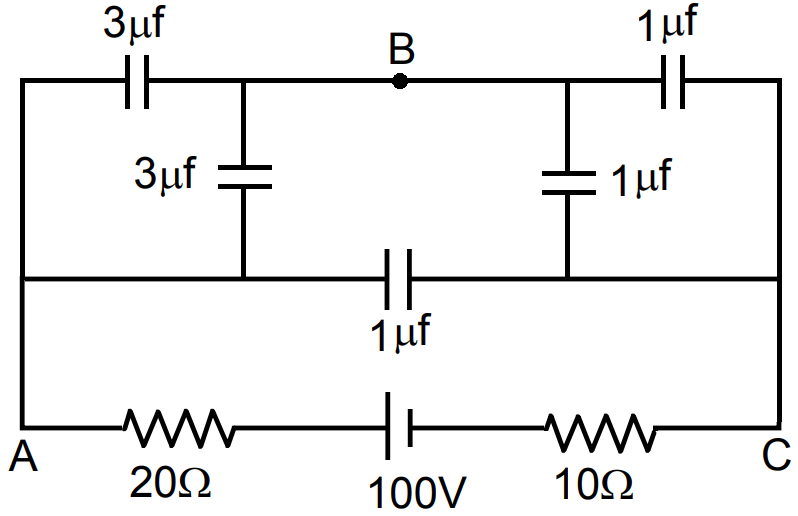
Find the potential difference between the points A and B and between the points B and C of the figure. in steady state.

Answer


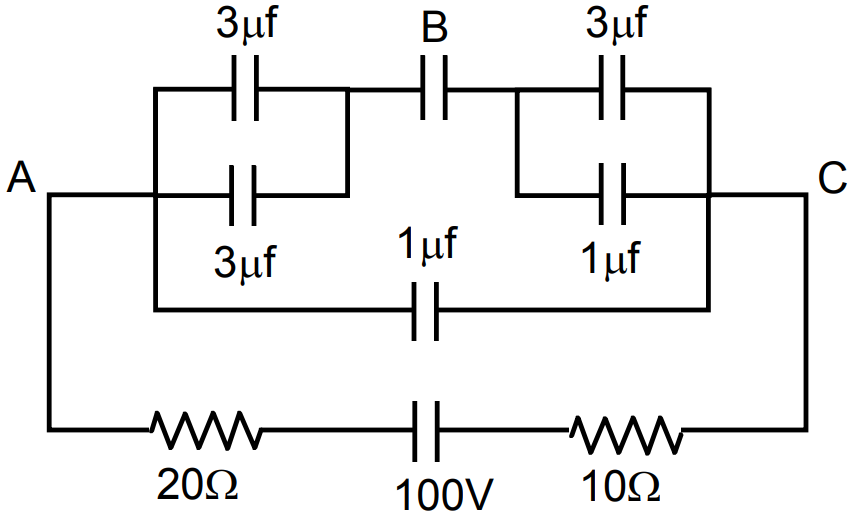
$\text{C}_\text{eq}=\big[(3\mu\text{fp}\ 3\mu\text{f})\text{s}(1\mu\text{f p}1\mu\text{f})\big]\text{p}(1\mu\text{f})$
$=\big[(3+3)\mu\text{f s}(2\mu\text{f})\big]\text{p}1\mu\text{f}$
$=\frac{3}{2}+1=\frac{5}{2}\mu\text{f}$
$\text{V}=100\text{V}$
$\text{Q}=\text{CV}=\frac{5}{2}\times100=250\mu\text{c}$
Charge stored across $1\mu\text{f}$ capacitor $=100\mu\text{C}$
$C_{eq}$ between A and B is $=6\mu\text{f}=\text{C}$
Potential drop across $\text{AB}=\text{V}=\frac{\text{Q}}{\text{C}}=25\text{V}$
Potential drop across BC = 75V.

Need a full question paper?

Generate a complete, print-ready paper with questions like this in minutes — across 16+ boards, with answer keys.
Start Generating Free

Similar questions

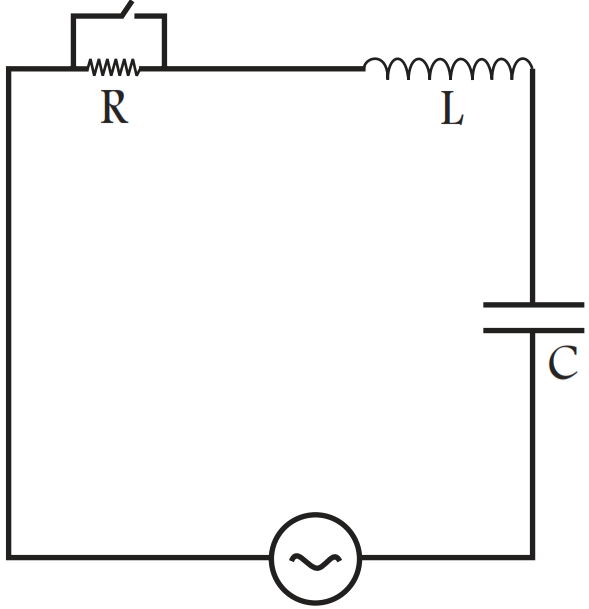
In the LCR circuit shown in Fig, the ac driving voltage is $\text{v}=\text{v}_\text{m}\sin\omega\text{t}$.
  1. Write down the equation of motion for q(t).
  2. At $t = t_0$, the voltage source stops and R is short circuited. Now write down how much energy is stored in each of L and C.
  3. Describe subsequent motion of charges
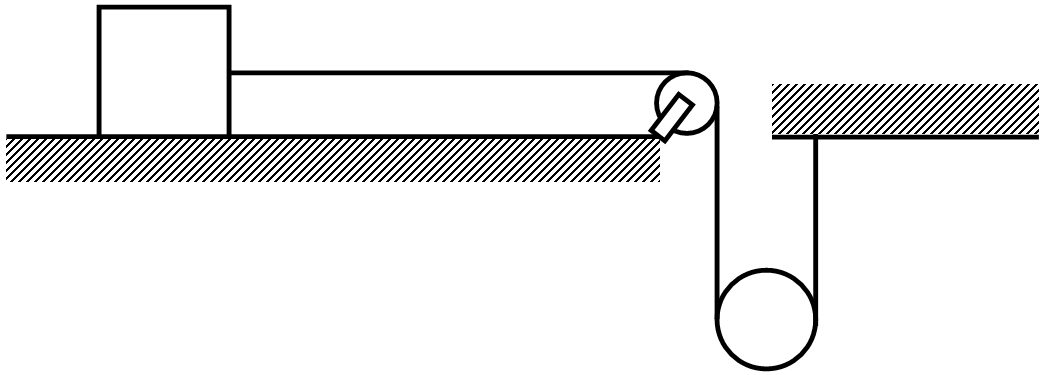
The descending pulley shown in figure has a radius 20cm and moment of inertia $0.20kg-m^2.$ The fixed pulley is light and the horizontal plane frictionless. Find the acceleration of the block if its mass is 1.0kg.
A uniform disc of radius r is to be suspended through a small hole made in the disc. Find the minimum possible time period of the disc for small oscillations. What should be the distance of the hole from the centre for it to have minimum time period?
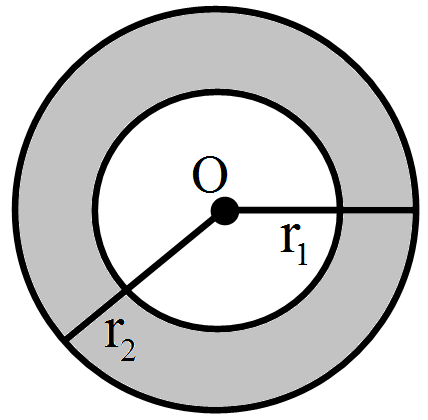
A charge Q is distributed uniformly within the material of a hollow sphere of inner and outer radii $r_1$ and $r_2$ (figure). Find the electric field at a point P a distance x away from the centre for $r_1 < x < r_2$ Draw a rough graph showing the electric field as a function of x for $O < x < 2r_2$ (figure).
In a gamma decay process, the internal energy of a nucleus of mass M decreases, a gamma photon of energy E and linear momentum $\frac{\text{E}}{\text{c}}$ is emitted and the nucleus recoils. Find the decrease in internal energy.
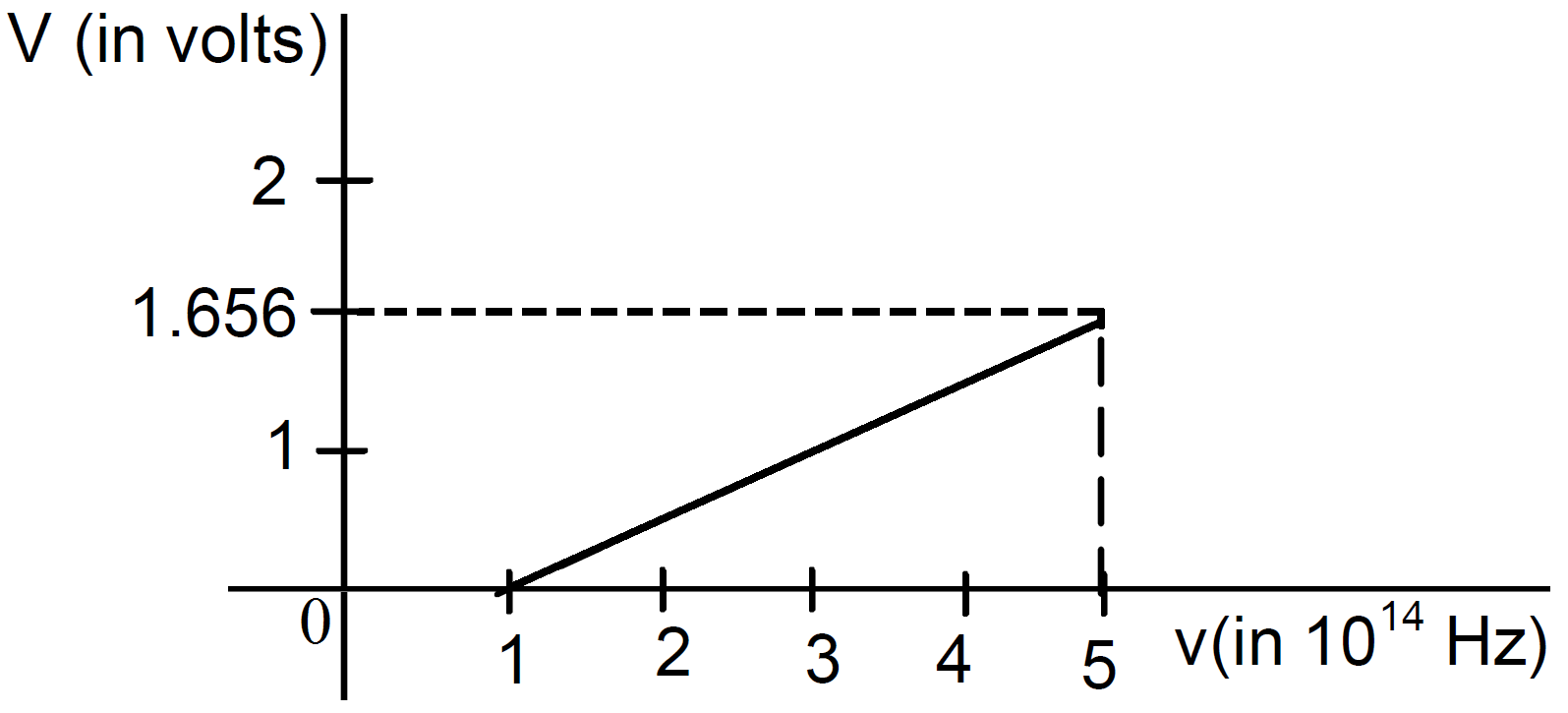
Figure is the plot of the stopping potential versus the frequency of the light used in an experiment on photoelectric effect. Find.
  1. The ratio h/e and.
  2. The work function.
$i$. Using Huygens's construction of secondary wavelets explains how a diffraction pattern is obtained on a screen due to a narrow slit on which a monochromatic beam of light is incident normally.
$ii.$ Show that the angular width of first diffraction fringe is half that of the central fringe.
$iii.$ Explain why the maxima at $\theta=\left(n+\frac{1}{2}\right) \frac{\lambda}{a}$ a become weaker and weaker with increasing $n$.
Two particles A and B, each having a charge Q, are placed a distance d apart. Where should a particle of charge q be placed on the perpendicular bisector of AB so that it experiences maximum force What is the magnitude of this maximum force?
Why does blowing over a spoonful of hot tea cools it? Does evaporation play a role? Does radiation play a role?
An ideal gas is kept in a long cylindrical vessel fitted with a frictionless piston of cross-sectional area $10cm^2$ and weight 1kg. The length of the gas column in the vessel is 20cm. The atmospheric pressure is 100kPa. The vessel is now taken into a spaceship revolving round the earth as a satellite. The air pressure in the spaceship is maintained at 100kPa. Find the length of the gas column in the cylinder.