Question
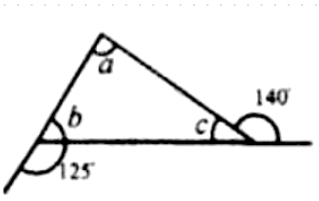
✓
Answer
We know that in a triangle if one side of it is produced, then
Exterior angle = sum of its interior opposite angles.
In fig., 125° = a + c .......(i)
and 140° = a + b ............(ii)
Adding, we get
a + c + a + b = 125° + 140°
⇒ a + a + b + c = 265°
But a + b + c = 180° ........(sum of angles of a triangle)
∴ a + 180° = 265°
⇒ a = 265° − 180° = 85°
But a + b = 140°
⇒ 85° + b = 140°
⇒ b = 140°− 85° = 55°
and a + c = 125°
⇒ 85° + c = 125°
⇒ c = 125° − 85° = 40°
Hence a = 85°, b = 55° and c = 40°
Exterior angle = sum of its interior opposite angles.
In fig., 125° = a + c .......(i)
and 140° = a + b ............(ii)
Adding, we get
a + c + a + b = 125° + 140°
⇒ a + a + b + c = 265°
But a + b + c = 180° ........(sum of angles of a triangle)
∴ a + 180° = 265°
⇒ a = 265° − 180° = 85°
But a + b = 140°
⇒ 85° + b = 140°
⇒ b = 140°− 85° = 55°
and a + c = 125°
⇒ 85° + c = 125°
⇒ c = 125° − 85° = 40°
Hence a = 85°, b = 55° and c = 40°
Need a full question paper?
Generate a complete, print-ready paper with questions like this in minutes — across 16+ boards, with answer keys.
Explore more
Similar questions
A computer purchased for ₹ 72900 loses two-third of its value every year. Its value is evaluated at the end of every year.
Q.1. Which of the following expressions gives the value of the computer (in ₹) after n years?
(a) $\frac{72900}{\left(\frac{2}{3}\right)^n}$ $\quad$$\quad$(b) $\frac{2^n \times 27900}{3^n}$ $\quad$$\quad$(c) $\frac{72900}{3^n}$ $\quad$$\quad$ (d) $\frac{72900}{2^n \times 3^n}$
Q.2. Find the value of the computer after 3 years.
(a) ₹ 8100 $\quad$$\quad$(b) ₹ 2430 $\quad$$\quad$(c) ₹ 5600$\quad$$\quad$ (d) ₹ 2700
Q.3. In how many years will the value of the computer be less than ₹ 200?
(a) 6 years $\quad$$\quad$(b) 7 years $\quad$$\quad$(c) 8 years $\quad$$\quad$(d) 10 years
Q.4. By how much will the value of the computer reduce in 4 years?
(a) ₹ 24300 $\quad$$\quad$(b) ₹ 1800 $\quad$$\quad$(c) ₹ 8100 $\quad$$\quad$(d) ₹ 72000
→Q.1. Which of the following expressions gives the value of the computer (in ₹) after n years?
(a) $\frac{72900}{\left(\frac{2}{3}\right)^n}$ $\quad$$\quad$(b) $\frac{2^n \times 27900}{3^n}$ $\quad$$\quad$(c) $\frac{72900}{3^n}$ $\quad$$\quad$ (d) $\frac{72900}{2^n \times 3^n}$
Q.2. Find the value of the computer after 3 years.
(a) ₹ 8100 $\quad$$\quad$(b) ₹ 2430 $\quad$$\quad$(c) ₹ 5600$\quad$$\quad$ (d) ₹ 2700
Q.3. In how many years will the value of the computer be less than ₹ 200?
(a) 6 years $\quad$$\quad$(b) 7 years $\quad$$\quad$(c) 8 years $\quad$$\quad$(d) 10 years
Q.4. By how much will the value of the computer reduce in 4 years?
(a) ₹ 24300 $\quad$$\quad$(b) ₹ 1800 $\quad$$\quad$(c) ₹ 8100 $\quad$$\quad$(d) ₹ 72000
Evaluate: $\left(2^2\right)^0+2^{-4} \div 2^{-6}+\left(\frac{1}{2}\right)^{-3}$
→Construct an isosceles Δ ABC such that:
Base AB = 6.2 cm and base angle = 45°. Measure the other two sides of the triangle.
Base AB = 6.2 cm and base angle = 45°. Measure the other two sides of the triangle.
Solve: $\frac{x+1}{3}+\frac{x+4}{5}=\frac{x-4}{7}$
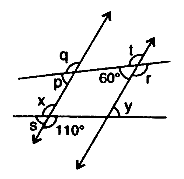
→In the given figure, the directed lines are parallel to each other. Find the unknown angles.
Find three consecutive natural numbers such that the sum of the first and the second is 15 more than the third.
Evaluate: $\frac{7}{-27}+\frac{11}{18}$
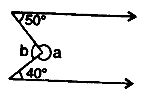
→In the given figure, the directed lines are parallel to each other. Find the unknown angles.
Find the area of a right-angled triangle whose hypotenuse is 13 cm long and one of its legs is 12 cm long.
The sum of three numbers, whose ratios are $3 \frac{1}{3}: 4 \frac{1}{5}: 6 \frac{1}{8}$ is 4917 . Find the numbers.
→